






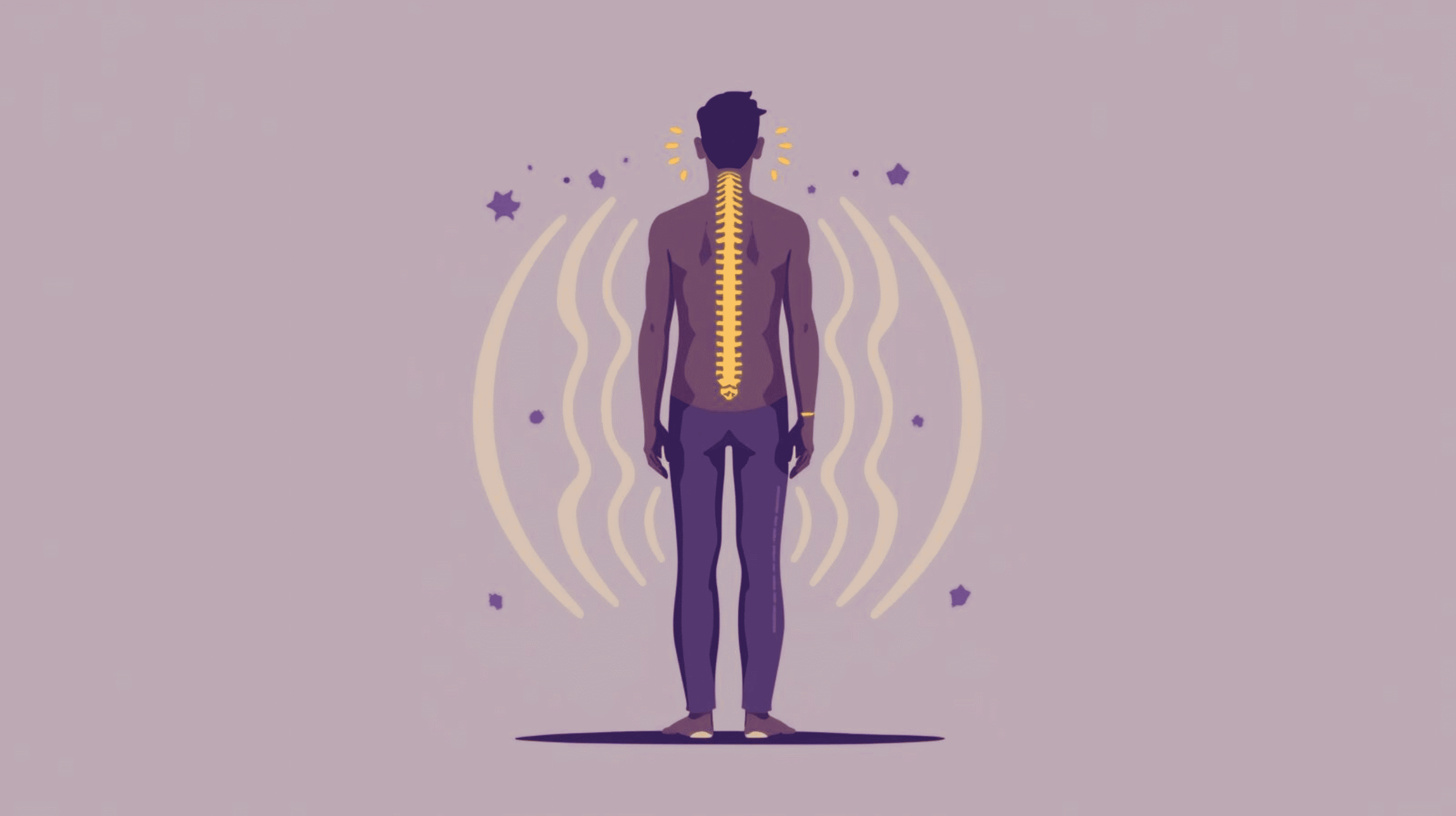
Modern life rewards efficiency. We sit longer, move less, and ask our bodies to adapt quietly to hours of screens, stress, and static posture. Over time, we normalize slumping, stiffness, and low-grade discomfort as part of adulthood. But the body keeps score, especially the spine.
Resilience, both physical and emotional, quite literally has a backbone.
A flexible yet stable spine is one of the strongest predictors of how well we handle stress, recover from setbacks, and move through life with energy rather than exhaustion. When posture collapses, resilience quietly follows.
The Spine Is More Than a Stack of Bones
The spine is not just a structural column holding you upright. It is a dynamic communication highway between the brain and the body. Every movement, every breath, every emotional response passes through it.
A healthy spine balances mobility and stability:
- Mobility allows you to rotate, bend, extend, and adapt
- Stability allows you to stay upright, grounded, and supported under load
When this balance is lost often through prolonged sitting and habitual slumping, the body shifts into compensation mode. Muscles overwork. Breathing becomes shallow. Movement becomes cautious. And resilience, both mental and physical, quietly erodes.
Posture Shapes Your Nervous System
Posture is not neutral to the brain.
Research consistently shows that a slumped posture is associated with:[1][2]
- Increased cortisol (the stress hormone)
- Reduced confidence and energy
- Greater feelings of helplessness and fatigue
When the spine collapses forward, the nervous system interprets it as a signal of threat or defeat. The chest compresses, the diaphragm loses efficiency, and the brain shifts toward a stress-dominant state.[3]
An upright but relaxed spine, on the other hand, supports:
- Better breathing mechanics
- Improved vagal tone (parasympathetic activation)[4]
- Emotional regulation and focus
A strong back doesn’t just help you lift weight.
It helps you carry the weight of life.
Flexibility Without Stability Is Fragile
Stability Without Flexibility Is Rigid
True spinal resilience lives in the middle.[5]
Over-rigid spines may look strong but adapt poorly. Over-mobile spines move easily but lack control. Both lead to pain, fatigue, and vulnerability under stress.
Resilient spines:
- Rotate smoothly without strain
- Extend and flex without collapsing
- Stabilize automatically when load increases
This is why people with healthy spines don’t just “work out” better so they recover better, regulate stress more effectively, and feel more grounded in daily life.
Fascia, Posture, and Emotional Load
The spine is deeply integrated with fascia, the connective tissue network that transmits force and sensation throughout the body. Chronic poor posture dehydrates fascia, reducing its elasticity and shock-absorbing capacity.[6]
Over time, this creates:
- A feeling of heaviness or stiffness
- Reduced spinal fluidity
- Heightened sensitivity to stress and fatigue
When posture improves and the spine moves through varied ranges – rotation, side bending, gentle extension, fascia regains its spring. Movement feels lighter. Effort feels more proportional. Emotional load becomes easier to manage.
The body quite literally feels more supported.
A Stable Spine Anchors the Mind
There’s a reason phrases like “stand tall,” “grow a backbone,” and “stay grounded” exist across cultures. They reflect a deep biological truth.
When your spine is stable:
- Balance improves
- Gait becomes more efficient
- The nervous system feels safer
This sense of safety is foundational to resilience. A nervous system that feels supported doesn’t overreact to stress. It adapts.
Resilience is not toughness.
It’s adaptable under pressure.
Modern Life Challenges the Spine Daily
Long hours of sitting, phone use, and forward-head posture quietly train the spine into collapse. Over time, this doesn’t just lead to back pain, it reduces energy, confidence, and emotional endurance.
The solution isn’t rigid “perfect posture” or forceful correction.
It’s restoring capacity.
- Can your spine rotate freely?
- Can you sit upright without strain?
- Can you extend without compressing your lower back?
- Can you stabilize when load or stress increases?
These are markers of resilience, not aesthetics.
Strengthening the Backbone of Resilience
Spinal health thrives on:
- Varied movement (rotation, side bending, extension)
- Postural awareness without rigidity
- Supportive environments (ergonomic seating, proper footwear)
- Regular decompression and mobility
When the spine is supported through movement, alignment, and smart load management, the body becomes more adaptable, and the mind follows.
Resilience Starts From the Ground Up
A resilient life doesn’t begin with motivation or mindset alone. It begins with structure-literally.
When your spine is flexible yet stable, you don’t just move better.
Respond better.
Recover faster.
You stand taller under pressure.
Because resilience isn’t about pushing harder.
It’s about being supported enough to bend without breaking.
And that support begins with your backbone.
Co- authored by: Shayamal Vallabhjee
Chief Science Officer: betterhood
Shayamal is a Human Performance Designer who works at the intersection of psychology, physiology, and human systems design, for the last 25 years he is helping high-performing leaders, teams, and athletes thrive in environments of stress, complexity, and change. His work spans across elite sports, corporate leadership, and chronic health—and is grounded in the belief that true performance isn’t about pushing harder, but designing better.
References
[1] Carney, D.R., Cuddy, A.J.C., Yap, A.J., 2010. Power Posing: Brief Nonverbal Displays Affect Neuroendocrine Levels and Risk Tolerance. Available at: https://doi.org/10.1177/0956797610383437
[2] Peper, E., Lin, I.M., Harvey, R., Perez, J., 2017. How Posture Affects Memory Recall and Mood. Available at: https://doi.org/10.1016/j.biofeedback.2017.01.001
[3] Kolar, P., 2014. Clinical Rehabilitation of the Spine and Core. Available at: https://www.researchgate.net
[4] Porges, S.W., 2011. The Polyvagal Theory: Neurophysiological Foundations of Emotions. Available at: https://wwnorton.com
[5] McGill, S., 2015. Low Back Disorders: Evidence-Based Prevention and Rehabilitation. Available at: https://www.humankinetics.com
[6] Schleip, R., Findley, T.W., Chaitow, L., Huijing, P., 2012. Fascia: The Tensional Network of the Human Body. Available at: https://www.elsevier.com


