





Your legs are likely doing more for you than you give them credit for. They carry your body weight. They stabilize your spine. They take a beating whenever you walk, run, climb stairs or even stand still for any length of time. Strong legs are about more than just aesthetics or lifting as much weight as possible. They also are about support, balance, posture and injury resilience.
Most people train their legs for just strength. Heavy squats. Big deadlifts. Maximum load. But strength without balance is also one of the surest means to bring on knee pain, hip tightness or lower-back strain. The body is not fragmented. It travels as one coherent system.
When leg training is done right, it makes you better at running, changing direction,s and sprinting all out; jumping up to settle under passes or above the rim; lifting heavy objects and lowering them with control and grace and becoming more resilient as you age. Which can lead to stiffness, discomfort or chronic injury later.
This guide zooms in on the top gym-based leg exercises that will help you to achieve strength and stability. We’ll cover compound lifts, unilateral moves, “often neglected muscle” exercises, mobility work and recovery tactics to help safeguard your gains in the long run.
The Importance of Building Leg Strength for Long-Term Health
Balanced leg workouts lend themselves to developing strength, coordination and control in all of the major muscles, not just those Instagram-worthy ones.
Studies have, in fact, proven that muscle imbalances between the front and back of the legs greatly increase your risk for knee injuries and chronic pain [1]. When one group of muscles takes over, joints are left to take up a load they were never designed to bear on their own.
Joint Protection and Injury Prevention
Powerful, stable legs are what keep the force of movement evenly distributed throughout your knees, hips and ankles. This helps to alleviate extra pressure on cartilage, ligaments and tendons while working out and during normal daily activities.
Promoting stability focuses on teaching the stabilizing muscles to respond to quick, rapid changes in directions and load. This is particularly critical when it comes to avoiding overuse injuries and pitfalls that squash training consistency.[2]
Improved Posture, Stability, and Mobility
Posture and the alignment of your spine directly depends on the strength of your leg. Weak glutes and hamstrings frequently induce what is known as an anteriorly tilted pelvis, or ‘excessive lordosis’ of the lower back, which can become sore and tight over time.
Posture automatically improves when your leg muscles act in conjunction as they’re designed to. Walking tall, walking smoothly, moving beautifully become almost effortless; they are not longer forced or tiring.
Key Muscle Groups Involved in Effective Leg Training
Good leg workouts train multiple interrelated muscle groups that will help you in real-life actions.
1. Quadriceps
The quadriceps bring the knee to full extension and act as shock absorbers when we walk, run or go up/down stairs. Healthy quadriceps act as a natural joint protector controlling deceleration and providing support in joint alignment.
2. Hamstrings
Hamstrings flex the knee and assist in decelerating the body while in motion. These are very important to help protect knee injuries, especially when stopping or changing directions.
3. Glutes
The hip and lower back are supported through the glutes. They help stabilize the pelvis to minimize unnecessary stress on the spine as well as play a key role during lifting and heavy work tasks for everyday movement.
4. Calves
Calf muscles also help to stabilize your ankle, balance and push you forward. They cushion impact as you walk or run and maintain your stamina during sustained standing or activity.
5. Hip Stabilizers
These smaller muscles help with stabilization during single-leg exercises. In an undertrained state, these muscles lead to cave-like knees and sad hips and make you move really poorly.
Best Compound Leg Exercises for Overall Strength
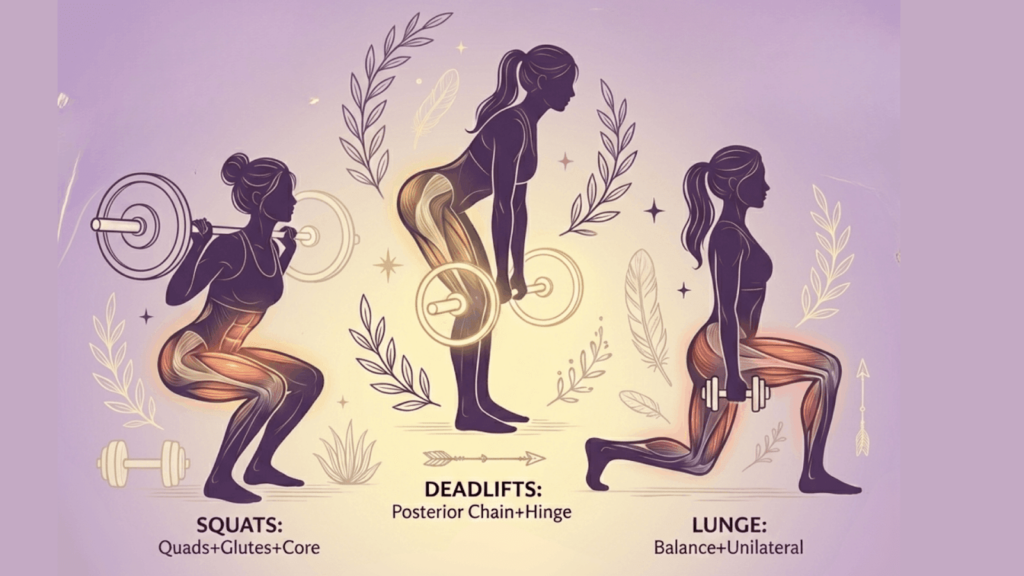
Compound exercises are those which work multiple joints and muscles at the same time. They are the basis for really effective leg training because they develop strength, coordination, and structural support as a unit.[3]
These are productive movements, when done properly they contribute to force production, structure and posture under load.
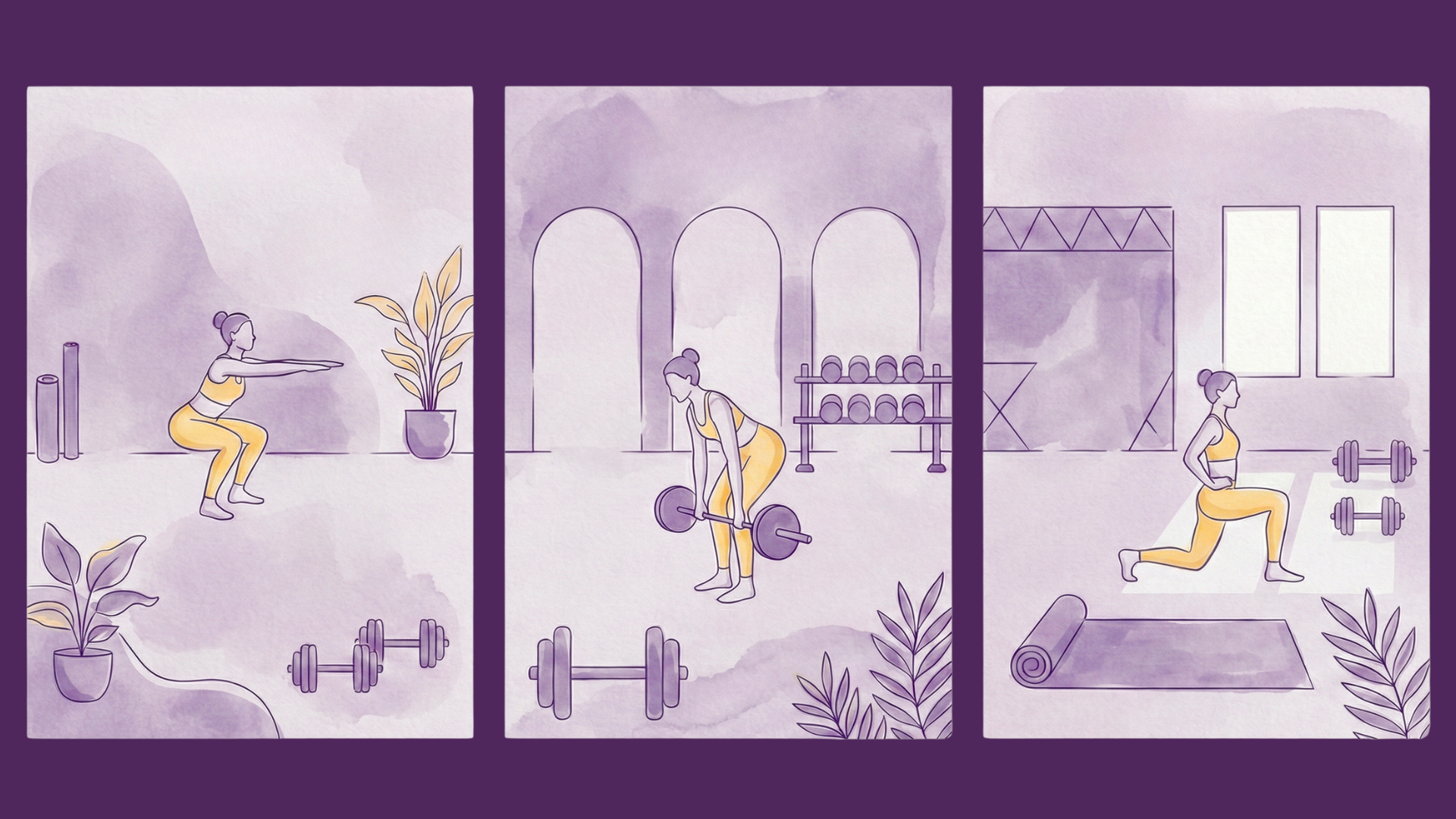
1. Squats (Back Squat, Front Squat, and Goblet Squat).
Quadriceps, glutes, hamstrings, and core all work together during squats. They are teaching the body to generate force while stabilizing the spine and keeping joints in alignment.
With the front squat and goblet squats inherently resulting in a more upright posture, this can alleviate strain on the lower back and enhance proprioception of proper positioning. When you squat to depth consistently over time, you can also gain mobility in hips and ankles.
How to Do It
- Keep your feet a little wider apart than hip-width and your toes slightly pointing out.
- Engage your core, and keep chest lifted
- Set your hips back and down as if to sit in a chair.
- Descend until your thighs are at least parallel with the floor
- Maintain a controlled descent with knees tracking over your toes
- Push through your heels to come back up to standing without arching the back.
When performed with both control and intention, squats become one of the most effective movement patterns for creating lifelong lower body strength.
2. Deadlifts (Conventional, Romanian, Trap Bar)
Deadlifts compound movement which will work the posterior chain including hamstrings, glutes and spinal stabilizers/upper back. You need them for lift mechanics and for daily movement strength.
Romanian deadlifts highlight controlled flexion of the hamstring for flexibility and injury prevention. Trap bar deadlifts have more of an upright torso, which will limit the amount of stress on your back while still building strength.
How to Do It
- Positioned with the bar at shin’s distance and feet hip width apart
- Hip Hinges while maintaining a Neutral spine
- Grab the bar with a strong overhand grip and brace through your core.
- Press through the floor to push your hips and knees up at the same time
- Don’t be reaching back and don’ t be forcing the knee lock out to hard either.
- Slowly lower the bar, by pushing through the hips (do not round your back).
A good deadlift doesn’t just build strength, it helps teach you how to perform the hip hinge during activities in your daily life.
3. Lunges (Forward, Reverse, Walking)
Lunges are a unilateral strength exercise that can also help to improve balance, coordination and hip stability. They aid in correcting strength imbalances and movement control.
The knees are most relaxed in reverse lunges, while the walking version optimizes dynamic balance and coordination during walking.
How to Do It
- Kick: Stand with feet hip-width apart
- Step one leg forward or back.
- Bend both knees until your body lowers down to about 90 degrees
- Keep you chest up as the front knee moves over ankle
- Drive through the front heel to return to standing.
- Switch legs or rep it out on one side before switching
Lunges bridge the gap between gym strength and real world movement, which is why you can’t do without them when working on functional fitness.
Unilateral Leg Exercises for Balance and Stability
Unilateral movements work each half of your body one at a time. They reveal imbalances, coordinate better and strengthen the stabilizing muscles that guard joints.
1. Step-Ups
Step-ups strengthen the quads and glutes so you can better support your knees and hips. They are similar to stair climbing and hence, very functional for everyday activities.
And by varying the height of your step or adding resistance, you can efficiently work these same muscles with less stress on your joints.
How to Do It
- How to do it: Stand in front of a strong box or bench
- Put one entire foot on the platform
- Use your heels to push yourself up.offset-pushup Reps: 10, each side*Start in plank with hands under shoulders and body straight.
- Try to keep hips square and torso tall
- Step down slowly with control
- Do all reps on one leg before repping out with the other side
Step-ups are a lesson in patience and moderation, developing strength that leads to self-assured pain-free movement.
2. Bulgarian Split Squats
Bulgarian split squats improve leg strength, balance and hip mobility all in one. Since the front leg takes a lot of the load, it doesn’t require much weight to see big results.
This also kind of helps to challenge balance and stability, balance is going at it.
How to Do It
- Position yourself a couple of feet in front of a bench
- Step one foot back onto the bench
- Lift chest and stay engaged through the core
- Dropping hips straight down by bending the front knee
- Push through the heel of your front foot to come back up to standing.
- Do full reps on one side before switching legs.
Bulgarian split squats will honest weaknesses, which is why they rank as one of the best movements for building balanced strength.
Supporting Leg Muscles Often Ignored in Workouts
Skipping over weaker or lesser seen muscles, tends to result in a plateau and pain, and those same complaints will continue to come back.
1. Hip-Stability and Power Glutes
Strong glutes stabilize the knees and lower back by managing hip rotation and pelvis position. They are critical for both the function of movement and injury prevention.
Weak glutes are frequently associated with bad posture, lower back pain, and knee tracking problems [2].
2. Hamstrings for Knee Health and Deceleration
When you throw the ball, on its way back down to your throwing hand, slow it down so that it dangles over your head.
The hamstrings counteract the force that the quadriceps create and protect the knee during motion. Without strong hamstrings your risk for injury is much higher.
Beautiful and strong hamstrings enhance the efficiency of sprinters, protect ligaments and maintain low risk for hamstring sprain [4].
3. Calves for Stability and Endurance in the Ankle
Calves help us to keep balance, walk efficiently and absorb shock. Low calf muscles can cause foot pain, Achilles problems, and fatigue at work.
Calves training enhances the resilience of your ankle and overall lower body endurance.
Mobility and Warm-Up Exercises for Leg Training
An appropriate warm-up primes muscle and joints for loading. Dynamic stretching, hip opening and ankle mobility should be used for higher quality of movement.
More squat depth, better stride mechanics and muscles that are better able to generate force. It also decreases stiffness and secondary movement patterns over time.
Recovery and Injury Prevention for Leg Workouts
Training provides stimulus; recovery makes you improve.
1. Stretching and Cool-Down Techniques
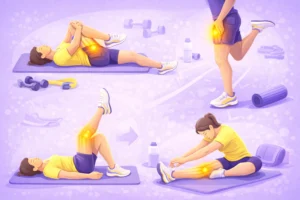
Workout, stretching is beneficial as it helps to increase circulation and decrease muscle tension. Gentle mobility work is designed to keep range of motion up and prevent inertia from building into stiffness.
2. Proper Footwear and Gym Form
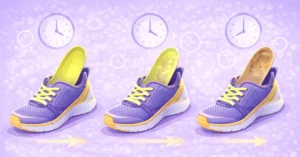
Shoes affect alignment from the ankles, knees and hips. Shoes with appropriate support can decrease joint pressure and promote better lifting mechanics.
Staying in position reduces strain on joints and ligaments, which can be especially helpful when you’re lifting heavier weights.
3. Rest Days and Recovery Support
Muscle repair does not happen during workouts, it happens when you are resting. The quality of sleep, spinal alignment and physical comfort all impact the rate of recovery.
Also helpful recovery tools are ergonomic pillows, posture-aligned sleep setups and other options that assist in allowing muscles to completely relax and provide for a deeper, more restorative rest.
How to Structure Your Leg Workouts: Beginner, Intermediate, and Advanced Splits
Beginners
1-2 leg workout sessions a week for compound lifts, balance and mobility. Form and coordination should be the priority.
Intermediate
A combination of compound exercises and unilateral work at moderate volume. Largest losses expected, efficacy of recovery strategies seems more relevant while training intensity increases.
Advanced
A novel combination of Volume, Intensity, and recovery in planning and progression- Periodization. Strategic deload and recovery aids in longevity.
Most Common Leg Workout Mistakes (and How to Avoid Them)
- Failing to warm up decreases joint preparedness and raises the risk of injury.
- But chasing heavier weights before mastering technique more often than not results in some kind of compensatory movement.
- Focusing on bilateral does not give us a complete picture, as unilateral is non existent.
- Sleep on recovery, lack of sleep limits long term progress far more than skipped workouts.
Most plateaus are a result of too little recovery, not too much effort.
Final Verdict: Strong Legs That Can Support Your Entire Body
Having strong legs is not just about lifting the heaviest amount of weight you possibly can. They cushion impact, take pressure off your joints, keep your core stable and hold you up every time you stand or walk. When intention is made to build leg strength, it serves as the foundation for comfort, confidence and mobility to come.
Real strength endurance comes from balance; smart training, purposeful recovery and knowledge of how the body adapts over time. When you prioritise recovery and protect your sleep, and also maintain that alignment throughout the day, leg work stops feeling like something to recover from and starts feeling like support for everything else you do.
Mindful, health-forward support whether you’re moving or resting, healing or just going about your day, keeps you in alignment, minimizes needless stress and empowers your legs to do what they were made for: get you where you want to go with strength, stability and ease.
Explore More Health & Wellness Solutions:
Want to stay informed about wellness and everyday health issues? Here are some insightful reads to guide you. Explore the links below for practical tips and solutions.
- How to Prevent Knee Injuries: Proven Tips, and Lifestyle Strategies for Stronger Joints
- How Can Knee Cap Support Help Prevent Injury and Reduce Pain While Running
- 10 Effective Home Remedies for Body Pain Relief Naturally
- Mobility Exercises: Benefits, Techniques & Routines for Better Movement
Frequently Asked Questions:
1. How many days a week should you do leg day?
The optimal amount for most individuals is one to three leg sessions per week, intensity and volume dependent of course.
2. Can training the legs help with knee pain?
Yes. With a sound leg program, the stabilizing muscles are trained better and the joint mechanics will function better, which over time in many cases shows to alleviate knee pain [4].
3. Which is better, machines or free weights?
Both are valuable. Free weights bring into play supporting muscles, and it means they work in coordination where as machines are allowing independent targeted loading, assisting rehabilitation or isolating a specific muscle.
4. Can leg training improve posture and lower back health?
Absolutely. Powerful legs and glutes minimize overload on the lower back by optimizing pelvic stability and movement mechanics, which in turn can help to prevent compensatory stress and recurring back pain in the long run.
5. Why is recovery so crucial to leg training?
The muscles in the legs are big and get a lot of daily use. This leads to fatigue build up, an increased risk of injury and no progress. Sleep, mobility work and supportive alignment tools are also big factors in long term strength.
References
- FIT India Trust. (2025, December 23). Muscle imbalances: Major risk factors for injuries. https://www.fitindiatrust.org/blog/how-muscle-imbalances-increase-the-risk-of-injuries
- Bliven, K. C. H., & Anderson, B. E. (2013). Core stability training for injury prevention. Strength and Conditioning Journal, 35(6), 9–19. https://pmc.ncbi.nlm.nih.gov/articles/PMC3806175/
- Paoli, A., Marcolin, G., & Petrone, N. (2009). The effect of different resistance training loads on trapezius muscle activation in multi-joint upper body compound exercises. Strength and Conditioning Journal, 31(6), 43–51.https://www.acefitness.org/resources/pros/expert-articles/5811/5-benefits-of-compound-exercises/
- Bencke, J., & Damsgaard, R. (2023). Differences in thigh muscle activation between standing and side-lying position during hip abductions in females with and without previous anterior cruciate ligament reconstruction. Sports Biomechanics. Advance online publication. https://pmc.ncbi.nlm.nih.gov/articles/PMC9897038/
- Barton, C. J., Lack, S., Hemmings, S., Tufail, S., & Morrissey, D. (2015). The “best practice guide to conservative management of patellofemoral pain”: Incorporating level 1 evidence with expert clinical reasoning. British Journal of Sports Medicine, 49(14), 923–934. https://bjsm.bmj.com/content/49/14/923