





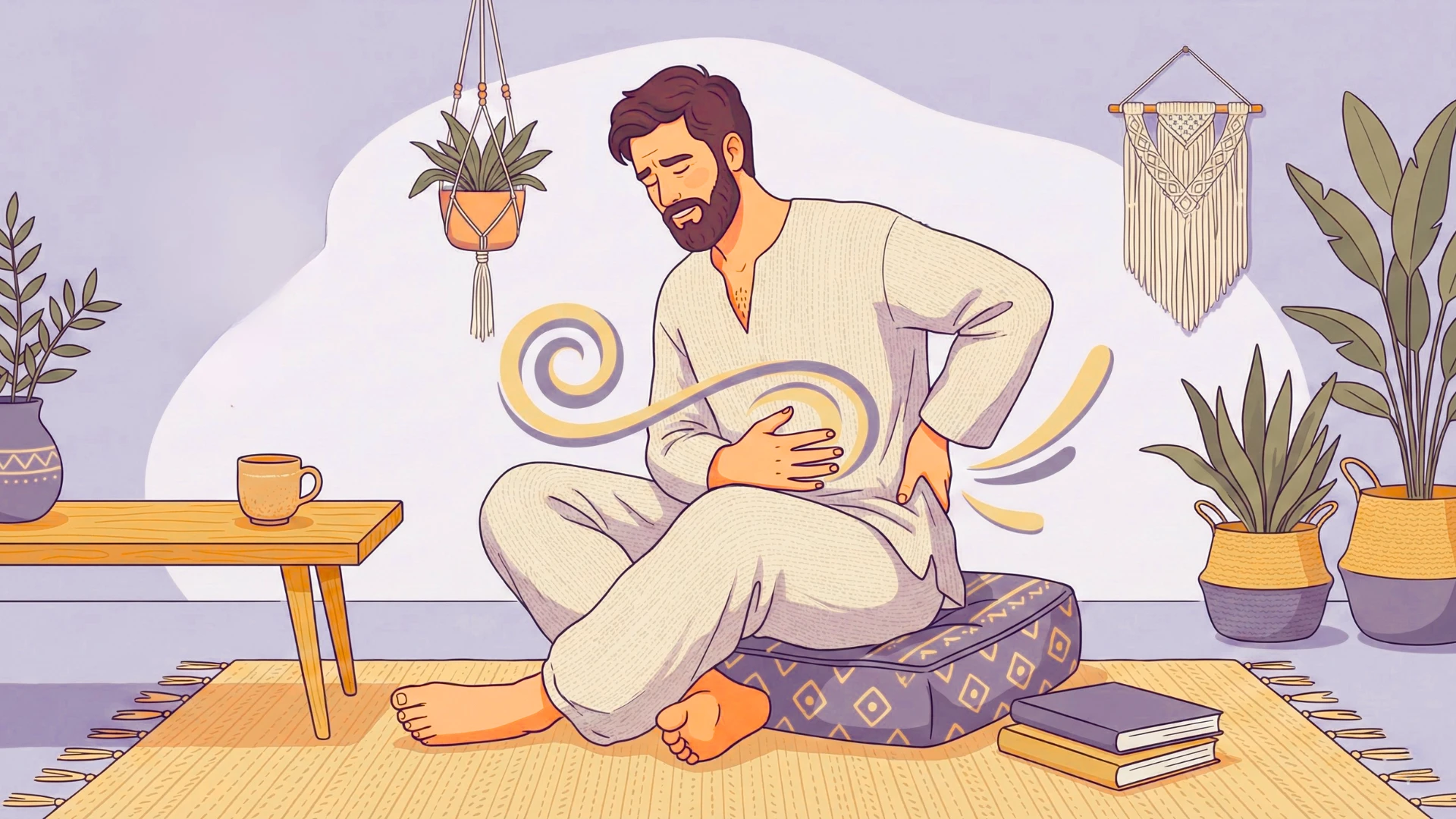
We’ve all been there, another heavy Sunday lunch of Chole Bhature or a midnight spicy Pav Bhaji and you just can’t wait for that regular bloating. But all of the sudden, from out of nowhere, your back is aching. It’s an overarching, nagging pain that makes you wonder if you’ve pulled a muscle or whether your spine is finally complaining about the long hours at your desk. Before you start cursing at google, convinced it’s a slipped disc or a kidney emergency, take a deep breath.
A question that many people wonder about is whether gas can cause back pain, and the result is even more surprising than you would expect. In the Indian scenario, with our legume-heavy diets and spice-laden dishes and an entire culture centered on “adjusting” to discomfort, this correlation becomes all too real.
At betterhood, we think pain is not good for you. Whether you’re limping through a long commute in Bangalore traffic or suffering the physical tolls of Diwali cleaning, knowing that your gut and your back are connected is the first step to taking back control over your comfort.
Can Gas Really Cause Back Pain, or Is It Something Else?
The short answer is a big yes. We’re so used to expecting gas will stay in our bellies; however, the human body is a complex network.
How the Connection Works?
The intestines are quite close to the muscles and nerves that attach to your lower and upper back. When gas is retained in the digestive system, it raises pressure inside of the abdominal cavity. This is because that force isn’t just directed outwards against your skin; it’s also pressing inwards and backwards against the nerves and muscles of the backstairs [1].Understanding what causes back pain often requires looking beyond just the bones and muscles to the internal organs nearby
Common Areas Where Gas Pain Radiates:
- Lower spine: The most common location, large intestine rests directly against the lumbar area.
- Mid-Back: Frequently described as a “tight band” around the ribs.
- Upper Back- Between the Shoulder Blades: This is a common location for gas to become trapped, it’s a result of gas becoming stuck in the diaphragm.
Why Does Gas Cause Pain in the Back? (The Science)
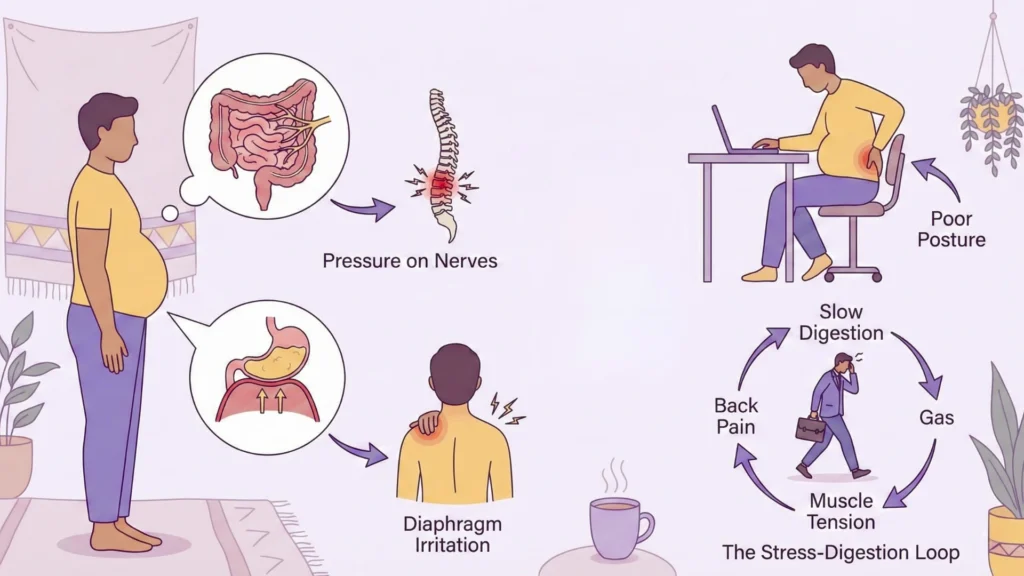
It is a strange concept, how can the air in your stomach hurt your back? There are four essential physiological ones:
Stimulation of Abdominal Nerves:
When the intestines are distended by gas, they can stimulate the visceral nerves. These nerves travel with the nerves in your back, so your brain thinks it is feeling pain from the spine [2].
Diaphragm pressure:
When gas collects in the upper stomach or transverse colon, it pushes upwards against the diaphragm. This may lead to referred pain in the upper back or even into the shoulders.
Bad Posture and Bloating:
When most of us get bloated, we slump or curl up in a ball to ease the tension on our stomachs. In the Indian corporate world where we already have to fight ”Tech Neck“, this excess slouching further overexerts back muscles to hold us up.
The Stress-Digestion Loop:
High-stress situations (such as commuting in a Mumbai local during evening rush hour) slow down your digestion. Undigested food ferments in the gut, causing gas and muscle tension, a double whammy of misery. This is a primary reason why can gas cause back pain is such a frequently searched topic among urban professionals.
What Are the Symptoms of Gas Pain Radiating to the Back?
Gas pain is dramatic; it hardly ever comes quietly. Pinpointing the particular “flavor” of your pain can help you distinguish it from a more serious orthopedic issue.
Common Symptoms Include:
- Bloating and Tightness: Your belly’s as bloated as a really gassy drum.
- Sharp, Crampy Lower Back Pain: Your pain will often strike in “waves”; it might not be a steady throb.
- Pressure on the Ribs: Sensation that someone is pushing down your chest, or squeezing your mid-back and pressure around the ribcage.
- The “Miracle Moment”: The most interesting thing is if the back pain goes away once you’ve burped or passed gas [3].
Symptoms That Mimic More Serious Conditions
The nerves are so densely packed that gas pain can be:
- Gallbladder Issues: Specifically pain under the right shoulder blade.
- Kidney Stones: Sharp pain on the left or right side of the lower back (flank).
- Muscle Strain: Feeling like you’ve “thrown your back out” after a heavy meal.
Why Gas Pain Is So Common in Indians: Lifestyle & Food Triggers
Gas doesn’t appear magically. In our culture, here’s what most often sets it off:
Swallowing Air (Aerophagia): Eating too fast or talking during meals, a common occurrence at our social, boisterous and busy family dinners.
Deep-Fried or Fatty Foods:Pakoras, Samosas and heavy gravies slows down the “gastric emptying” process.
Dairy Sensitivity: A lot of Indian adults have a mild sensitivity to lactose. That night It turns out Malai Chai could be your mysterious morning backache’s source.
Artificial Sweeteners: Where in “sugar-free” treats, sugar alcohols also ferment quite fast in the gut.
Carbonated Drinks: The “fizz” in sodas is nothing but imprisoned gas.
Constipation: When the “exit” is closed, gas builds up behind the stool and exerts considerable pressure.
IBS or Sensitive Gut: Due to modern urban stress, the occurrence of Irritable Bowel Syndrome is also on the rise.
How to Tell Gas Pain from Back Pain: Common Lifestyle Signs
How can you tell if it’s gas or a spinal problem? Use these daily activity checks:
- The “Squat” Test: If you struggle to perform a basic squat because your stomach feels too tight, rather than your legs being weak, it’s likely gas.
- The “Commuter’s Bounce”: If you feel a sharp jolt in your mid-back every time your rickshaw hits a pothole after a heavy meal, it’s often referred to as gas pain.
- The “Pooja” Posture: If sitting cross-legged on the floor for a pooja feels impossible because of abdominal pressure radiating to your lower back, it’s a sign that gas can cause back pain in your specific case.
Progressive Solutions and Tips for Quick Relief
At betterhood, we recommend a staged approach to address this dissatisfaction.
Stage 1: Passive Relief (The “Calm” Phase)
- Heat Pack: Use a warm water bag on your tummy and lower back. The heat itself loosens up the smooth muscles in your gut.
- Left-Side Sleeping: Gravity can aid in pushing gas through the colon. If you’re getting bloated at night, lie down on your left side [2].
Level 2: Active Changes (The “Move” Phase)
- Gentle Movement: For example, raking the leaves or scooping snow off a sidewalk (10 minutes of this will help your gut “peristalsis” (muscle contractions).
- Targeted Stretching: Home back pain stretches can assist in releasing tension from muscles around the gut.
- Peppermint or Ginger Teas: Natural carminatives help the body rid itself of gas.
Level 3: Long-term Habits (The “Prevention” Phase)
- Probiotic: Include homemade dahi (curd) to maintain gut health.
- Systemic Recovery: Use sustained recovery solutions for months beyond pain relief to support gut and spine health.
Role of betterhood Tools: Your “Training Wheels” for Recovery
Digestive back pain can be made worse when your posture unravels and if you are bloated, of course you want to bend forward and that stresses the lumbar spine.
At betterhood, our gear acts as your “recovery partner.” Our orthopedic seat cushions and spine-support gear help maintain a neutral alignment. This ensures that even when your stomach is under pressure, your back muscles aren’t being forced to overcompensate. Better posture leads to less referred pain, allowing your digestive system the space it needs to settle.
When Is Back Pain From Gas a Warning Sign?
Although gas-related back pain is usually temporary and goes away on its own, you should see a doctor if any of the following ‘Red Flags’ happen to be associated with your check engine light.
You’re Throwing up Randomly or Consistently: If you can’t keep a sip of water down.
- Fever: Any temperature spike with lower tummy pain.
- Blood in the Stools: This warrants immediate exploration.
- Chest Pain: This can be misinterpreted as gas, but could also be cardiac.
- Pain Lasting >48 Hours: If it doesn’t resolve with movement or passing gas.
Conclusion: Small Shifts, Big Relief
Gas pain can be surprisingly intense and often confusing, especially when it mimics back or spinal discomfort. The reassuring part? In most cases, it’s temporary and highly manageable with mindful eating, better posture, and simple daily movement. Understanding how gas can influence back pain helps you respond smarter, not panic faster.
When your body stays mobile, upright, and well-aligned, internal pressure has less room to create discomfort. Start small: walk a little more after meals, sit a little taller, chew a little slower, and let your digestive system do its job without resistance.
Your body doesn’t ask for perfection, it just needs a bit of attention. Give it that, and comfort tends to follow.
Explore More Health & Wellness Solutions:
Want to stay informed about wellness and everyday health issues? Here are some insightful reads to guide you. Explore the links below for practical tips and solutions.
- How to Prevent Knee Injuries: Proven Tips, and Lifestyle Strategies for Stronger Joints
- How Can Knee Cap Support Help Prevent Injury and Reduce Pain While Running
- 10 Effective Home Remedies for Body Pain Relief Naturally
Frequently Asked Questions
Yes. When the lower stomach is full of gas, it’s very possible for the gas to irritate your phrenic nerve (which runs from your abdomen up around through your diaphragm and into your shoulder area) which can cause pain in this area and referral pain between the shoulder blades.
That’s usually courtesy of “gastric distension,” where your stomach gets bigger and pushes against the nerves around it as it balloons out during a meal.
Absolutely. It’s gas trapped in the “splenic flexure” (that would be the bend in your colon) and it’s sitting very near to the kidneys.
Generally, it will take from a few minutes to a couple of hours until you pass the gas.
Pawanmuktasana (Wind-Relieving Pose) is excellent. Lying on your back and pulling your knees to your chest can physically push trapped gas out of the body.
References
- Lacy, B. E., et al. (2016). Bloating and Gas: Evaluation and Management. Gastroenterology & Hepatology, 12(5), 297–307. https://www.ncbi.nlm.nih.gov/pmc/articles/PMC4893422/
- Seo, A. Y., Kim, N., & Oh, D. H. (2013). Abdominal bloating: Pathophysiology and treatment. Journal of Neurogastroenterology and Motility, 19(4), 433–446. https://doi.org/10.5056/jnm.2013.19.4.433
- Harder, H., Viladrich, F., Serradesignona, G., Accarino, A., & Azpiroz, F. (2003). Intestinal gas distribution determines abdominal symptoms. Gut, 52(10), 1435–1441. https://pmc.ncbi.nlm.nih.gov/articles/PMC1773885/
- Cleveland Clinic. (2022). Gas Pain in Chest & Back. https://my.clevelandclinic.org/health/diseases/7314-gas-and-gas-pain