






Shoulder pain is surprisingly sneaky. One minute you’re lifting a bag of groceries or reaching for a spice jar on the top shelf, and the next, your shoulder starts protesting like it wasn’t built for basic human tasks. Because the shoulder is the most mobile joint in your body, even tiny alignment issues can cause big discomfort.
In our busy lives, whether it’s the long commute in heavy traffic, the static load of a 9-to-5 desk job, or the repetitive overhead movements of daily household chores; our shoulders take a beating.
At betterhood, we believe that understanding the “why” behind your ache is the first step toward reclaiming your range of motion.
This guide breaks down the most common causes of shoulder pain using an easy shoulder pain diagnosis chart logic and clear, evidence-based explanations.
Understanding Shoulder Pain
The shoulder isn’t just a single joint; it’s a complex system where your humerus (upper arm bone), scapula (shoulder blade) and clavicle (collarbone) converge. They are connected by a group of four muscles and their tendons, which are collectively called the rotator cuff.
In India (including Pakistan), we have shoulder problems caused by doing either the repetitive “overhead” stuff you do in the house, or by putting on a static load of being in front of your laptop for 9 hours a day. When these muscles surrounding the joint become unbalanced, the “ball” of the joint doesn’t fit perfectly in the “socket,” resulting in friction, inflammation and pain [1].
Types of Shoulder Pain
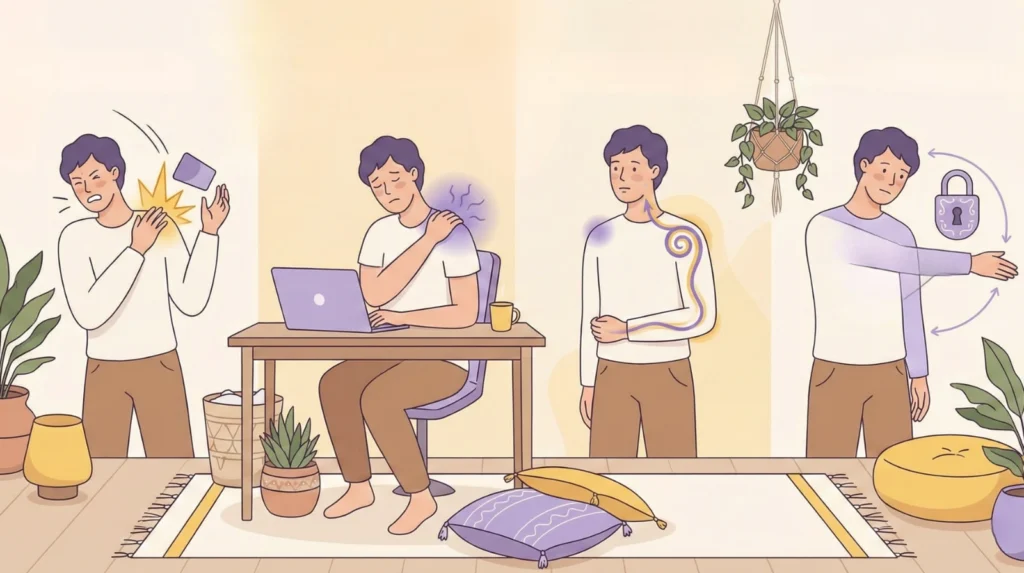
Not all shoulder pain feels the same. Discerning the kind of physical sensation you are having can give immediate signals to what’s happening underneath:
- Acute Pain: Sudden, sharp, and usually linked to a specific movement or injury (like catching a falling heavy dabba).
- Chronic Pain: A persistent, dull ache that has lasted for months, often worse after a long day at the office.
- Radiating Pain: Pain that starts in the shoulder but travels down toward the elbow or up into the neck.
- Stiff/Locked Pain: A complete loss of movement, where the arm feels physically stuck (common in Frozen Shoulder).
Why Does Pain Location Matters ?
The shoulder’s a little space, but move your finger just two centimeters and you’re into the wrong diagnosis altogether. Why does location matter? This muscle is located on the shoulder, where everything is crammed in. Pain on the “top” predominantly means a bone-to-bone joint while pain on the “side” normally signifies a tendon. By isolating the spot, you help determine what specific structure; whether a ligament, a bursa sac or a nerve is crying out for help.
The Shoulder Pain Diagnosis Chart (The “Where” Matters)
While only a doctor can give a final medical diagnosis, where you feel the pain often points to the culprit. Use this mental “shoulder pain diagnosis chart” to categorize your discomfort:
| Area of Pain | Possible Cause | Common Feeling |
| Top of the Shoulder | AC Joint Issue | Sharp pain when crossing your arm over your chest. |
| Outer Arm/Deltoid | Rotator Cuff Tear | Deep ache; difficult to lift the arm sideways or sleep on that side. |
| Front of the Shoulder | Biceps Tendinitis | Pain when lifting grocery bags or heavy buckets. |
| Deep Inside/All Over | Frozen Shoulder | Severe stiffness; “stuck” feeling in all directions. |
| Back/Shoulder Blade | Postural Strain | Burning sensation after long hours at a laptop or driving. |
| Left Shoulder Specific | Referral/Systemic | Vague ache, often accompanied by chest or jaw discomfort. |
7 Most Common Reasons for Shoulder Pain in Urban India
1. Rotator Cuff Tendinopathy
This is shoulder pain at its most common. It happens when the tendons are irritated or pinched. This occurs most frequently in Indian households, because people often do “unaccustomed” heavy lifting such as carrying heavy furniture during diwali cleaning or hoisting a suitcase into the upper berth of a train [2].
2. Frozen Shoulder (Adhesive Capsulitis)
Frozen Shoulder, which is statistically higher in people with diabetes, is a huge problem in India. The joint capsule becomes thickened and tightened, going so far as to nearly freeze the arm. Often times it begins with a period that is very painful, then develops into severe stiffness.
3. Subacromial Impingement
This is the shoulder of “you are an office worker and should really try to loosen up.” When we slump, there is a decreased volume in the shoulder joint. As you raise your arm, the tendons rub or “impinge” against the bone. The key to opening this space back up is consistency in exercise protocols.
4. Bicipital Tendinitis
Do you have pain at the very front of your shoulder that runs down toward your biceps? If yes, then this may mean that it is the tendon attaching your arm muscle to the shoulder that is inflamed. This is what happens to a lot of people who just recently got into the gym routine without warming up.
5. AC Joint Arthritis
The Acromioclavicular (AC) joint is that little “bump” on the top of your shoulder. Wear and tear over years can inflame this structure, which is enough to cause you pain when you sleep on your side or reach across to scrub your opposite shoulder in the shower.
6. Bursitis
Bursae are little fluid-filled sacs that serve as cushions between bones and soft tissues. As a consequence, when one of those sacs becomes inflamed, everything is “hot” and tender. This is frequently combined with joint pain relief exercises focused on decreasing overall inflammation.
7. Referred Neck Pain
Sometimes the shoulder isn’t the issue at all. A pinched nerve in your neck can shoot pain down to your shoulder blade and arm. If your shoulder pain is also accompanied by tingling, the problem is likely in your neck.
Diagnosing the Symptoms: Is It a Tear or Just Tension?
Sometimes it’s difficult to know whether you require rest or a surgery. So, a few “Indianese” benchmarks for your symptoms:
- The “Auto-Rickshaw” Sign: Severe pain when extending hand back to take an item from the back of a car. Classic sign of rotator cuff problem Most likely scenario is that the biceps tendon is put on a stretch.
- The “Night Ache”: If it’s so difficult to find a comfortable position to sleep with pain waking you up at 3 AM, you definitely have significant inflammation or a tear [3].
- The ‘Comb Test’: If you find it impossible to reach the back of your head to comb your hair or tie a juda (bun), you are likely entering the “frozen” phase of a frozen shoulder.
Diagnosis: How Doctors Assess Your Shoulder ?
When you go to see a specialist , it’s more than likely that they will perform a couple of “provocative tests”:
- The Empty Can Test: You’ll be requested to hold your arms out as though you were emptying two cans of soda. If you can’t resist the pressure, it indicates a rotator cuff tear.
- Range of Motion: They will test active (you move it) vs. passive (they move it) movement. Both of these are limited in a Frozen Shoulder.
- Imaging: An X-ray is a way of checking for bone spurs or arthritis, but the “gold standard” test looks at the soft tendons and muscles [4] : an M.R.I.
Shoulder Pain Treatment: A Progressive Recovery Approach
At betterhood, we don’t do “all or nothing.” Recovery is a ladder.
1. Protection, Passive Movement (The Pain Phase)
If your pain is 7/10, stop lifting heavy. To relax the muscles, instead try heat packs and “Pendulum Swings”, leaning over a table and letting your arm dangle and swing in small circles to help keep the joint lubricated without strain.
2. Controlled Mobility (The Stiffness Phase)
As soon as the intense pain subsides, begin with light mobility and movements. And make sure to “climb the wall”, walk your fingers slowly up a wall for gradual height raises.
3. Strength & Stabilization (the Prevention Phase)
Strength is the ultimate cure. And focus on so-called “external rotation” with light resistance bands. The muscles located behind your shoulder blades (the rhomboids) help provide internal support for the joint.
Shoulder Pain Support Tools: When and How They Help ?
Shoulder pain is hard to recover from, especially when navigating a busy Indian lifestyle, which consists of commuting and cooking, trying to balance between the twin worlds in art and advertising is no cake walk. Some fifth-podium supports can accommodate the span.
Shoulder Immobilizers : Good to have early after an injury so you don’t accidentally do a “jerk” in the middle of a bumpy ride.
Posture Correctors: For office dwellers, they function as a gentle reminder to maintain the shoulders back and not risk impingement.
betterhood Method: Targeted pain-relief sprays and patches can act like short-term “training wheels” during shoulder recovery. They help soothe muscle tension, improve local comfort, and reduce flare-ups, making it easier to stay gently active while your shoulder heals without masking the need for proper movement and rest.
When to Contact a Medical Professional ?
Please do not “adjust” your own shoulder or go to an untrained “pehlwan” if you experience:
- Deformity: If the shoulder looks “squared off” or out of place (Dislocation).
- Inability to lift: If you suddenly cannot lift your arm at all after a fall.
- Red Flags: If shoulder pain is accompanied by chest tightness, shortness of breath, or jaw pain (this could be a cardiac event).
- Fever: If the joint is hot, red, and you have a fever, it could be an infection.
Conclusion: Don’t Carry the Weight Alone
Shoulder pain has a way of sneaking into everyday moments; reaching for the top shelf, hanging laundry, or even a simple commute can suddenly feel exhausting. But when you use a shoulder pain diagnosis chart to understand what’s really going on and respect the body’s need for gradual, guided movement, recovery becomes far more achievable.
At betterhood, we believe healing isn’t about pushing through pain, it’s about moving smart, supporting the joint when needed, and rebuilding confidence step by step. Your shoulders were designed to move freely, lift lightly, and support your life, not carry every burden alone.
Take care of them today, and they’ll carry you comfortably into tomorrow.
Explore More Health & Wellness Solutions:
Would you like to be up-to-date on everyday health and wellness issues? Here are some interesting pieces to help you. Follow the links below if you want practical tips or solutions:
- What Causes Back Pain? Understanding Root Triggers & Prevention Tips
- 10 Effective Home Remedies for Body Pain Relief Naturally
- Wrist Support Braces Explained: Protocols for Pain Relief
- Chronic Shoulder Pain due to Frozen Shoulder : Understanding the Cause
Frequently Asked Questions
In Indian traditional wisdom, “Vaat” or gas is often linked to joint pain. Medically, gallbladder issues or severe acidity can cause “referred pain” specifically in the right shoulder blade area.
Cold weather causes muscles to tighten and reduces blood circulation to the tendons. In North Indian winters, people often “hunch” to stay warm, which worsens impingement.
A gentle massage on the muscles (traps and deltoids) is fine, but avoid deep, aggressive pressure directly on the point of pain, as this can worsen bursitis or a tear.
Without intervention, it can take 18–24 months. However, with the right physiotherapy and consistent mobility work, this “thawing” process can be significantly shortened.
For a new injury (first 48 hours), use ice to reduce swelling. For chronic stiffness and “desk ache,” use heat to improve blood flow and relax the muscles.
References
- American Academy of Orthopaedic Surgeons (AAOS). (2022). Shoulder Pain and Common Shoulder Problems. https://orthoinfo.aaos.org/en/diseases–conditions/shoulder-pain-and-common-shoulder-problems/
- Mayo Clinic. (2023). Shoulder pain: Symptoms & Causes. https://www.mayoclinic.org/symptoms/shoulder-pain/basics/causes/sym-20050696
- Harvard Health Publishing. (2021). Ouch! Shoulder pain and how to manage it. https://www.health.harvard.edu/pain/ouch-shoulder-pain-and-how-to-treat-it
- Journal of Shoulder and Elbow Surgery. (2019). The Pathophysiology of Adhesive Capsulitis. https://www.jshoulderelbow.org
- National Institute of Neurological Disorders and Stroke (NINDS). (2023). Low Back Pain Fact Sheet (Reference for Referred Pain Systems). https://www.ninds.nih.gov/
- Mayo Clinic. (2023). Shoulder pain. [https://www.mayoclinic.org/symptoms/shoulder-pain/basics/definition/sym-20050696]
- Cleveland Clinic. (2022). Rotator Cuff Tendinopathy.https://my.clevelandclinic.org/services/rotator-cuff-injuries-treatment