






We’ve all been there cramped into a Mumbai local train or clogged in an endless traffic jam on Bangalore roads, that feeling of the familiar nagging knot tightening between our shoulder blades. Maybe it’s the cumulative effect of a day hunched over a laptop in your home office or the residual fatigue of an even longer weekend spent deep-cleaning every last inch of the house before the family pooja. We live butt-in-chair lives, and this era of high-speed urban living has inculcated a sense that back and shoulder aches are an inevitable pain-tax we pay for productivity. But what if rather than a weeklong spa getaway, the relief you seek is something along the lines of a simple technique to do at your desk? By learning exact acupressure points, you can access a “5-minute fix” to send your nervous system into relax and release deep set tension.
At betterhood, we think wellness shouldn’t be confusing. Just as we prop ourselves up with ergonomic supports to align our posture, we can use ancient wisdom supported by contemporary science to manage the aches of day-to-day life. In this guide, we’ll discover which points can be activated to help you (and your loved ones) move from a place of “adjusting” by pain to one of living with ease.
Understanding Acupressure: How it Works
Acupressure is a traditional Chinese medicine modality based on the same principles as acupuncture but without the needles. It works by using pressure points on the body (acupoints) to relieve pain. In terms of modern physiology, pressing these points would be considered to stimulate the endorphin agents such as hormones that block pain and excess blood flow in the body by toxic substances [1].
For the Indian audience, acupressure is not entirely alien to us: many of our own maalish traditions instinctively address these same areas. As you press on a point, you are essentially “speaking” to your nervous system, motivating it to move from a stressed out perspective called “fight or flight” mode, into the more relaxed perspective of “rest and repair”.This means it’s a really powerful way to eliminate the muscular fatigue we all experience from the jacked-up lifestyle of long commutes, or sitting at a desk all day.
7 Primary Advantages of Utilizing Acupressure for Everyday Discomfort
Instant Muscle Pain Relief: Acupressure “resets” the muscle spindles that cause painful spasms, allowing your muscle to release instantly – relieving you from the feeling of being stuck in your neck or lower back.
Decreased Stress Hormones:
Given activating particular points has been proven to reduce cortisol levels, that’s great for the day when you’re juggling work deadlines and family duties [2].
Enhanced Blood Flow:
Compression enhances the blood flow to your groins and, as a result, helps flush out metabolic waste that builds up in muscles (including lactic acid that makes your muscles stiff).
Improved Sleep Quality:
Relieving shoulder and neck tension before bed helps to prevent tossing and turning that robs you of deep, restful sleep.
Improved Posture Awareness:
Doing a “5-minute fix” forces you to pay attention to your body, increasing the likelihood that you will address that slouch during your waking hours.
Non-Invasive Pain Relief:
Acupressure is a non-intrusive method that you can use as often as you like without any of the side effects of over the counter pain medication.
Free Wellness:
You don’t have to belong to a gym or pay for exercise equipment, just use your own hands and five minutes of focus.
5 Acupressure Points for Back and Shoulder Pain
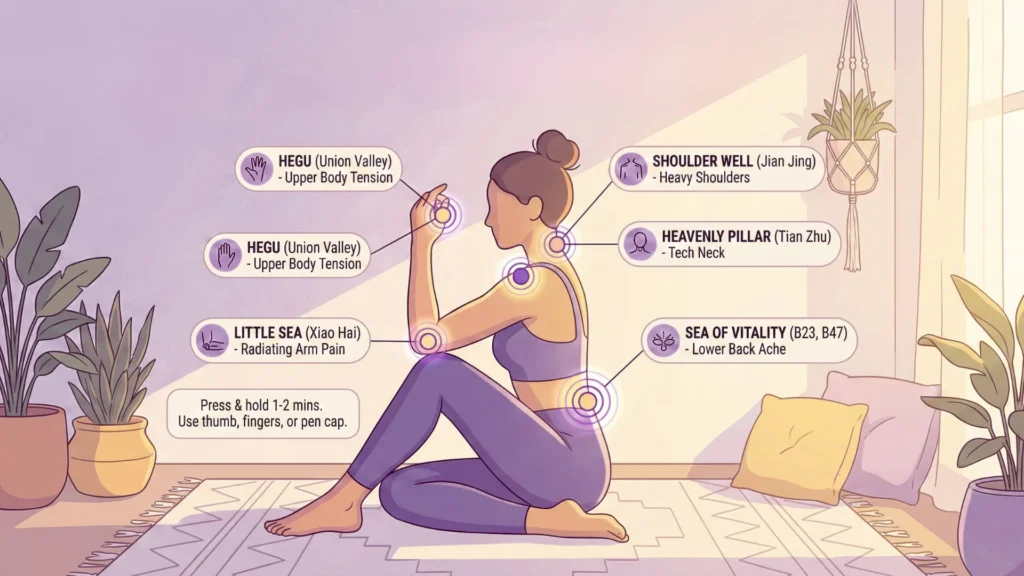
Here’s how to do it: Now just press from the points marked above and hold 1–2 minutes on each. You can use your thumb, fingers or even a blunt object like a pen cap to apply pressure.
1. “Hegu”, or “Union Valley” (He Gu – LI4)
Found in the soft webbing between your thumb and first finger.
Best for: Overall upper body tension and headaches stemming from tightness in your shoulders.
Indian Context: Ideal to have a quick press while in some dull Zoom meeting, or when your chai is brewing.
2. The “Shoulder Well” (Jian Jing -GB21)
Positioned at the top of your shoulder muscle, halfway between the bottom of your neck and end of your shoulder.
Best for: The weight, heavy like the world) feeling in your shoulders.
N.B. Approach with caution if pregnant as this point is contraindicated during pregnancy.
3. The “Heavenly Pillar” (Tian Zhu – B10)
On the back of the neck, about a finger-width below the base of your skull, on either side of the spine.
Best for: “Tech Neck” and stiffness caused by craning to look down at a smartphone or scooting long distances.
4. The “Little Sea” Above the Wrist (Xiao Hai – SI8)
Located between the “funny bone” and the elbow’s tip when in bent position.
Best for: Pain, numbness or tingling that travels from the shoulder down to your arm and into your hand.
5. The “Sea of Vitality” (B23 and B47)
An area of the lower back, between two and four finger widths below the waist.
Best for: Lower back aches from hours on your feet in the kitchen and time spent sitting in an unsupportive wooden chair.
Which Acupressure Points Work Best for Shoulder and Upper Back Pain?
Here’s a list of key acupressure points for quick relief:
| Point | Location | Primary Benefit | Pressure & Duration |
| GB21 (Shoulder Well) | Top of shoulder, midway between neck and shoulder edge | Releases stiffness, improves circulation | 30-60s, firm but comfortable |
| SI11 (Heavenly Pillar) | Upper shoulder blade, midway between spine and outer edge | Eases muscle knots, relieves tension | 30-45s, circular motion |
| BL10 (Celestial Pillar) | Base of neck, 1.3 inches lateral to spine | Relieves neck and upper back tightness | 30-60s |
| LI15 (Shoulder Joint Point) | Outer shoulder, near deltoid attachment | Improves mobility, reduces pain | 30-60s |
| SJ14 (Upper Arm Point) | Upper arm near shoulder joint | Helps shoulder rotation and mobility | 30-60s |
| BL43 (Vital Region) | Upper back, near spine between shoulder blades | Relieves fatigue-related tension | 30-45s |
| SI3 (Back Stream) | Inner edge of shoulder blade | Relaxes upper back muscles | 30-60s |
Tips for Effective Use
- Locate each point using anatomical landmarks for accuracy.
- Apply firm but gentle pressure, avoiding pain.
- Combine 2-3 points in a short 5-minute routine for maximum effect.
- Track which points provide the most relief and adapt your routine accordingly.
Posture Pain Signs You Shouldn’t Ignore + a 5-Minute Reset
How do you tell if your body is craving a pressure reset ?Pay attention to these classic signs of a desi lifestyle:
- The “Traffic Tense”: You sit in traffic for 45 minutes, wind your way through the city’s maniacal streets, and you realize that your shoulders have pulled themselves up to your ears. This is an indication of severe trapezius tension.
- The “Pooja Prep” Pull: When you stand up straight, does your low-back feel locked after a day of bending over to clean floors or hoist heavy decorations?
- The whatsapp wince: Staring down at your phone for more than 10 minutes results in a dull throb at the base of the skull and likely means your “Heavenly Pillar” points are inflamed.
betterhood Pro-Tip: Don’t let the pain get to be an 8/10. Set a ‘Posture Alarm’ on your phone every three hours and spend just 60 seconds on the ‘Union Valley’ point. As with so many things in life, “an ounce of prevention is worth a pound of cure” also applies to musculoskeletal health.
Beyond Acupressure: A 3-Level Plan for Lasting Pain Relief
Acupressure is great as a quick fix but it really works best when part of an overall lifestyle that includes movement.
1: Passive Release (The “Calm” Period)
Concentrate on the 5 minute acupressure routine outlined earlier. This in turn, when accompanied with deep, diaphragmatic breathing. Breathe in for 4 counts, hold for 4 and exhale slowly to the count of 8. This “Vagus Nerve” kicking in, intensifies the pressure points.
2: Active Adaptations (Move Phase)
After you’ve brought down the acute pain, learn mobility exercises and daily routines to keep your joints oiled up. Gentle neck rolls and “Cat-Cow” stretches on the floor are also lovely adjuncts to acupressure. If you have lingering pain in your back, start looking into a posture correction exercise routine that will help correct the source.
3: Long-Term Habits (The “Build” Phase)
For those with chronic urban lifestyle pain, though, it’s all about consistency. Integrate acupressure into joint pain stretching exercises. This helps you build muscular strength to help support your spine, so the pain doesn’t come straight back when you sit back down at your desk.
betterhood Tools as Your Recovery Partners
Your hands are great for acupressure, of course but not every point is easily within reach, and you certainly can’t just take a load off and push on all of them during your workday or while sleeping. That’s where ergonomic tools act as training wheels for a better life.
Supportive Seating: If you’re regularly needing to press on your Columbus points in order to get back in the zone every hour, then your chair may be to blame. We use only the best, which is why even with an ergonomically designed lumbar cushion for your car seat, spine curvature (or lack thereof) will keep them looking hunched for a while.
Knee & Joint Braces: If back pain is from misaligned legs and heavier duties throughout the average day, the correct compression knee sleeve provides a foundation needed to block referred pain from traveling up your body into your back.
Ergonomic Pillows: A lot of our shoulder pain is ‘manufactured’ while we sleep. Rich minders tend to use pillows with a support structure that holds your neck in shape, so you don’t wake up needing an emergency acupressure session.
When to Seek Professional Advice ?
Acupressure is a harmless and helpful method, however it is not an alternative to medical treatment. Please consult a physician or registered physiotherapist if:
- You have discomfort from a recent injury (such as a fall or car accident).
- The pain is associated with fever, involuntary weight loss or excessive night sweats.
- You have “Red Flag” symptoms such as loss of bladder control or sudden and severe weakness in your legs.
- The pain is stabbing and radiates and doesn’t get better at all with rest or gentle movement.
Conclusion: Small Daily Actions, Lasting Relief
The real power of a simple 5-minute acupressure routine is the reminder that pain isn’t always something you have to “push through” or live with. Even in a desk-bound, high-stress lifestyle, small intentional actions can calm the nervous system, ease muscle tension, and protect your long-term joint health. A few mindful minutes each day can restore mobility, reduce stress-related pain, and bring a surprising sense of control back to your body.
Support makes that journey easier. When time-tested practices like acupressure are paired with thoughtfully designed pain-relief tools and everyday recovery aids, relief becomes more consistent and sustainable, not temporary. The goal isn’t perfection; it’s progress, comfort, and movement that feels natural again.
So start where you are. Pause, breathe deeply, press the Union Valley point, and let your body exhale the tension it’s been holding onto. Relief doesn’t always demand big changes; sometimes, it begins with one small, well-placed step.
Explore More Health & Wellness Solutions:
Want to stay informed about wellness and everyday health issues? Here are some insightful reads to guide you. Explore the links below for practical tips and solutions:
- Struggling to Breathe? Here’s a Simple Postural Drainage Routine to do at Home
- Acupressure Points in the Foot: Benefits, Chart & Pressure Techniques
- How Can Knee Cap Support Help Prevent Injury and Reduce Pain While Running
Frequently Asked Questions
Some points can’t be needled, but GB21 (Shoulder Well) and LI4 (Union Valley) are conventionally contraindicated because they could reflect uterine contractions. Always check with your doctor or a participation specialist before attempting acupressure during pregnancy.
You want to use “firm but comfortable” pressure. You should feel a “good hurt” — a deep, achy feeling. It should never be aching, sharp pain. If so, go a bit easier on the stroke.
Yes, but with a whole lot less pressure. Children nowadays can suffer from “Tech Neck,” due to online classes and tablets; a gentle, 30-second massage on the “Heavenly Pillar” points can be very calming for them.
The immediate help may take between 30 minutes and a few hours. Ergonomic corrections and regular movement are necessary for long-lasting results.
This is a great sign! It signifies you’re body is no longer in the “fight or flight” mode (Sympathetic (Stress) nervous system), but rather switched into the “Relaxation Response” of the Parasympathetic (Relaxation) nervous system. Your body is ready to heal.
Absolutely. You can take it off for 5 minutes to perform your routine and put it back on to continue your alignment throughout the rest of your
References
- NCCIH. (2023). Acupuncture: What You Need To Know (Note: Principles apply to acupressure). https://www.nccih.nih.gov/health/acupuncture-what-you-need-to-know
- Kuo, S. Y., et al. (2016). Auricular acupressure relieves anxiety and fatigue, and reduces cortisol levels in post-caesarean section women: A single-blind, randomised controlled study. International Journal of Nursing Studies, 53, 17–26. https://pubmed.ncbi.nlm.nih.gov/26525188/
- Li, T., Li, Y., & Zhang, Y. (2021). Clinical efficacy and safety of acupressure on low back pain: A systematic review and meta-analysis. Evidence-Based Complementary and Alternative Medicine, 2021, Article 8862399. https://doi.org/10.1155/2021/8862399
- Mayo Clinic. (2023). Alternative medicine for back pain. https://www.mayoclinic.org/diseases-conditions/back-pain/diagnosis-treatment/drc-20369911


