






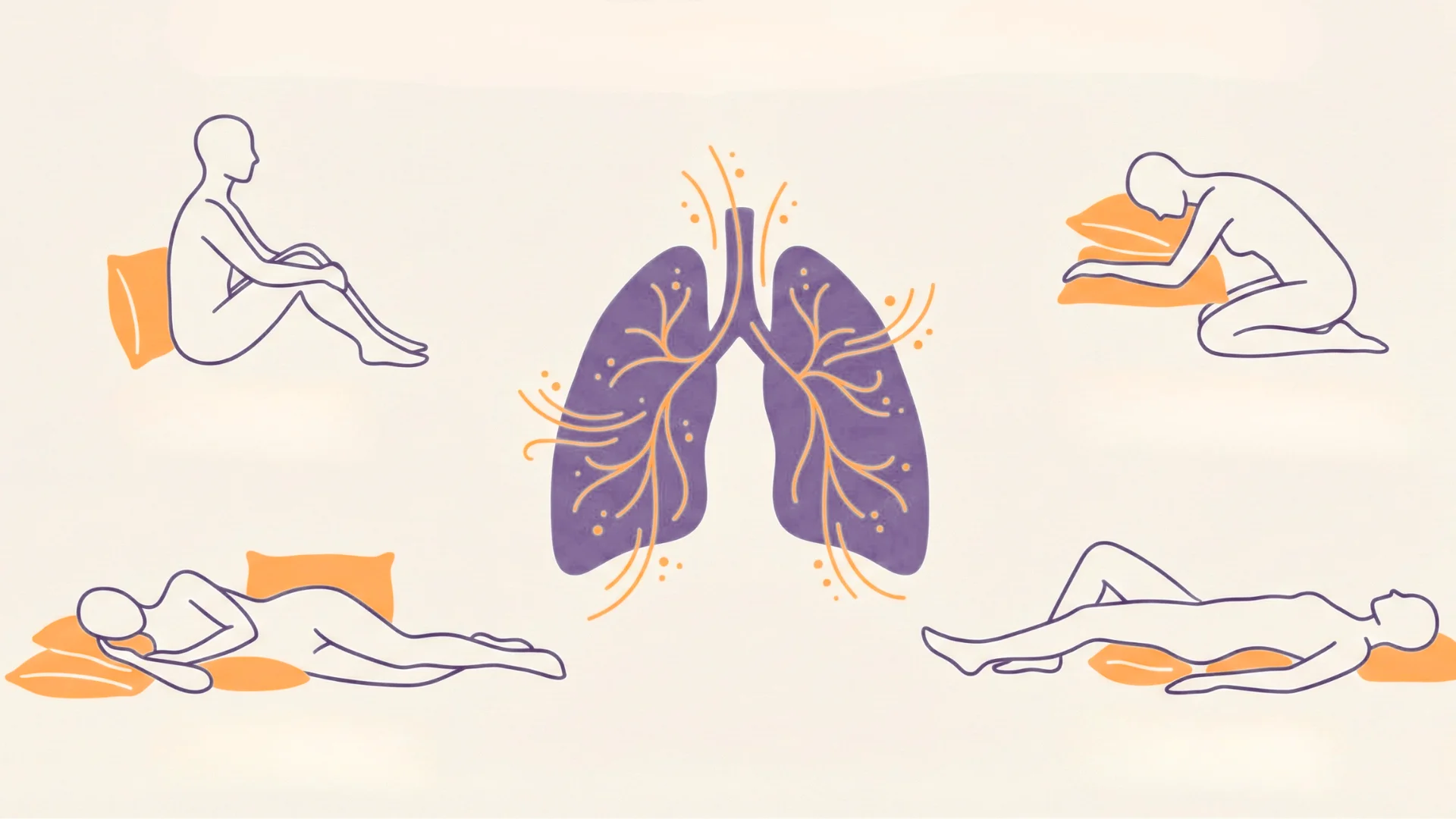
Breathing is something we tend to ignore, until mucus clogging the nose makes every breath as hard to get as a line at the DMV. That heavy, congested feeling in your chest, the constant urge to clear your throat, and the fatigue that comes from working harder just to get enough air can be exhausting.That’s your body’s way of saying that it’s time to clear up your airways, and the proper positions for postural drainage can make a surprising difference.
One thing that people often fail to take into account is posture and how it impacts the drainage of your lungs. Your lungs are not simply passive air sacs; they’re sophisticated organs with specialized sections that depend on gravity and the alignment of body parts to be able to drain well. By using the correct postural drainage position, you can clear away mucus that is congesting your airways and making it difficult to breathe. [1]
So there you have it – who is primarily going to benefit the most from postural drainage? These are methods that people with chronic lung diseases like COPD or cystic fibrosis have been relying on for years. But you don’t need a diagnosis of chronic to benefit. After a viral illness such as a cold or flu, after bronchitis and whenever you have seasonal respiratory congestion – simply move the cat into different positions.
In this article, we’ll learn the most effective postural drainage positions and how to use them safely to breathe easier and clear mucus naturally.
What Is Postural Drainage?
So here’s a simple definition: postural drainage is an intervention involving precise body positioning to use the force of gravity to help mucus drain from smaller airways into larger ones, where it can be coughed up or cleared in most cases more effectively.
Think of your lungs as though they were a tree; your trachea is the trunk, your bronchi are the main branches and those smaller bronchioles are the twigs. When mucus becomes trapped in those tinier channels, it impedes air flow and causes that heavy, clogged sensation. When you place your body in such a manner as to raise impacted segments of lung above the central airways, gravity assists with the process of mucus and other productive materials making their way toward your throat [2].
Gravity-assisted mucus clearance is gentler and often more effective than forceful coughing alone. In fact, violent coughing can exacerbate airway irritation and also occasionally get mucus lodged even deeper in your lungs. Postural drainage enables the action of your body’s natural ciliary escalator (the small hair-like cells in your airways) to function more effectively and help the mucus slowly work its way upwards as well.
It is important to recognize the difference between coughing and drainage. Coughing is reactive when your body senses something’s in the way, coughing is its emergency plan to help you clear the obstruction (in this case, your airways). Drainage is active; you’re helping your lungs clear themselves out naturally. Both have their place, but postural drainage spares you tiring coughing bouts and is usually more effective.
How Postural Drainage Improves Breathing ?
The advantages of postural drainage are more than just clearing out mucus, important as that is.
Better oxygen exchange: Because mucus clogs the airways, the air sacs (alveoli) beyond those blockages can’t assist with gas exchange. You’re basically having to breathe with a small, nonfunctional portion of lung. And by opening those airways via postural drainage you can restore oxygen flow to these previously obstructed regions, improve your blood-oxygen levels and lessen the rate at which you need to work (i.e. breathe) [3].
Lowered Airway Obstructions: Excessive mucus plays a bit of a cruel joke when it comes to airway obstructions. Mucus irritates airways, leading to inflammation that creates more mucus. By breaking this cycle and physically removing accumulated mucus, inflammation can resolve and mucus accumulation can be limited”.
Alleviation of chest tightness and wheezing: Chest feeling hard to breathe in ? You can thank clogged airways (likely from excess mucus) for that. When your airways are reopened by the relief of drainage, you’ll feel less pressure on your chest and find yourself breathing easier; that whistle-like wheeze will subside. Reports of “feeling able to take a proper breath again” continue to be heard from many people following effective postural drainage treatment [4].
If you are living with a chronic respiratory condition, adopting a practice of postural drainage with right positions can ease the burden of acute exacerbations and enhance your overall lung function as well.
Who Should Use Postural Drainage ?
Postural drainage isn’t just for those with severe lung disease, it’s a technique useful in many different respiratory problems.
Chronic bronchitis: If you have chronic inflammation accompanied by constant mucus production in your bronchial tubes, then postural drainage is a great tool to use daily to combat the symptoms. A morning hocking session helps many people with chronic bronchitis kick their day off with some clearer breathing [5].
Asthma (with a qualifier): Asthma is less about mucus overproduction and more about airway constriction, but there are people for whom asthma leaves one feeling mucus-plugged; particularly after respiratory illnesses. Certain positions, however, can bring on bronchospasm in susceptible people, so you should consult your doctor to find out which positions will be safe and effective for you.
Post-infection congestion: Before your congestion took hold, you may have had a cold or been down with the flu or another respiratory infection and are now stuck with lingering mucus that may last weeks. This is among the best uses of postural drainage for non-critically ill individuals to achieve a quicker and more complete recovery. Instead of crossing your fingers and waiting weeks for congestion to slowly clear, you can actively help it move out.
Post-surgical recovery: After some surgical procedures, particularly abdominal or thoracic surgeries, coughing can be a painful process. Postural drainage is especially useful at this point as it promotes clearance of secretions with less forceful coughing, decreasing pain and minimizing the development of post-surgical complications such as pneumonia [6].
If you are in recovery from any kind of respiratory challenge, and are struggling to enjoy high-quality sleep, sleeping in a manner that supports your breathing can dovetail magnificently with your drainage routine.
Best Postural Drainage Positions
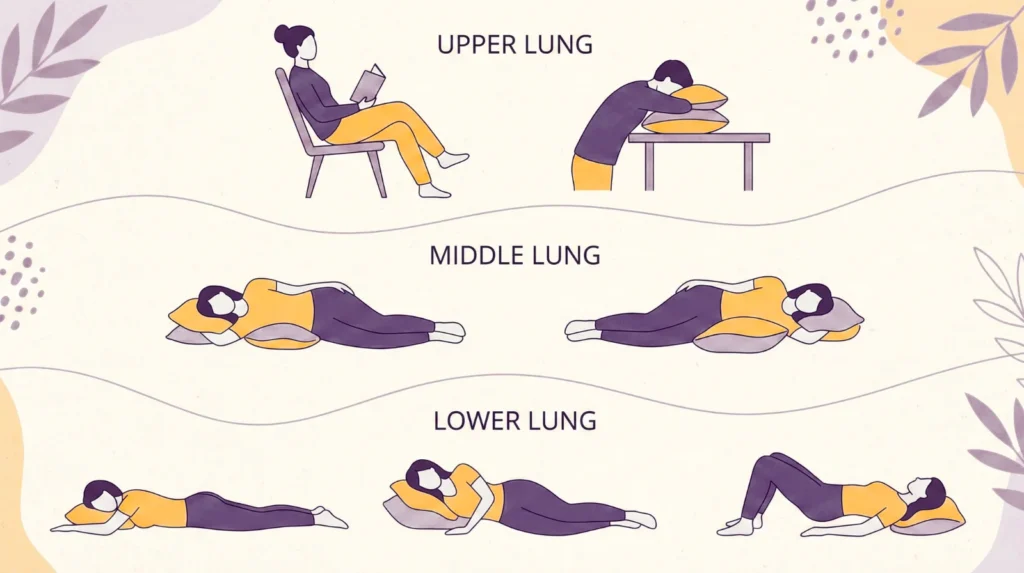
Specific positions promote optimal drainage of the various lung segments. Though percussion which is gentle clapping on the back may be done by physical therapists during postural drainage, there are still great benefits of only assuming the positions at home.
You will do one for 5-10 minutes, breathing slowly and fully. Keep a box of tissues handy and cough gently if you need to; your nasal exhalations will be carrying some heat away.
Upper Lung Drainage Positions
For upper front lung segments: While sitting up in a chair that is not too soft, lean back on the chair at a 30-degree angle. This is usually the most comfortable and can be done while reading or watching TV. It’s especially good at clearing out the apical (top) part of your lungs.
For upper back lung segments: Sit up and bend forward over a pillow that is on a table so that your head and arms can relax. This position gets to the posterior (back) upper lobes and is particularly useful if you have mucus congestion up in your chest between your shoulder blades.
Middle Lung Drainage Positions
For right middle lobe: Left side lying turned slightly towards the back (about a quarter turn). Place pillows under your hips to prop them up so that they’re about 12-16 inches higher than your head. This is a focused position that permits the right middle lobe, which is predisposed to mucus entrapment because of its anatomical shape.
For left medial segments: Lying on your right side, the body slightly turned backward, hips raised. The balance keeps both lungs draining as well as possible.
These positions can be uncomfortable at first, which is why support matters. A good positioner can also help you breathe without being as uncomfortable as some pillows.
Lower Lung Drainage Positions
For lung segment in the lower back: Lie on your stomach with two or three pillows under your hips to raise them, allowing your head and chest to be lower than the rest of the body. Hands can relax at your sides. This position removes the posterior basal (lower back) segments, which are often filled with mucus if you’ve been lying down for a while.
Lower side lung segments: Lie on your side with your hips propped up by pillows. For the left lower lobe, lay on your right side; for the right lower lobe, lay on your left side. These positions aim to open up the lateral basal segments where mucus can become trapped when you’ve been inactive.
For lower front lung segments: Lie on your back with hips propped up on a few pillows, which creates a downward slope from the hips to head. This position evacuates the anterobasal segments.
Comfortably arranging these positions is essential for performance. If you’re uncomfortable, you won’t hold the position long enough for the drainage to be as effective. A positionable, support mattress can help make home-based postural drainage easier and more comfortable to perform on a routine basis.
How Long and How Often Should You Practice ?
Ideal duration per position: Hold each position for 5-10 minutes. You don’t have to perform all the positions in every session, just concentrate on the spaces where you’re most congested. A full postural drainage session that includes all lung segments may last 30 to 40 minutes, although most perform only 2-4 positions as needed when they feel congested⁷.
Daily vs episodic use: The frequency depends on your situation:
- During acute illness (like bronchitis or post-viral congestion): 2-3 times daily until symptoms significantly improve
- For chronic conditions (like COPD or bronchiectasis): Once or twice daily as part of ongoing airway clearance
- For prevention (after surgery or during prolonged bed rest): At least once daily to prevent mucus accumulation
Listen to your body. If you can get that mucus discharge happening, that position is doing its job and may need to be duplicated. If there is no movement, it may be that that area doesn’t need drainage right now, or you may have to hold at that spot longer.
Timing matters too. Morning drainage can help clear night time accumulations when people are most congested and an evening treatment prior to going to bed may cut down on night time coughing and aid in better sleep. To learn additional tips on how you can build your own bedtime routines to help maintain optimal respiratory health, see our guide on better sleep quality.
Safety Tips and When to Avoid Postural Drainage
Although postural drainage is safe in most cases, some precautions or medical clearance may be necessary.
Blood pressure issues: Head-down positions can temporarily elevate blood pressure and intracranial (inside the skull) pressure. When your head is below hip level: If you have uncontrolled high blood pressure (hypertension), glaucoma, or a history of stroke, ask your health care provider if positions in which your head is lower than your hips are safe for you. Have modified tilting position such as less dramatic tilt may be a safer alternative [8].
Pregnancy precautions: Lying flat on your back in the second half of pregnancy can squeeze major blood vessels, and head-down positions may be uncomfortable. Pregnant persons should try sitting and side-lying positions with the least possible inclination, and consult a health care provider beforehand.
Acid reflux precautions: If the baby has reflux, a head-down position may aggravate the gastroesophageal reflux. Postural Drainage If you have GERD or frequent heartburn, do not perform postural drainage after meals and avoid positions in which your head is lower than your stomach. You may also want to sleep with your head elevated, even between drainage sessions, to control for reflux.
When to stop: If you have any of these symptoms, stop postural drainage and call your healthcare provider:
- Dizziness or severe headache
- You have chest pain or experience more trouble breathing
- Blood in your sputum
- Nausea or vomiting
- Irregular heartbeat
These are the signs that this method may not be right for where you’re at in your process, or that something is going on beneath the surface that requires a medical intervention.
Breathing Easier, One Position at a Time
Postural drainage can sound too simple, too easy to be impactful. But occasionally the most effective interventions are those that go with your body’s natural mechanisms, not against them.
Your lungs have an extraordinary natural serviceability program to help keep airways clean. Sometimes it just needs a little gravitational help to operate at its best. It’s not just waiting for congestion to clear up, you’re participating in your recovery by knowing which positions target which lung segments.
Lung function increases when posture supports lungs, not only during postural drainage treatment but every moment of your day and night. How you situate yourself in sleep, work and rest influences the ability of your lungs to drain and function. That is exactly why creating a conducive environment for healthy positions for postural drainage matters so much more than the minutes you take doing formal drainage exercises.
At betterhood, we think wellness is not about complex protocols or expensive interventions, but about knowing what your body needs and making it possible for that to happen at its best. Whether that means supportive sleep surfaces that allow for aligning, positioning aids which help make the therapeutic lifestyle possible, or just everyday wisdom from aligning experts like us.
Since every breath should be light, full and free, not work.
Explore More Health & Wellness Solutions:
Want to stay informed about wellness and everyday health issues? Here are some insightful reads to guide you. Explore the links below for practical tips and solutions.
- How Poor Posture Causes Knee Pain and How to Fix It
- Can Your Sitting Posture Cause Hip Misalignment? How to Correct It
- 10 Effective Home Remedies for Body Pain Relief Naturally
Frequently Asked Questions
It might assist in clearing mucus, but some positions could provoke bronchospasm so consult a physician, and stay upright if you’re sensitive
Yes, it is generally safe to take daily, but some people with certain health conditions should consult their doctor first.
Some people feel relief within minutes, but thick mucus may require this kind of propping up over several days.
No, support pillows or a wedge for comfort is all that’s needed, it’s hanging out in this position comfortably for 5-10 minutes.
Use bronchodilators before drainage and steroid inhalers after, unless your doctor advises otherwise.
Yes, but only with more gentle positions and shorter sessions, and when there is adult supervision to ensure safety.
References
- Fink, J. B. (2007). Forced expiratory technique, directed cough, and autogenic drainage. Respiratory Care, 52(9), 1210-1221. https://rc.rcjournal.com/content/52/9/1210
- Hess, D. R. (2001). The evidence for secretion clearance techniques. Respiratory Care, 46(11), 1276-1293. https://rc.rcjournal.com/content/46/11/1276
- McCool, F. D., & Rosen, M. J. (2006). Nonpharmacologic airway clearance therapies: ACCP evidence-based clinical practice guidelines. Chest, 129(1), 250S-259S. https://doi.org/10.1378/chest.129.1_suppl.250S
- Osadnik, C. R., McDonald, C. F., Jones, A. P., & Holland, A. E. (2012). Airway clearance techniques for chronic obstructive pulmonary disease. Cochrane Database of Systematic Reviews, 3, CD008328. https://doi.org/10.1002/14651858.CD008328.pub2
- Mayo Clinic. (2023). Chronic bronchitis: Diagnosis and treatment. Retrieved from https://www.mayoclinic.org/diseases-conditions/bronchitis/diagnosis-treatment/drc-20355572
- Restrepo, R. D., & Braverman, J. (2009). Current challenges in the recognition, prevention and treatment of perioperative pulmonary atelectasis. Expert Review of Respiratory Medicine, 3(3), 269-278. https://doi.org/10.1586/ers.09.16
- Pryor, J. A., & Prasad, A. (2008). Physiotherapy for respiratory and cardiac problems: Adults and paediatrics (4th ed.). Churchill Livingstone Elsevier. https://www.elsevier.com/books/physiotherapy-for-respiratory-and-cardiac-problems/pryor/978-0-7020-3000-6
- American Association for Respiratory Care. (2010). AARC clinical practice guideline: Postural drainage therapy. Respiratory Care, 36(12), 1418-1426. https://rc.rcjournal.com/content/36/12/1418


