






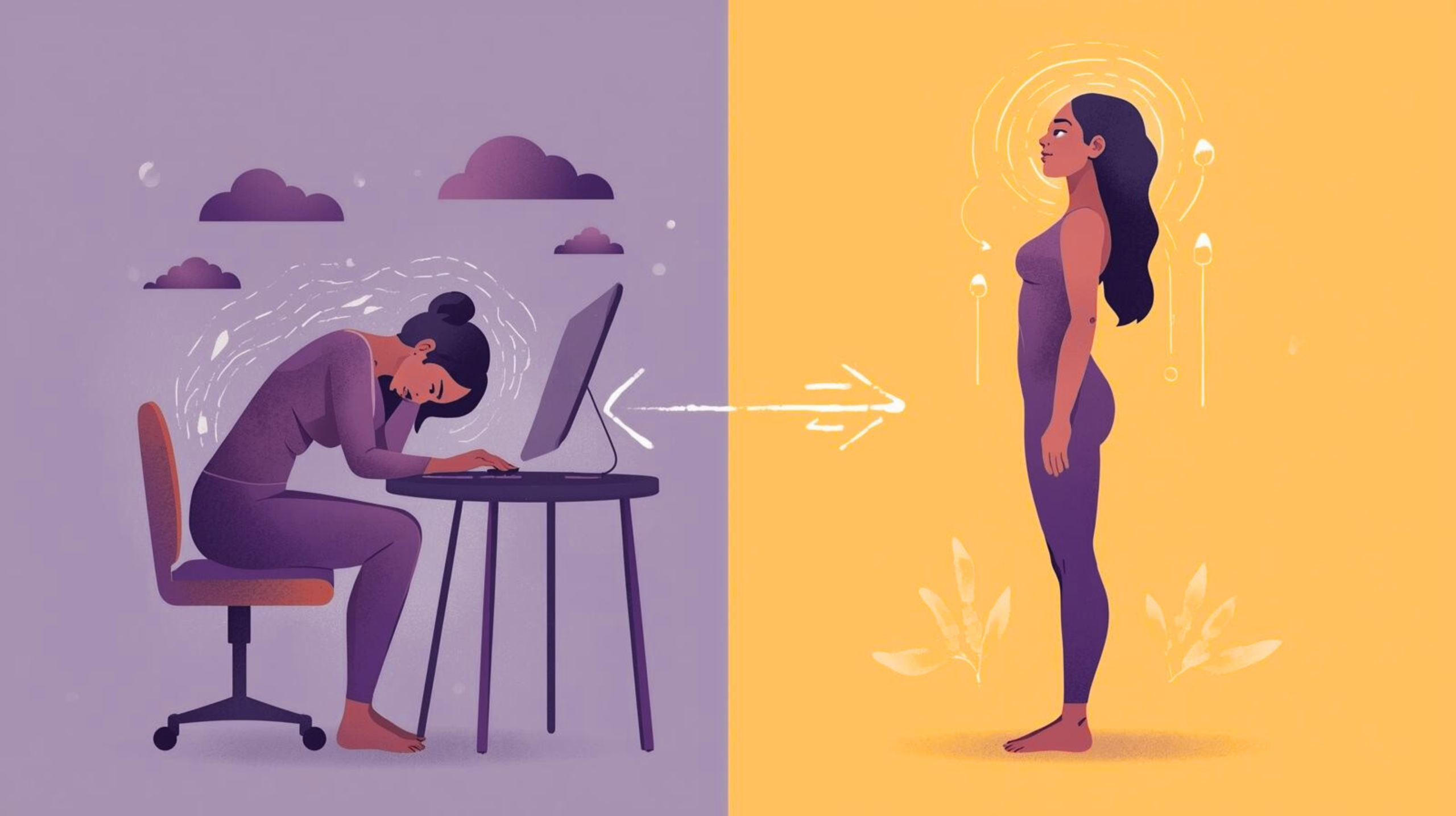
Posture isn’t just about standing straight or sitting “properly.” It’s a physical expression of what’s happening inside you. Stress, deadlines, emotional load, uncertainty—your body absorbs all of it. Long before your mind fully registers tension, your shoulders rise, your jaw tightens, your breath shortens, and your spine subtly collapses inward. Over time, this becomes your default posture.
This is where the stress–posture cycle begins.
Stress changes how you hold your body. That altered posture then feeds back into your nervous system, increasing fatigue, discomfort, and mental strain. Left unchecked, it becomes a loop that quietly drains your energy, focus, and resilience.
How Stress Reshapes the Body
When you’re under stress, your body shifts into a protective mode. This is not a flaw—it’s survival biology.
- Shoulders round forward to guard the chest
- The neck juts forward to “scan” for threats
- The diaphragm tightens, leading to shallow breathing
- Core muscles disengage while the lower back overworks
In the short term, this response is helpful. In the long term, it becomes harmful.
What starts as emotional tension slowly turns into physical imbalance. Muscles that are meant to move become rigid. Muscles meant to stabilize become weak. Joints lose their natural alignment. The spine, your body’s central support system, takes the brunt of it.
This is why people under chronic stress often report:
- Persistent neck and shoulder pain
- Tight hips and lower back discomfort
- Frequent headaches or jaw pain
- A constant feeling of physical exhaustion
When Posture Feeds Stress Back Into the Mind
Here’s the part most people miss: poor posture doesn’t just result from stress—it actively creates more of it.
A collapsed posture compresses the lungs, reducing oxygen intake. Shallow breathing sends subtle signals of danger to the brain, keeping the nervous system on edge. Slouching also increases muscular effort, forcing your body to work harder just to stay upright.
The result?
- Faster fatigue
- Reduced concentration
- Increased irritability
- Lower confidence and motivation
Your brain interprets your posture as information. When your body looks defeated or guarded, your mind often follows suit.
The Everyday Stress Traps You Don’t Notice
You don’t need a traumatic event to fall into the stress–posture cycle. It’s the quiet, repetitive habits that do the most damage:
- Leaning toward your screen during mentally demanding work
- Clenching your jaw while multitasking
- Holding your breath during stressful conversations
- Sitting without back support while “just finishing one more task”
- Standing rigidly instead of shifting weight naturally
Each habit reinforces tension. Each day, the body learns to treat stress as the norm.
Over months and years, this can lead to chronic pain, reduced mobility, poor sleep quality, and a constant sense of being “wired but tired.”
Early Signs the Cycle Has Started
Your body gives warnings before things escalate. Pay attention if you notice:
- Tight shoulders even when resting
- A stiff neck first thing in the morning
- Feeling mentally drained after sitting for long periods
- Shallow breathing without realizing it
- Pain that worsens during stressful days
These aren’t just posture issues or stress issues, they’re both.
A Simple Stress–Posture Check (1 Minute)
Stand or sit upright and ask yourself:
- Are my shoulders creeping upward?
- Is my jaw clenched?
- Am I breathing into my chest instead of my ribs?
- Is my head drifting forward instead of stacking over my spine?
If the answer is yes to more than one, your body is holding stress physically.
Awareness is the first interruption of the cycle.
Your 2-Minute Stress–Posture Reset
You don’t need perfect posture. You need regular resets.
1. Unload the Shoulders
Inhale, lift shoulders gently. Exhale, let them drop completely. Repeat twice.
2. Realign the Spine
Imagine your head floating upward while your tailbone gently drops downward. No force—just length.
3. Release the Jaw
Let your tongue rest on the floor of your mouth. Teeth slightly apart.
4. Breathe Low and Slow
Inhale through the nose, expanding the ribs. Exhale longer than you inhale.
5. Soften, Don’t Stiffen
Good posture feels light, not rigid.
Do this after stressful moments, long meetings, or extended screen time.
The Bottom Line
Stress and posture are in constant conversation. One shapes the other—always.
You don’t fix this cycle with rigid rules or constant correction. You fix it with awareness, gentle realignment, and frequent release of tension. When your body feels supported, your mind feels safer. When your mind feels calmer, your posture naturally improves.
Posture isn’t about looking confident.
It’s about creating a body that can handle life without breaking down under it.
And that’s not a one-time fix—it’s a daily practice.
Co- authored by: Shayamal Vallabhjee
Chief Science Officer: betterhood
Shayamal is a Human Performance Designer who works at the intersection of psychology, physiology, and human systems design, for the last 25 years he is helping high-performing leaders, teams, and athletes thrive in environments of stress, complexity, and change. His work spans across elite sports, corporate leadership, and chronic health—and is grounded in the belief that true performance isn’t about pushing harder, but designing better.


