






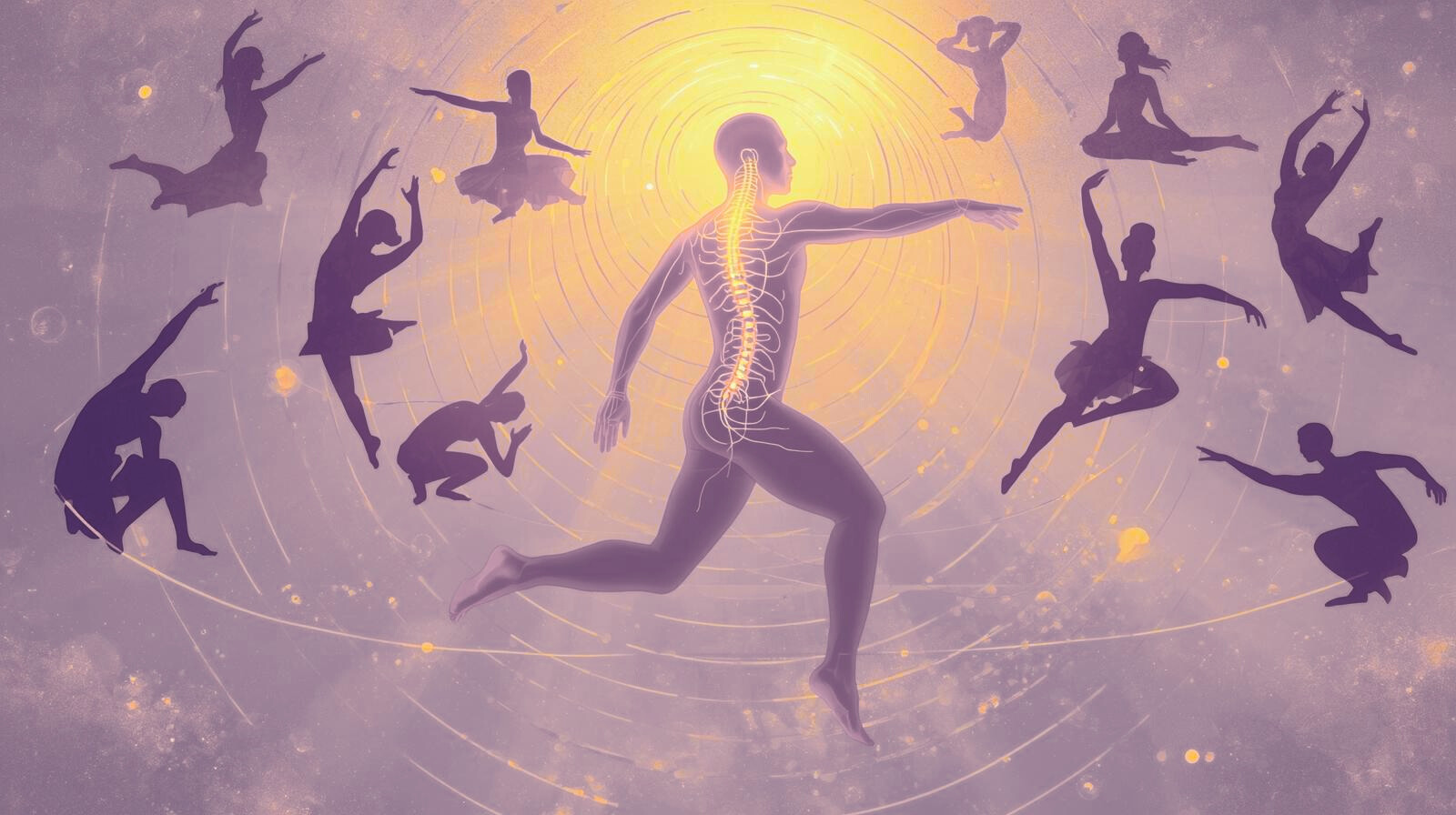
Modern life rewards efficiency. We minimize effort, streamline movement, and reduce physical expression to what is strictly necessary. We sit longer, breathe shallower, and move in straight lines from chair to car to screen. Over time, stillness becomes normal, and restlessness, anxiety, and fatigue are treated as personal failures rather than biological signals.
But the human nervous system did not evolve for this kind of quiet immobility.
Long before fitness trackers and productivity hacks, cultures across the world built movement directly into daily life, ritual, and healing. These were not workouts. They were systems of regulation.
Old rituals like Qigong, Sufi spinning, and African squat dancing were not just cultural expressions. They were neurological hygiene. [1]
And we abandoned them at a cost.
The Past Didn’t Move Randomly
It Moved Rhythmically
Traditional movement systems shared common elements, even across continents:
- Repetitive, flowing motion
- Coordinated breath
- Rhythm and timing
- Full-body involvement
- Grounded stances and rotation
Qigong emphasized slow, circular movements synchronized with breath to calm the mind and circulate energy.Sufi whirling used continuous spinning to induce coherence between balance, breath, and attention. [3] [2]
Many African dance forms relied on deep squats, pelvic rhythm, and foot-ground connection to regulate communal energy and emotional expression. [4]
These movements trained the nervous system to oscillate smoothly between effort and ease.
They taught the body how to return to balance.
Movement as Nervous System Regulation
The nervous system does not reset through stillness alone. It resets through organized motion.
Rhythmic movement does three critical things:
- Regulates breath
Repeated motion naturally lengthens exhalation, activating the parasympathetic nervous system. [5] - Creates predictability
Rhythm signals safety to the brain. Predictable movement patterns reduce threat perception and mental noise. - Builds coherence
When breath, movement, and attention align, the brain shifts from fragmentation to integration.
This is why people often feel calm, clear, or emotionally released after dancing, swaying, spinning, or slow flowing movement, even if they can’t explain why.
The body remembers how to regulate itself when given the right input.
Modern Stillness Is Not Neutral
We often treat lack of movement as “rest.” Neurologically, it isn’t.
Prolonged stillness without rhythmic input leads to:
- Heightened baseline stress
- Reduced sensory integration
- Poor emotional processing
- Restlessness without release
Sitting quietly while mentally overstimulated traps the nervous system in a half-activated state. There is no discharge, no rhythm, no resolution.
Ancient movement gave the nervous system something modern life withholds: a way to complete stress cycles.
Why These Practices Felt Sacred
Ritualized movement wasn’t framed as exercise or therapy. It was framed as meaning.
That mattered.
When movement is repetitive, rhythmic, and purposeful, it bypasses overthinking and speaks directly to the brainstem and cerebellum, the parts responsible for balance, timing, and survival regulation. [6]
This is why:
- Spinning can feel disorienting and centering at the same time
- Squatting rhythms feel grounding and energizing
- Slow circular movements feel calming without being sedating
These practices didn’t just train muscles. They trained in state control.
We Replaced Regulation With Suppression
Instead of moving stress out of the body, modern systems encourage us to:
- Sit still and focus harder
- Medicare symptoms
- Distract ourselves
- Push through fatigue
The result is a population that is productive but dysregulated.
Ancient cultures understood something we often ignore:
If you don’t move emotion, it moves you.
What We Forgot (and Can Relearn)
We don’t need to replicate ancient rituals perfectly. But we do need to restore their principles:
- Daily rhythmic movement
- Breath-led motion
- Rotation, swaying, and grounding
- Movement that is expressive, not just efficient
Walking alone isn’t enough. Stretching alone isn’t enough. Strength training alone isn’t enough.
The nervous system needs rhythm, variation, and flow.
Sanity Is a Movement Skill
Mental clarity, emotional stability, and resilience are not purely psychological traits. They are embodied capacities.
The past moved better than we do now.
Not because it was smarter, but because it listened to the body before silencing it.
Ancient motion wasn’t about fitness. It was about keeping the mind inhabitable.
In a world that asks us to sit still while everything speeds up, moving rhythmically might be one of the most modern acts of sanity we have left.
Co- authored by: Shayamal Vallabhjee
Chief Science Officer: betterhood
Shayamal is a Human Performance Designer who works at the intersection of psychology, physiology, and human systems design, for the last 25 years he is helping high-performing leaders, teams, and athletes thrive in environments of stress, complexity, and change. His work spans across elite sports, corporate leadership, and chronic health and is grounded in the belief that true performance
References
National Institute of Neurological Disorders and Stroke. (2022). Brain Basics: Cerebellum. https://www.ninds.nih.gov/health-information/patient-caregiver-education/brain-basicsce isn’t about pushing harder, but designing better.
National Center for Complementary and Integrative Health. (2023). Qigong: What You Need To Know. https://www.nccih.nih.gov/health/qigong-what-you-need-to-know
Harvard Health Publishing. (2020). The health benefits of tai chi and qigong. https://www.health.harvard.edu/staying-healthy/the-health-benefits-of-tai-chi-and-qigong
Encyclopaedia Britannica. (2023). Sufism: Whirling Dervishes. https://www.britannica.com/topic/Sufism
Journal of Dance Medicine & Science. (2018). The Physiological Effects of African Dance. https://journals.sagepub.com/home/dms
Cleveland Clinic. (2022). Diaphragmatic Breathing Benefits. https://my.clevelandclinic.org/health/articles/9445-diaphragmatic-breathing


