






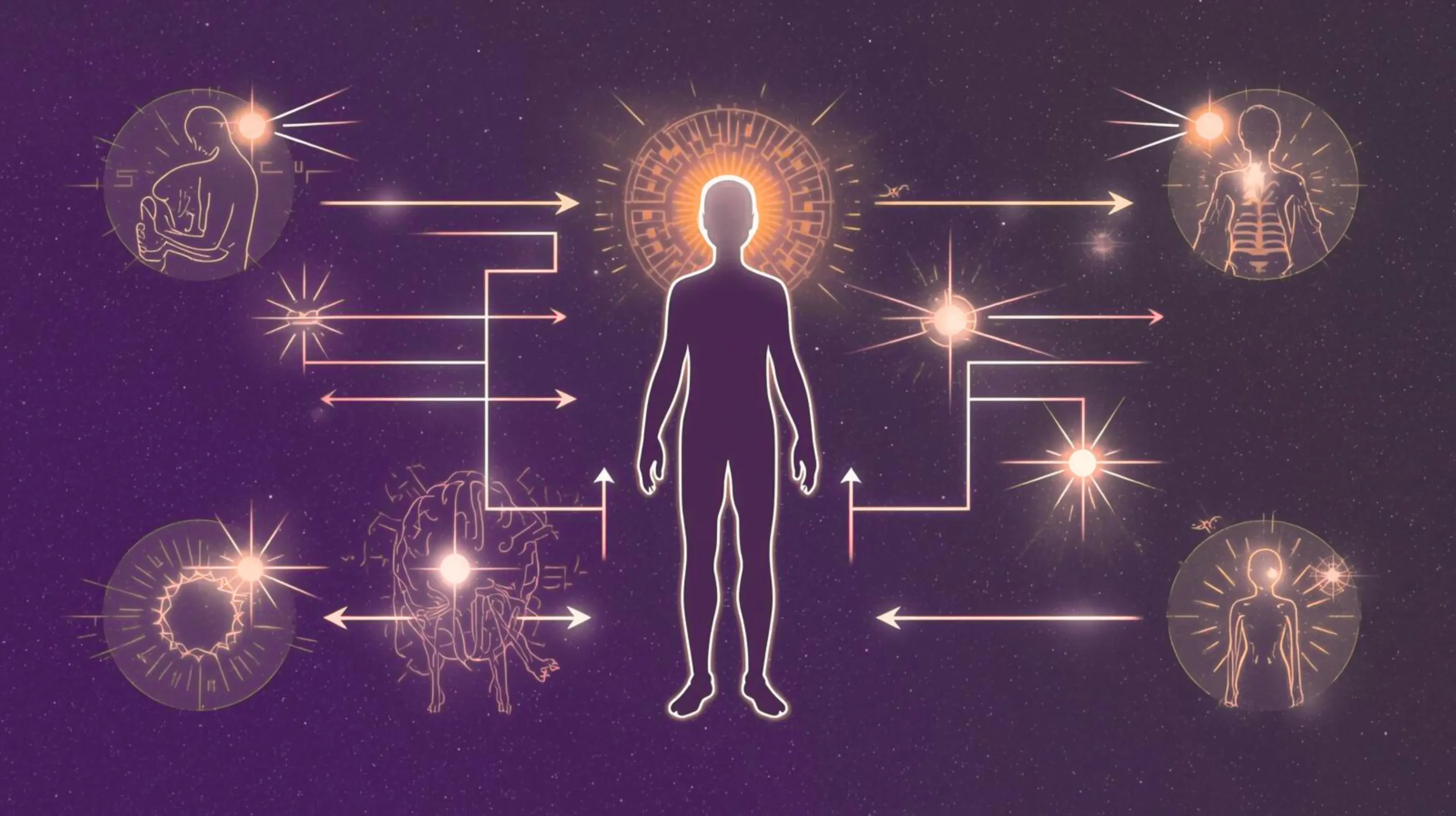
Movement is often treated as a purely mechanical function. Muscles contract, joints rotate, and the body performs tasks. From this perspective, movement is simply the physical expression of strength, flexibility, and coordination.
But the body does not move only to accomplish tasks. It also moves to communicate.
Posture, tension, pacing, and gestures continuously reflect how the nervous system interprets the environment. These signals provide insight into stress levels, emotional states, fatigue, and overall physiological balance. [1]
When we begin to view movement as a form of language rather than just mechanics, the body’s patterns start to reveal important information.
The Nervous System Speaks Through Movement
The nervous system constantly evaluates the environment to determine whether it is safe, demanding, or threatening. Based on this assessment, it adjusts muscle tone, posture, breathing patterns, and movement behavior. [2]
When the system perceives safety, movement tends to appear relaxed and fluid. The body explores space easily, breathing is steady, and muscles activate only when necessary.
When the system detects stress or pressure, movement often becomes more guarded. Shoulders elevate slightly, breathing becomes shallower, and muscles maintain a higher baseline level of tension.
These changes are rarely intentional. They occur automatically as part of the body’s regulatory system.
In this way, movement becomes a visible reflection of internal state.
Posture as a Reflection of Load
Posture is often discussed in terms of correct or incorrect positions. However, posture frequently reflects accumulated physical and psychological load rather than simple alignment. [3]
Long periods of concentration may lead to a forward head position. Emotional stress can elevate shoulder tension. Fatigue often results in collapsed posture or slower movement patterns.
These positions are not always mistakes. They are adaptive responses to sustained demand.
The body adjusts its structure temporarily to manage effort. The challenge arises when these positions become habitual and recovery opportunities are limited.
Tension as Information
Muscle tension is commonly interpreted as a problem that needs to be eliminated. While excessive tension can certainly contribute to discomfort, tension itself is not inherently harmful.
Tension often represents preparation.
The nervous system increases muscle activation when it anticipates effort, instability, or potential threat. This response stabilizes joints and prepares the body to respond quickly. [2]
However, when tension remains elevated for long periods without release, it can create fatigue and discomfort. Chronic neck tightness, jaw clenching, and lower back stiffness often develop this way. [4]
Rather than simply forcing muscles to relax, it can be more helpful to ask what conditions caused the tension to appear in the first place.
Movement Patterns Tell a Story
Every person develops unique movement habits based on past experiences, injuries, daily routines, and environmental demands.
Some individuals move cautiously, avoiding certain ranges of motion. Others rely heavily on specific muscles while underusing others. Some breathe shallowly during effort, while others hold their breath during concentration.
These patterns are not random. They represent learned strategies for managing load.
The body remembers what has worked before and repeats those solutions. Over time, these strategies become default patterns, even if the original stressor has disappeared. [5]
Understanding movement as language allows us to interpret these patterns as messages rather than flaws.
When the Body Stops Speaking Clearly
Over time, people can become less aware of the signals their body provides. Modern environments encourage prolonged sitting, constant screen engagement, and limited sensory variation. [3]
When movement becomes restricted or repetitive, the body’s communication signals become quieter. Subtle tension signals may go unnoticed until discomfort becomes persistent.
At this stage, pain often emerges as a stronger message.
Pain is rarely the first signal the body sends. It is often the final message after earlier signals were overlooked or suppressed. [4]
Relearning the Language of Movement
Improving body awareness does not require complex techniques. It begins with noticing small changes.
How does breathing shift during stress?
Do shoulders rise during concentration?
Does posture change after long periods of sitting?
Does movement feel different when tired or rushed?
These observations help reconnect attention to the body’s regulatory signals.
When awareness improves, adjustments can happen earlier. Standing up, stretching, walking, or breathing deeply can restore balance before discomfort develops. [1]
The Role of Variety
Just as spoken language relies on a wide vocabulary, movement health depends on variety.
When the body experiences different positions, speeds, and directions of motion, tissues remain adaptable and resilient. Variety distributes mechanical load and refreshes nervous system input. [5]
Without variety, the body repeats the same patterns repeatedly. Over time, these patterns become rigid and less efficient.
Introducing small variations throughout the day like walking, reaching, rotating or changing posture helps maintain the body’s expressive capacity.
The Real Takeaway
Movement is more than a physical action. It is a continuous conversation between the body, the nervous system, and the environment.
Posture, tension, and motion often reveal how the body is managing stress, effort, and recovery. When these signals are ignored, the body eventually communicates more strongly through discomfort or pain.
Learning to interpret movement as language encourages curiosity rather than criticism. Instead of asking whether movement is correct or incorrect, it becomes more useful to ask what the body might be responding to.
When we listen more closely, the body usually explains what it needs.
And often, the message is simpler than expected:
move differently, move more, and give the system space to recover.
Co- authored by:Shayamal Vallabhjee
Chief Science Officer: betterhood
Shayamal is a Human Performance Designer who works at the intersection of psychology, physiology, and human systems design, for the last 25 years he is helping high-performing leaders, teams, and athletes thrive in environments of stress, complexity, and change. His work spans across elite sports, corporate leadership, and chronic health and is grounded in the belief that true performance isn’t about pushing harder, but designing better.
References
American Council on Exercise. (2022). Movement variability and functional fitness. https://www.acefitness.orgtter.
Harvard Health Publishing. (2022). Mind-body connection and stress responses. https://www.health.harvard.edu
Cleveland Clinic. (2023). Autonomic nervous system and body regulation. https://my.clevelandclinic.org
World Health Organization. (2020). Physical inactivity and its impact on health. https://www.who.int/news-room/fact-sheets/detail/physical-activity
National Institutes of Health. (2021). Chronic pain and muscle tension. https://www.ncbi.nlm.nih.gov


