





The first step toward recovery is understanding your body. A back pain chart is a crucial roadmap when you have discomfort, and it can help you figure out what is causing your distress. Covering everything from common spinal triggers to professional treatments, this extensive guide will give you all the visibility you need in understanding (and healing) your spine.
What Is a Back Pain Chart?
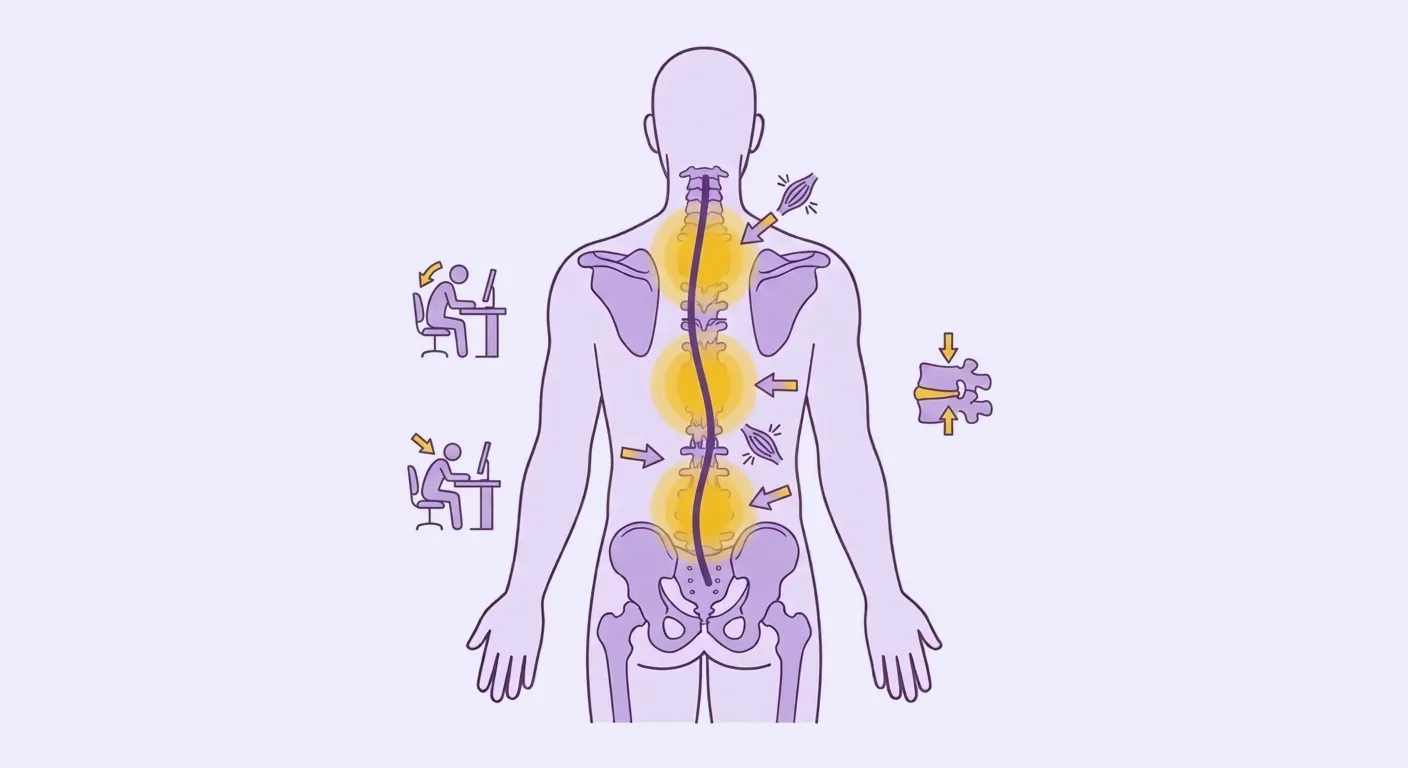
A back pain chart is a visual or textual tool that serves to classify the nature of your back pain by location, severity, and cause. That helps patients and doctors discern localized muscle strain from radiating nerve issues. By identifying where it hurts on a spinal map, you can more accurately communicate your symptoms to a health care provider. Therefore, this makes diagnosis to be much quicker and treatment plans more effective.
Why Location Matters?
- Human Spine: A complex of 33 vertebrae, discs, nerves and muscles So having a clear idea of the “address” of your pain is very important. The spine is categorized into three major sections:
- Cervical (Neck): Frequently related to posture, “tech neck,” or stress.
- Thoracic (Middle Back): Typically associated with rib, muscle, or internal organ pain.
- Lumbar (Lower Back): This area is the most common area of chronic pain and injury due to the weight-bearing nature of this part of the lower spine.
Detailed Anatomy: Mapping the Spine
Back Pain Chart Using the navigation. The spine is more than a bone; it is a mechanical collage of segments.
The Cervical Region (C1 to C7)
Your head’s weight is supported by the neck. If you have your own back pain chart which looks like this . Upper neck Pain (C1-C2) Tension headaches. Lower cervical pain (C5-C7) frequently radiates into the shoulders and down the arms.
The Thoracic Region (T1 to T12)
This region lies attached to your rib cage. It is stable, but can become stiff when you slouch for too long. Pain here is commonly referred to as a “knot” between the shoulder blades.
The Lumbar Region (L1 to L5)
This is the heavy lifter of the spine. The L4 and L5 vertebrae get highlighted on most charts of back pain because they are the ones that handle the most mechanical pressure. Most herniated discs happen in this area.
The Sacrum and Coccyx
At the base of the spine, the sacrum connects to the pelvis through SI joints. Pain in this area usually manifests as a deep ache in the glutes or tailbone.
Back Pain Chart: Common Reasons You Might Experience Back Pain
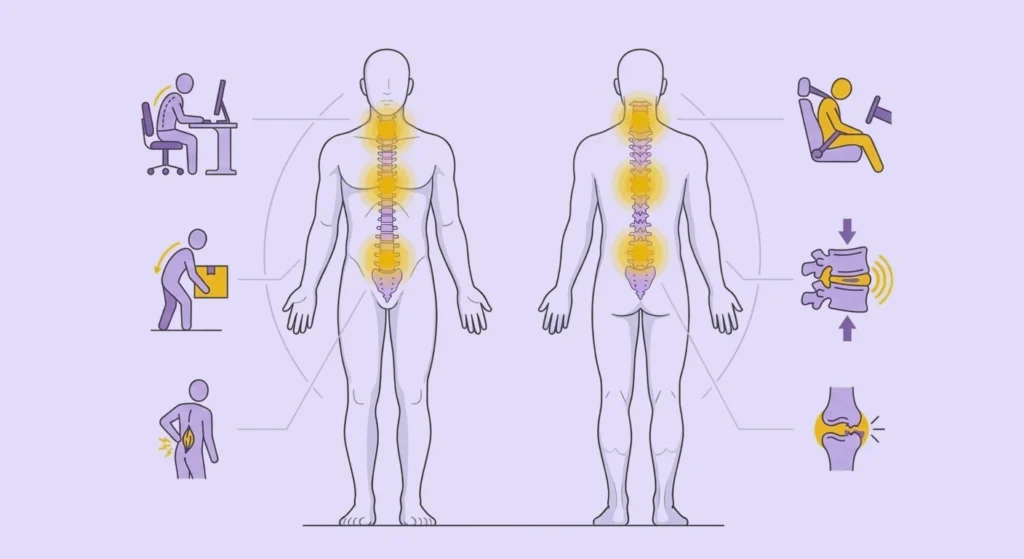
Spinal discomfort may come from myriad sources. But most cases fit a handful of particular categories. Recognizing these early can save long-term injury and chronic disability.
Muscle Strain and Ligament Sprain
Most of the acute episodes logged on a back pain chart occur when someone suddenly moves or lifts something heavy. When you overstretch a muscle, it causes micro-tears, which leads to inflammation and stiffness. Muscle strain is the top reason people visit physicians for back problems [1]
Disc Herniation and Degeneration
Soft, jelly-like discs cushion your vertebrae. If a disc ruptures or bulges, it can push on adjacent nerves. This often produces referred pain, which radiates down the legs or arms. As we get older, these discs lose fluid as part of a normal process called degenerative disc disease. Research from Johns Hopkins Medicine related to age-related spinal decay includes a key focus of this structural change [2]
Using a Back Pain Chart for Self-Assessment
Beyond looking at a picture, using a back pain chart entails more information. The sensation that you feel must be assessed to determine the underlying pathology.
Identifying Pain Patterns
Dull ache A common symptom of muscular fatigue, bad posture or myofascial trigger points.
- Sharp, Stabbing Pain: Often indicates a mechanical problem like a fractured vertebra or acute injury.
- Tingling or Numbness: These red flag symptoms are most usually related to nerve compression, as in sciatica.
- Burning Pain: Common in nerve irritation (e.g., sciatica) or certain inflammatory conditions.
Pain Intensity Scales
Most charts use a 1 to 10 scale.
- 1 to 3 (Mild): Annoying but manageable.
- 4 to 6 (Moderate): Impairment of daily activities.
- 7 to 10 (Severe): Immediate medical treatment or bed rest needed.
Cutting Through The Sciatica and Radiating Pain Science
When you look at a back pain chart, you might see lines drawn from the low back down to the feet. This shows the path of the sciatic nerve.
What is Sciatica?
Sciatica is not a disease, but rather a symptom of an underlying problem, such as herniated disc or bone spur. It feels like an electrical current running through the buttock and down the leg.
The “Saddle Anesthesia” Warning
If your back pain chart assessment includes numbness in the inner thighs or groin, however, this is a medical emergency called Cauda Equina Syndrome. Seek immediate care.
Ergonomics: Preventing Future Chart Entries
Your spine health is dictated by your environment. When you don’t pay attention to ergonomics, your lower and upper back will likely get repeated markers on the pain chart.
The Perfect Desk Setup
Monitor Height Top third of the screen at eye level.
- Chair Support: Sit in a chair with lumbar support that follows the natural curve of the spine.
- Elbow Angle: Avoid shoulder strain by keeping elbows at 90-degree angle.
Standing Desks
Changing posture every half an hour from sitting to standing can make a huge difference and relieve the pressure on your lower back discs.
Exercises and Stretching Routines
If your back pain map reads tension, movement is usually the best medicine. But movement needs to be controlled and deliberate.
Core Strengthening: The Foundation
The core is not just your six-pack; it’s a cylinder of muscles surrounding and protecting your spine. Other important exercises are the Plank and Dead Bug.
- Flexibility: The Cat-Cow and Cobra
- Cat-Cow: On all fours, alternately arch and round the back to mobilize the vertebrae.
- Cobra Stretch: While lying on your stomach, raise your chest to stretch the abdominal wall and decompress the lumbar spine.
Lifestyle and Systemic Factors
You recover quicker and in a shorter space of time if you have healthy lifestyle choices, he says, pointing to how fast you get through the flare-up phase of your back pain chart.
- The Role of Nutrition: Pain is driven in a big way by inflammation. An anti-inflammatory diet filled with leafy greens, fatty fish and turmeric may relax inflamed nerves and muscles.
- Hydration and Discs: Spinal discs consist of approximately 80% water. If you are chronically dehydrated, your discs shrink in height and shock-absorption abilities correspondingly fail, resulting in more pain.
- Sleep Hygiene: But the most back-friendly position is probably side sleeping with a pillow between your knees. This maintains the level of the hips and avoids rotation in the lower spine.
Professional Treatments and Interventions
If self-care isn’t helping to take a mark off your back pain chart, then you need professional assistance.
Physical Therapy (PT)
PTs utilize manual therapy and corrective exercise. They assist in “re-training” your muscles to properly support your skeleton.
Chiropractic Adjustments
In fact, the word chiropractic is derived from Greek words meaning done by hand: using one’s hands to adjust what they call subluxation or in layman’s terms misalignment of your vertebrae. By reestablishing movement, they can alleviate the neurological disruption that leads to pain.
Advanced Imaging
When the pain doesn’t go away, MRIs or CT scans allow doctors to glimpse what the back pain chart cannot: The internal state of soft tissues and nerves.
Psychological Effects of Chronic Back Pain
We often only think of pain as if it’s physical, when in fact it is emotional. The chronic entries on your back pain chart can develop into “kinesiophobia” (the fear of movement), which actually makes the pain worse through muscle atrophy.
Mind-Body Connection
Examples include Cognitive Behavioral Therapy (CBT) and Mindfulness-Based Stress Reduction (MBSR), both of which have successfully demonstrated reduced pain scores through alterations on the way the brain interprets signals from the spinal column.
Conclusion
And this back pain chart is a self-awareness creation tool. When you know the areas of your spine and what symptoms coincide with them, you can begin to make strides toward recovery. Please do practice good posture, exercise and pay attention to what your body tells you.
Although this guide gives a sweeping overview, every body is different. So, if your pain doesn’t go away or is accompanied by neurologic symptoms, get a professional medical assessment right away.
Frequently Asked Questions
Locating your back pain on the chart will help you discern whether the pain is localized to one area, or radiates outwards. That is important for telling whether that’s just a muscle strain or something involving your nerves, like sciatica.
Lumbar area (lower back) is the most common site of pain according to most clinical details. This is due to the fact that your lower back supports most of your body weight and does the most motion.
Yes, stress typically presents itself as physical tension. In addition, the high stress drives your body to guard, tightening its muscles without you even realizing it and causing chronic aches in the neck and shoulders.
In most cases, yes. Walking is a low-impact aerobic activity that keeps the blood flowing to the spinal structures. At the same time, it builds the core muscles that surround and support your vertebrae.
For an acute injury, apply ice within the first 48 hours to help reduce swelling. Upon reducing the initial inflammation, migrate toward heat to soothe the muscles and promote circulation.
Reference
- Mayo Clinic. (n.d.). Back pain Symptoms and causes.Used in the Common Causes section to explain muscle strain as a major cause of back pain.https://www.mayoclinic.org/diseases-conditions/back-pain/symptoms-causes
- Johns Hopkins Medicine. (n.d.). Herniated disc and degenerative disc disease.Used in the Disc Herniation section to explain age-related disc changes.https://www.hopkinsmedicine.org/health/conditions-and-diseases/herniated-disk
- National Institute of Neurological Disorders and Stroke (NINDS). (n.d.). Low Back Pain Fact Sheet.Used in the Lumbar Spine section for global disability statistics.https://www.ninds.nih.gov/health-information/disorders/low-back-pain
- Harvard Health Publishing. (2025–2026). Back pain articles.Used for acupuncture benefits and walking-related pain reduction.https://www.health.harvard.edu/pain
- StatPearls. (2025–2026). Low Back Pain Evaluation.Used to define red flag symptoms and diagnostic tests.https://www.ncbi.nlm.nih.gov/books/
- Frontiers in Medicine. (2024). Non-spinal causes of low back pain review.Used for kidney stone and aneurysm related back pain discussion.https://www.frontiersin.org/journals/medicine
- International Association for the Study of Pain (IASP). (2026). Global burden of low back pain.Used for global prevalence and disability statistics.https://www.iasp-pain.org