





Low back pain is not merely a physical problem, it is a worldwide crisis impacting productivity, mental well-being and quality of life. For the majority of people, the underlying cause isn’t one particular injury but rather a lifetime of stacked compression in the spine. Every hour we spend sitting, every heavy bag slung over one shoulder and the very force of gravity itself adds to that crushing of our spinal discs.
This examines the mechanics of the human spine, why decompression is a biological necessity and how to regain your mobility through a multi-faceted approach combining exercises, orthopedic technology and lifestyle modifications.
The Biomechanics of Compression
In order to address a challenge, we must first diagnose the minutiae of how it operates. The human spine is a marvel of biological engineering built to keep the spinal cord safe, while offering structural support. But it has an Achilles heel: the intervertebral discs.
Anatomy of the Lumbar Spine
The lumbar region (lower back) is formed by five massive vertebrae (L1 to L5). In between these bones are the discs circular pads of cartilage that serve as shock absorbers.
- The Nucleus Pulposus: The jelly-like central core of the disc.
- The Annulus Fibrosus: The tough, tire-like outer ring.
What Happens During Compression?
Standing or sitting results in a vertical load being applied through gravity and muscle tension. This pressure pushes water and nutrients out of the discs. This causes Disc Height Loss over many years of postural issues or strain. If a disc loses height, the opening for nerves to leave the spine narrows. This is where the pain starts. [1]
The “Sitting Disease”
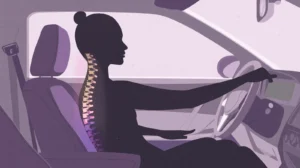
Modern research suggests sitting exerts even more force on the lumbar discs than standing. When you sit and slouch, the natural inward curve (lordosis) of your spine flattens out, pushing the disc material backward toward the spinal canal. That’s why many of us feel stiff or locked up after a long drive or sitting at a desk all day. [ 2]
What Is Spinal Decompression?
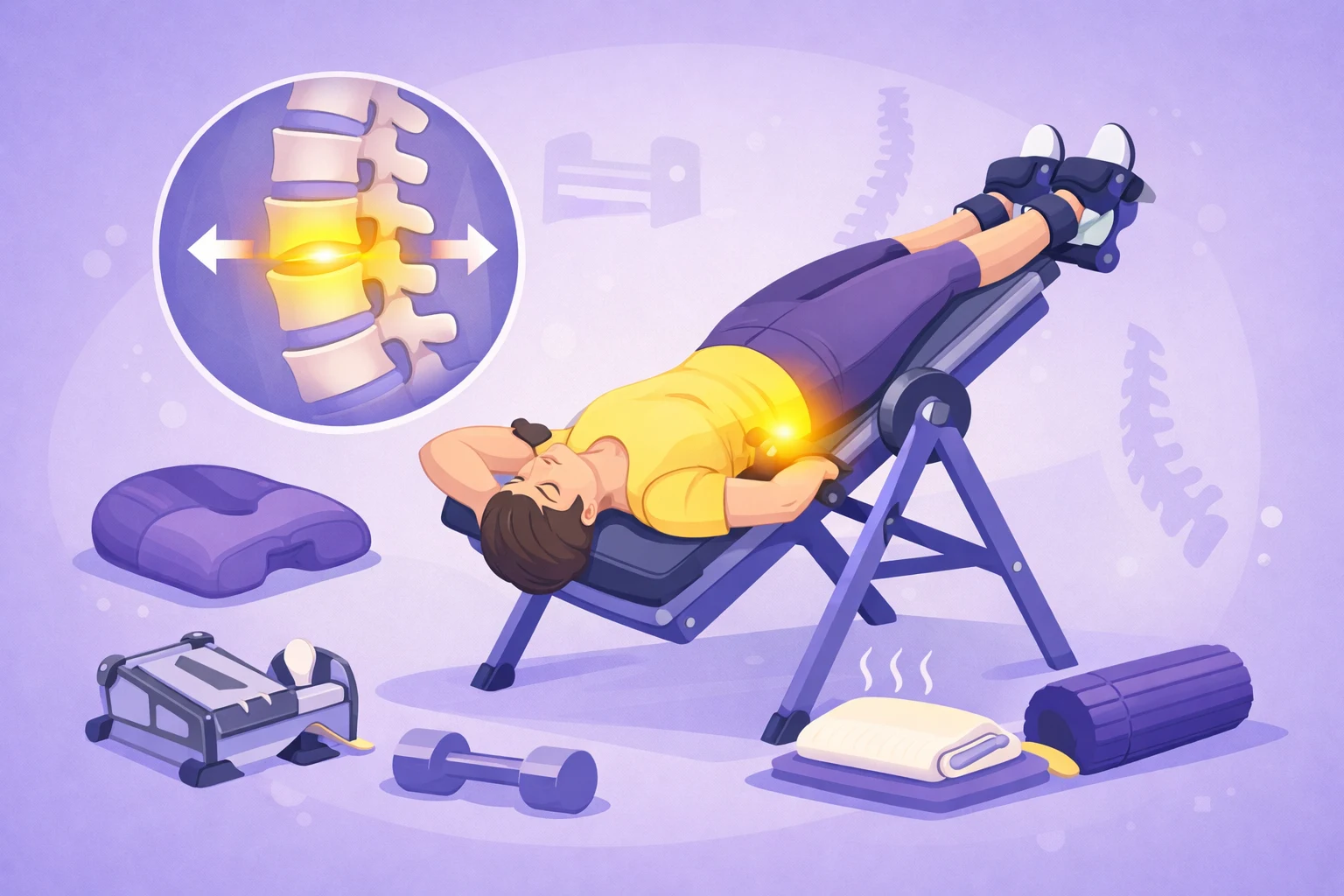
Spinal decompression is a therapeutic process of stretching the spine which alternates its force and position. This is not merely stretching muscles, this is a mechanical intervention for the joints themselves.
The Vacuum Effect (Negative Pressure)
Decompression, as the name indicates, is mainly to generate negative intra-discal pressure. It’s like a sponge that’s been wrung out; when you release the pressure, the sponge expands and absorbs water. Decompression does the same for your discs, pulling back bulging tissue and welcoming nutrient-rich fluids into the disc space. [Ref 4]
Decompression vs. Traction
Though the terms are sometimes used interchangeably, traction typically suggests some sort of ongoing pull, while “decompression” refers to cycles of tension and relaxation that effectively “pump” the spine. Both are effective, but home exercises primarily employ Static Traction through the use of bodyweight.
The At-Home Decompression Routine of Your Dreams
The following exercises are meant to be done daily. They don’t need fancy equipment, just gravity and a few things you might find in your home.
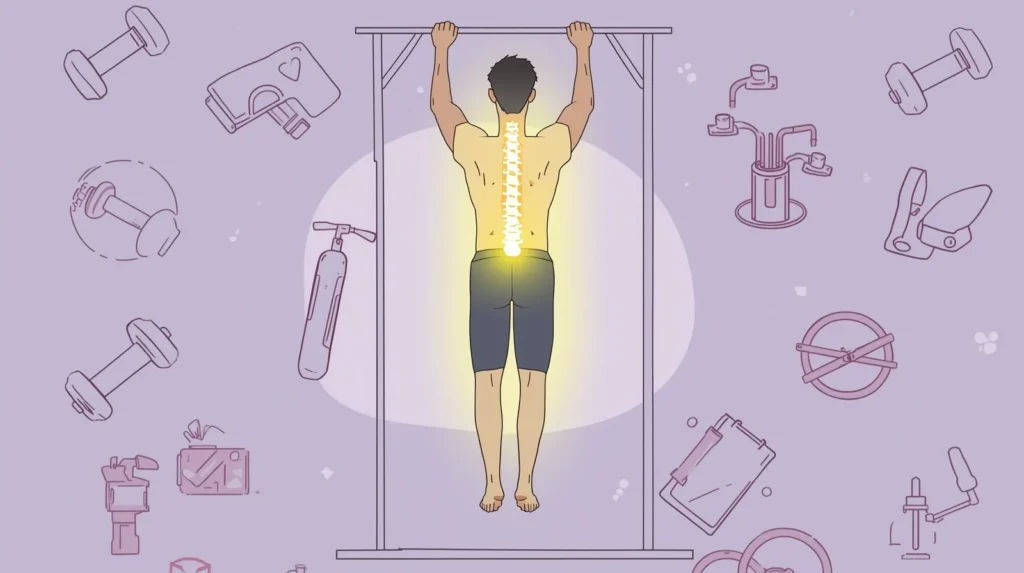
Gravity-Assisted Hanging (The Full Release)
This is also the simplest manner of decompression.
- Technique: Use a strong pull-up bar. Grab the bar and hang your body. If you’re not strong enough to hang freely, keep your toes on the floor and gently bend into your knees until you feel a bit of elongation in your lower back.
- Duration: 30 seconds, 3 times.
- The Decompression Factor: This counters the constant 1G pull of gravity (which all day long compresses your spine). [ 8]
The Kitchen Counter Traction
- Method: Stand facing a kitchen counter. Spread your palms on the surface. Walk your feet back and lean your hips away from the counter, letting your head drop between your arms.
- The Decompression Factor: Great for L4-L5 and L5-S1 relief, where the majority of herniates or bulges occur.
The Modified Child’s Pose
- Technique: Kneel on the floor. Extend your arms as far forward as you comfortably can, maintaining the pressure that your glutes maintain with your heels. For the sides (Quadratus Lumborum), walk your hands to the left, hold there for a few breaths, then walk them to the right.
- The Decompression Factor: This creates space in the facet joints at the back of the vertebrae, which are often jammed together in individuals with too much lower back arch. [6]
90/90 Static Back Reset
- Technique: Lie on the floor. Rest your legs on a chair or couch so that your hips and knees are bent at 90-degree angles. Play it relaxed, arms at your sides, palms up.
- Duration: 5 to 10 minutes.
- The Decompression Factor: This doesn’t so much “stretch” the back as it unloads it. This lets the psoas muscles release, enabling the lumbar spine to fall easily into its optimal position without musculoskeletal guarding. [ 9]
Cat-Cow Segmental Mobilization
- Technique: On all fours, gently oscillate between arched back (looking up) and rounded back (looking down).
- The Decompression Factor: This allows the synovial fluid to flow through the spinal joints, it is like “oil” for a rusty hinge. [7]
Orthopedic Support and The 24-Hour Spine Care Model
5 minutes of stretching cannot counter 8 hours of slouched posture. Real decompression requires a shift in how you support your body for the rest of the day.
The Science of Lumbar Support
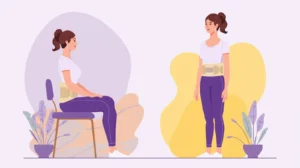
Here is what happens when you sit your sacrum moves posteriorly adapting a “C” shape for the lumbar spine. This causes a huge pinch on the front side of the discs.
An orthopedic solution such as the PosturePro Backrest plays the role of a physical fulcrum. It encourages the lumbar spine to shift forward, into a more natural curvature, redistributing weight through your vertebrae instead of your discs. [10]
The Foot: Base of the Structure
Your spine isn’t in isolation, it’s resting on your pelvis that is sitting up over your legs that are sitting on your feet. If your feet over-pronate (flat feet) your knees sit inwards, your pelvis “tips” forwards and hence your lower back slouches.
This kinetic chain is corrected by Arch Support Insoles. Arch support takes the role of a secondary decompression tool by preventing the tilt of the pelvis that leads to jamming into the spine. [11]
Topical Recovery and Inflammation
Decompression is a mechanical solution, but back pain often has a chemical aspect inflammation.
When this happens to a nerve swells from the pressure of the pinching but there’s hardly room left to give, it gets surrounded by even less space. The premium pain relief and recovery spray from betterhood is the perfect topical to use on sore muscles post decompression session as it locks in the benefits, reducing chemical irritation around nerve root.
Finding Your Pain Scenarios
Not all back pain is created equal. Knowing why you’re in pain informs how you should unwind.
Scenario A: The Morning Stiffener
If you’re fine during the day but can’t stoop in the morning, your discs are probably hyper-hydrated. Discs absorb water overnight, and when the outer ring is weaker, this added pressure causes pain.
Solution: For 30 minutes after you wake up, stay upright. So use gentle walking and the 90/90 position.
Scenario B: The Sciatica Sufferer
If the pain radiates down your leg, a disc is probably pushing on a nerve.
Solution: Traction is your friend. The Countertop Stretch or Hanging can offer instant, though sometimes brief relief by distracting the disc from pressing against the nerve. [Ref 3]
Scenario C: The Office Acher
If by 3 PM your back feels heavy and tired.
Fix: This is postural fatigue. Use a Lumbar Cushion and do 30 seconds of Cat-Cow every hour set a timer
Sustainable Lifestyle Practices for Spinal Wellness
The Hydration Connection
Approximately 80% of spinal discs are water. As we get older, our discs are desiccated (dry out). Discs dry out, as water content decreases, and they become thinner and more susceptible to herniation; this happens faster with dehydration. Let me tell you something If you drink 3 to 4 liters of water a day, then that is YOUR cushion for the back. [ 12]
Sleeping for Success
Sleeping on your stomach is the worst position for a compressed back because it puts the spine in an exaggerated curve.
- Side Sleepers: A pillow between your knees helps maintain a neutral pelvis.
- Back Sleepers: Put a pillow under your knees to press the lower back into the mattress.
Core Stability: Your “Internal Brace”
Though a brace or cushion helps, your end objective is to develop your “inner corset.” Transverse Abdominis (the deep core)
Check out The Bird-Dog Exercise Extending the opposite limb while quadruped. This creates stability without rounding the spine.
When You Need Medical Attention (Red Flags)
Though home decompression is safe for most, a few symptoms suggest you should go to the emergency room:
Cauda Equina Syndrome: Loss of bowel or bladder control. Seek ER immediately.
Saddle Anesthesia: Loss of sensation in the regions that would come in contact with a saddle.
Progressive Weakness: If you lose the ability to do “toe-walk” or “heel-walk,” a nerve is markedly affected.
Pain After Trauma: If your pain began after a fall or car crash, you need an X-ray or MRI to see if something is fractured. [ 5]
Conclusion
Our bodies were not built to sit, they were made to move. Lower back decompression isn’t a mere “hack” for pain, it’s a restorative practice that respects the biology of your spine. Incorporating active decompression movements with orthopedic supports such as those available from Betterhood and intentional lifestyle habits, it is possible to reverse years of compression.
Reminder: Your spine is the pillar of your health. Take care of it today, and it will take you a lifetime.
Frequently Asked Questions
Lower back decompression is a method of relieving the pressure on the spinal discs and nerves in the lumbar region (lower back) to help create space between vertebrae.
Yes, relieving pressure on spinal discs and surrounding nerves can aid in alleviating stiffness, tension, and mild low back pain.
Simple decompression stretches can be performed daily and especially after long periods of sitting and/or activity.It’s not a decompression and I don’t encourage you to hang from your spine.Hanging from a pull-up bar can use gravity to gently elongate the spine, giving temporary relief from compression in the low back.
Yes, maintaining slouching or improper sitting posture for long stretches of time places more pressure on lumbar discs that may lead to spinal compression over the years.
While seated, lumbar support cushions help to maintain the natural curve of the spine, this reduces pressure on spinal discs.
Yes, the spinal discs are mostly water; proper hydration helps them retain their height, flexibility and shock-absorbing ability.
Most mild stretches are safe, but those with severe back pain or fractures and people with nerve symptoms should speak with a health professional first.
They are best treated with rest, over-the-counter pain medications and physical therapy, which can strengthen back muscles. Seek medical care if the pain is severe or persistent, follows an injury or accompanies numbness, weakness or loss of bladder control.
Reference
- American Council on Exercise (ACE). (n.d.). Lower Back Flexibility and the Child’s Pose Stretch. https://www.acefitness.org
- Arthritis Foundation. (n.d.). Feet and Back Alignment. https://www.arthritis.org
- Cleveland Clinic. (n.d.). Understanding Sciatica Nerve Compression. https://my.clevelandclinic.org
- Cornell University Ergonomics Program. (n.d.). Sitting and Spinal Load. https://ergo.human.cornell.edu
- Harvard Health Publishing. (n.d.). When to Worry About Back Pain. https://www.health.harvard.edu
- Healthline. (n.d.). Cat-Cow Stretch for Spinal Health. https://www.healthline.com
- Journal of Physical Therapy Science. (n.d.). Non-Surgical Decompression and Spinal Disc Pressure. https://www.jstage.jst.go.jp
- Mayo Clinic. (n.d.). Back Pain and Posture. https://www.mayoclinic.org
- Medical News Today. (n.d.). Disc Desiccation and Hydration. https://www.medicalnewstoday.com
- National Institutes of Health (NIH). (n.d.). The Psoas–Lumbar Connection. https://www.nih.gov
- Physiopedia. (n.d.). Ergonomics of Lumbar Support. https://www.physio-pedia.com
- Spine‑Health. (n.d.). Traction for Back Pain Relief. https://www.spine-health.com