





Pretty much your feet are the most emotionally repressed part of your body. They come every day, do all the heavy lifting, put up with bad shoes, hard floors, missed breaks, and even your questionable life choices and still, they don’t immediately give out. They wait. Patiently. Like, “It’s okay, I’ll take care of it.”
Until one day they don’t.
That’s when it starts. A heel that is painful without a clear reason. An arch that feels sore although you haven’t done anything really for the area. A strange pain that goes away when you sit down so you fool yourself into thinking it is “not serious.” And suddenly your knees hurt, your lower back feels stiff, and walking to the kitchen seems like an unnecessary athletic event. All of this just because your feet have decided they are not going to take it anymore.
Foot pain is that kind of sneaky. It doesn’t come with sirens and warnings. It gradually gets into your daily life, changes your posture, lowers your energy level, and slowly it affects the parts of your body that haven’t been invited to the problem. And the worst thing is that most of us don’t take notice of it until it becomes loud.
This guide is here so that your feet don’t have to scream.
Top Benefits of Arch Support Insoles for Flat Feet
Flat feet don’t come with an announcement or a dramatic show of power. They don’t send out a caution signal. It’s just that…they start behaving.
One day you are okay, the following day your heels hurt as if they have been singled out. You get out of bed, put your feet on the ground, and immediately curse all your life decisions that have brought you here.
Is it age? Is it a bad choice of shoes? Is the floor cursed? It’s difficult to say. But in case your arches have done a vanishing trick, your feet are simply taking advantage of you instead of doing their work.
Flat feet are quite a common thing, and they are not afraid of getting older. Your foot becomes flatter as it seems to have given up on the structure altogether, the tendons, and ligaments that support your arch weaken. The result? Overpronation, bad posture, tired legs, irritated knees, and a lower back that now wants to be part of the drama. Your body is like one big WhatsApp group where one member acts up and the rest start complaining.
Basically, this is the role that arch support insoles perform – not as a fashion accessory, but as a responsible adult in the room. They raise and help the natural curve of your foot, change the pressure areas, and prevent your feet from going inward as if they have lost all their motivation. By correcting alignment, they take the strain not only from the feet but, legs, and spine as well.
Think of them as your gentle, yet firm, boundary-setters of your arches.
Insoles with arch support are to aging adults, a necessity rather than a luxury. They enhance the ability to balance, lessen weariness, and make routine activities walking, standing, even living immensely less irritating. Gradually, they also become a shield against plantar fasciitis, bunions, joint degeneration, and falling, among other things.
On the other hand, arch support insoles are far from being the ultimate solution of turning you into an athlete capable of running a marathon. They are simply there to remind your feet of the task that they are supposed to accomplish.
And if you ask me, that’s a win.
To dive deeper into how arch support insoles work, the different types available, and how to choose the right one for your feet, read our complete guide on the benefits of arch support insoles for flat feet.
How Gel Insoles Help Relieve Pressure on Feet and Joints
There is a very particular tiredness that comes from your feet. It is not the “I am sleepy” kind of tiredness but rather the “I have stood, walked, climbed, paced, and now my body is officially complaining” kind of one. After arriving at home, one removes his/her shoes and the relief lasts only for three seconds before feet start to throb as if they have been holding a grudge all the day. Knees hurt. Ankles are stiff. Even the hips seem weirdly affected. And somehow, we all just accept this as a normal thing of adult life.
However, the thing is – it should be this painful just to live.
Most of the agony that takes place at the end of the day results from the repeated impact and uneven pressure. For every step that someone takes on the hard floor, a small shockwave is sent from the heel up the legs. This is something that over time, it accumulates. Gel insoles act as silent shock absorbers in the shoes. They absorb the impact, allow the body to be more evenly distributed in the space, and prevent all the pressure from being dumped onto just a few spots (most often the heels and the balls of the feet).
In contrast to the stiff type of inserting that is a kind of punishment, gel insoles can slightly be compressed and they can fit the foot shape without any collapse. They reduce the impact on the heels, lower the load on the joints, and help keep feet in a better position – which does not require the knees, hips, and lower back to continue compensating for these joints. So, what is the outcome? Less soreness, less fatigue, and lesser number of “why does my body hate me” moments at the end of the day.
If you are a person who stands a lot, walks on hard surfaces, works long shifts, exercises regularly, or just feels that your joints age faster than the rest of you, then they will be very helpful. Gel insoles will not make your workday a spa experience but they will definitely make it less hostile for your feet and joints.
To understand how gel insoles work, who benefits from them the most, and how to choose the right pair for pressure relief, read our complete guide on how gel insoles help relieve pressure on feet and joints.
5 Best Arch Support Insoles for Standing All Day
Standing all day seems like it should be fine, doesn’t it? You’re not doing anything extreme like running a marathon or lifting weights. You’re just… standing. But, when the day comes to an end, your feet feel like they have been attacked, your legs are tingling, and your lower back is aching. If standing was really “doing nothing,” it wouldn’t hurt that much.
The issue is not with standing per se but with standing without support. When you are standing for several hours, your arches are doing the work silently. And without the proper support, they become more and more flattened with every step, thus your muscles and joints have to do more than their share just to keep you stable. This is how tiredness of the feet leads to pain of the heel, straining of the knees, plantar fasciitis, and that stiff feeling at the end of the day which makes sitting down feel like a big event.
Arch support aids cease being a matter of choice at this point and become a necessity. Properly fitted insoles not only comfort the feet but also provide support to the arch, take the pressure off the areas that have been excessively used like the heel and forefoot, and enable the entire posture to change to the most natural position. When your feet are properly aligned, your knees don’t have to do the extra work, your hips calm down, and your lower back finally gets a rest. It is less of a “comfort product” and more of a “structural intervention”.
Good arch support may be what keeps the pain at bay and the tiredness manageable in people who are always on their feet nurses, teachers, retail staff, construction workers, and anyone whose job is mostly done while standing. Quality insoles offer the arch the support and firmness it needs, provide comfort where the impact is the greatest, and prevent the feet from turning inwards by providing stability as the day progresses. In essence, standing all day is hard enough, as it is. Not having arch supports while doing it is just causing yourself more unnecessary pain.
To explore which arch support insoles actually work for long standing hours, how they differ, and which options suit different foot types, read our complete guide on the 5 best arch support insoles for standing all day.
Foot Acupressure Points: Ancient Wisdom, Modern Science, and Very Tired Feet
Foot acupressure manages to be both a very spiritual-sounding thing and at the same time a little distrustful. It has a rich history going back thousands of years with the energy channels and the pressure points being very precisely mapped. However, it is most of the time your real life that foot acupressure is telling you to just hit your foot hard and hope it changes after a long tiring day. So, in fact, neither of the two things is wrong.
The idea that the feet serve as a control panel for the body is basically what foot acupressure is all about. Chinese medicine and reflexology being traditional systems map the different parts of the foot to the organs, muscles, and the body systems – this can be digestion, sleep, stress, or pain. For example, Kidney 1 (Yongquan) point on the sole is usually associated with calming the nervous system and helping sleep, while the areas in the arch, heel, and ball of the foot are most frequently used for fatigue, back discomfort, and relaxation.
Contemporary research, while not completely endorsing the existence of energy Qi or meridians in the traditional sense, still, it gives a more scientific explanation of the phenomena of the positive feelings caused by foot acupressure. The feet have a large number of nerve endings and connective tissue. Pressure that is firm but still under control and done correctly will stimulate these nerves, will enhance blood flow, will lower muscle tension, and parasympathetic nervous system activation is possible in this way the part responsible for relaxation. There are clinical trials that have provided evidence that done regularly, structured foot acupressure or reflexology routines can be an aid in pain and anxiety reduction, alleviating stress, and enhancing sleep quality for some populations.
However, foot acupressure should not be regarded as a miracle. For example, it cannot fix your structural problems like flat feet that are very severe; it cannot rebuild arches that have collapsed; and it cannot serve as a substitute for medical treatment if you have chronic conditions. Where it truly shines is the support role of a patient, a low-risk, self-care practice. Persons who experience foot pain due to long hours of standing or walking, sleep problems, tiredness in general, stress caused by work, etc. can acquire to be not less than great, daily routine additions if they use foot acupressure, furthermore, the benefits of foot acupressure will increase also if good shoe-wearing, arch support, insoles, stretching, and resting accompany it.
In other words: when used, foot acupressure can bring the most benefits only when people have realistic expectations. It is not a matter of finding a single miraculous point on which to press and thereby solving all your problems ever. It is a way of enabling your body to calm down, let the blood flow quicker, and thus have a little more of restorative power recovered – one foot after another.
To explore detailed foot acupressure charts, specific pressure points, proper techniques, safety guidelines, and evidence-backed benefits, read our complete guideson foot acupressure points and science-backed foot acupressure benefits.
The Real Cost of Ignoring Foot Pain at Work (It’s More Than Just Sore Feet)
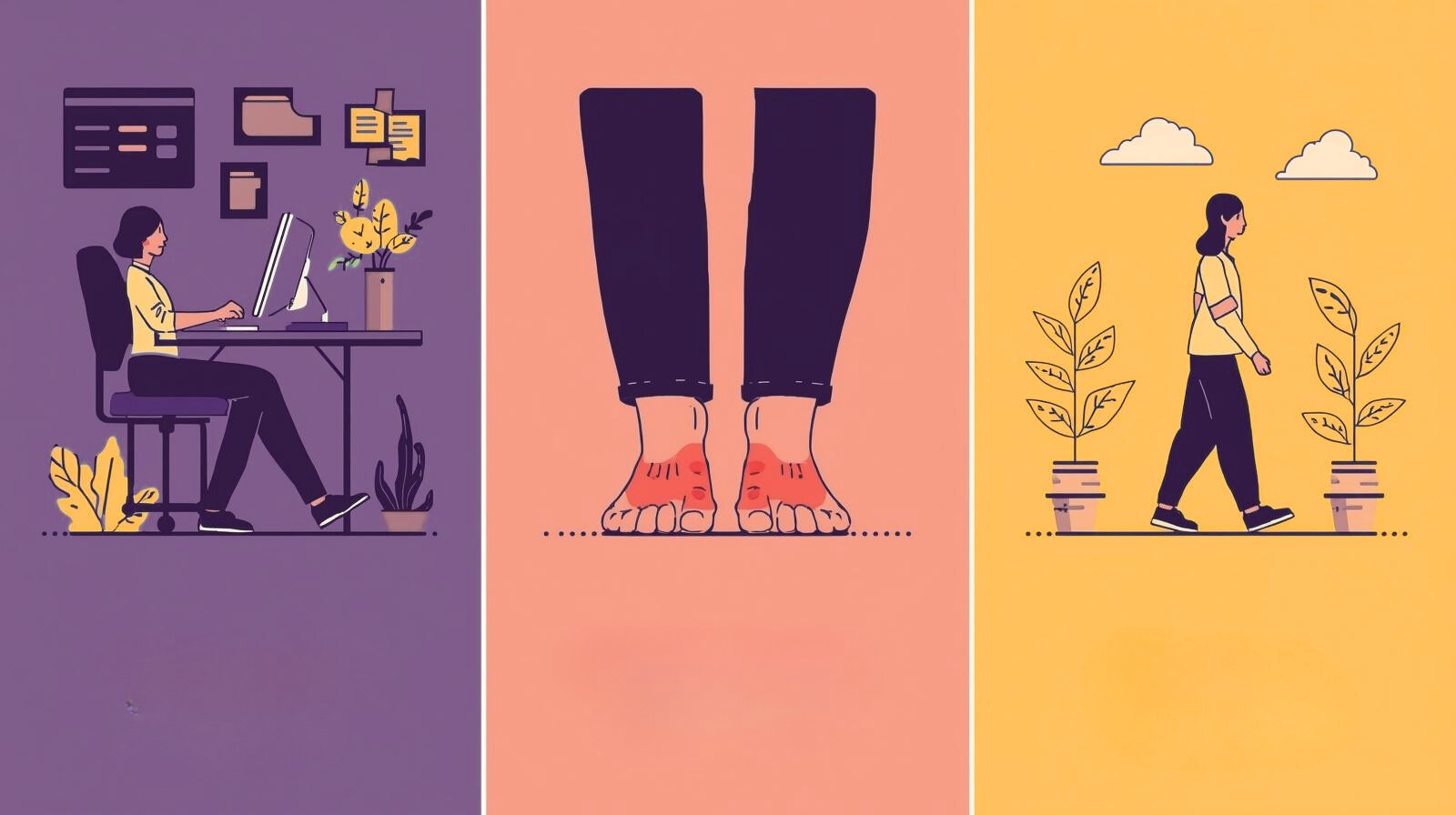
Foot pain is terribly annoying in that it is somewhat polite. It doesn’t scream. It doesn’t knock you down heavily in the middle of the office. But what it does is to nag. A dull ache after the shift. A slight limp in the morning. A “this feels weird” sensation that goes away once you sit down so you don’t pay attention to it. That was a big mistake.
Thus, if foot pain appears at your workplace and you continuously dismiss it, it will not remain in your feet. It will, in fact, go to other parts of your body. Slowly. Quietly. And with great cost.
Your feet are literally the base of your whole body. When they are painful you change, though subconsciously, how you stand, walk and distribute your weight just to make it through the day. You put a bit more weight on one leg. You take shorter steps. You slouch without realizing it. After a while, these small changes affect your knees, hips, spine, and posture. That is the way “just foot pain” becomes chronic back pain, stiff joints, limited mobility, and joints that feel older than they should be even though you are only in your 30s.
The story doesn’t end here. There is also the mental aspect. Continuous discomfort leads to increased stress hormone production, causes sleep problems, and drains concentration. You experience more tiredness, less productivity, and are rather irritable not because work has become more difficult, but because your body is always trying to make up for the imbalance. Pain, even if it is low, is very tiring.
At the same time, foot pain which is not taken care of, abruptly encourages you to live a more sedentary lifestyle. When movement hurts, you move less. Lesser movement leads to weaker muscles, poor balance, decreased cardiovascular health, and an increased risk of falling at an older age. This is the way the reduction of mobility starts years earlier than it should.
On the bright side, this downward spiral is very preventable. The right footwear, proper insoles or orthotics, ergonomic adjustments at work, foot-strengthening exercises, physiotherapy, and even very simple things like taking a short break to move and putting your feet up can slow down or even reverse the damage substantially. It is not dramatic to get foot pain under control early on. It’s clever.
Also, your feet are not being dramatic. They are simply giving you a heads up before the problem gets bigger.
To understand how untreated foot pain at work affects aging, posture, mental clarity, and long-term mobility, and what you can do to prevent it, read our complete guide on the real cost of ignoring foot pain at work.
How Your Shoes Secretly Control Your Posture (And Probably Your Back Pain Too)
On a personal level, we really like to think that shoes are just accessories, the thing that we match with an outfit, or the thing that looks cute in a mirror. But from a biomechanical point of view? Your shoes are the ones which have the most influence. The adapted information of every step goes straight from your feet to your knees, hips, spine, shoulders in fact, to your whole posture report card. So, if your shoe base is working badly, the rest of your body will all day long be in the mode of compensating for its shortcomings.
The triad of feet constitutes the body posture. The very feet themselves are constructed with arches which can absorb shock, can distribute weight, and can keep the person balanced. When chips are playing the role of turning the heel too high, flattening the arch, squeezing the toes, or producing too much (or too little) cushioning, the problem of alignment is what comes first. It starts slowly. Eventually quite painfully.
High heels are probably most often referred to as the biggest offenders. Moving your weight forward, tilting your pelvis, exaggerating spinal curves, and overloading your knees these are the things that high heels cause. Some flats are not much better than that without any support, they allow the arch to collapse, thus the rolling of the ankles inwards and the rotating of knees in an unnatural way takes place. Even when well cushioned, shoes can still pose foot problems if they are badly designed as they can weaken the foot muscles and change the foot strike pattern. Wearing tight shoes restricts the movement of toes which in turn affects the balance. Heavy work boots change the way one walks. Involving the back, hips, and neck in a problem that originated from the level of shoes is what happens next.
The very thing that makes this difficult to be understood is that the pain hardly, if ever, comes right away. Misalignment is slowly accumulating. A little knee strain here. A stiff lower back there. A posture change that you don’t realize until it is your habit. In time, the use of wrong footwear may lead to joint problems becoming chronic, spinal discomfort, and lowered mobility the reason is not that your body is weak, but that it is always in a state of compensation.
The solution is far from being dramatic. It’s actually quite a sensible one. Properly supported shoes with enough room for the toes, stable soles, and the right type of cushioning for the activity performed are the things that help in keeping the neutral alignment. If necessary, footbeds or orthotics can be used to correct the gait. Working out also includes foot muscle strengthening, calf and fascia stretching, and all of these things together lead to a better posture from the ground up.
Shoes are not a magic that will fix your posture.
The wrong ones can absolutely ruin it.
To understand how different types of footwear affect body alignment, posture, joint health, and long-term mobility and how to choose shoes that actually support your body read our complete guide on how footwear choices influence your overall body alignment.
Why Foot Arch Collapse Can Lead to More Than Just Foot Pain
Foot arches are that friend who does all the work quietly and doesn’t complain until the day they stop coming, and suddenly everything falls apart. When your arch gives way, it is not simply a foot issue. Instead, it is a domino effect involving the whole body.
Your body arches are meant to be like shock absorbers. They take the load of your body, control the movement, and absorb the impact every time your foot touches the ground. When they give way (hello, flat feet), the foot is excessively rolled inwards, a move referred to as overpronation. This small change may not be very noticeable at first, but your body immediately starts to make adjustments. Ankles lose stability. Knees turn inwards. Hips move. Pelvis tilts. And, in no time, your lower back is pulled into the problem which it had not anticipated.
For this reason, the pain caused by arch collapse is rarely the only one experienced. People suffering from fallen arches can also have knee pain, hip stiffness, chronic lower back discomfort, balance issues, and quicker joint fatigue. The altered biomechanics over time increases the wear and tear of cartilage and tendons, thus speeding up the process of joint aging and making the person more vulnerable to such conditions as plantar fasciitis, posterior tibial tendon dysfunction, osteoarthritis, and even sciatica.
One of the things that makes the arch collapse very sneaky is the gradual manner in which it unfolds. It may have developed as a result of a long-standing situation, only be able to wear bad shoes, changes in weight, injuries, diabetes or just aging. You make the necessary adjustments without realizing it taking shorter steps, uneven weight distribution, subtle posture changes until the pain becomes constant rather than occasional.
Well, there is a bright side to this situation early implementation of measures to counteract the effects of the arch collapse brings about a huge change. The use of appropriate shoes, arch support insoles or custom orthotics, the foot and hip strengthening exercises, and the gait correction can, to a great extent, relieve the symptoms and slow the condition progression. Physiotherapy or medical treatment may be necessary in extreme cases, but the majority of people get better with steady, non-invasive care.
The main point is: collapsed arches are not just about tired feet. They are about the need to protect your knees, hips, spine, posture, and long-term mobility starting from the ground up.
To understand the biomechanics behind arch collapse, its full-body effects, and how to prevent long-term damage, read our complete guide on why foot arch collapse can lead to more than just foot pain.
How to Choose Insoles for Your Foot Shape (Because Shoe Size Is a Lie)
If shoe size alone was sufficient, then none of us would be walking back with a limp after each day wondering why our shoes which we thought to be “perfectly fine” are now the ones that betray us. You do a fitting of the shoes at the store they look comfortable, supportive, and promising. After only three hours, it is your arches that hurt, it is your heels that ache and you are taking them off as if they have done you a personal disservice.
Usually, the problem is not the shoe. The part that is most likely failing is the insole which is there quietly and still doing its job.
The size of a shoe just gives you the length of a foot. It does not say a single thing about how a foot behaves. Flat feet, high arches, wide feet, narrow feet, pronation, supination none of these concepts is shown on a size label. And those happen to be the exact things that decide whether an insole will support you or slowly mess with your posture.
Low-arched feet are usually the ones that roll inward and thus need a firmer, stabilising type of support. High-arched feet don’t take shocks well and therefore would require additional cushioning. Normal arches are somewhere in between and would be the most suitable of them all having balanced support. When foot width and gait pattern are also taken into consideration, it becomes quite clear why a random, one-size-fits-all insole hardly ever works.
The deciding factor for the proper insole to choose is the match between the support and the shape of your foot rather than the use of forcing the foot to adapt. The right insole makes the pressure be distributed evenly, it lessens tiredness, it supports the right alignment, and it keeps you from that knee–hip–back pain pipeline which is not easily noticeable. The wrong insole does all these things at the opposite side to be exact, quite silently, gradually and until discomfort has become your new normal.
And it is not yet a lot of what you are able to learn by means of a quick wet-foot test, by looking at the wear patterns on your old shoes, and by paying attention to the places where the pain comes. After that, deciding upon insoles depending on the type of your arch, need for cushioning, and activity level changes the whole world of difference. It is not something fancy. It is just being more intelligent.
To learn how to identify your foot shape, understand different insole types, and choose support that actually works for your body, read our complete guide on how to choose insoles for your foot shape, not just shoe size.
Top Causes of Foot Pain (And Why Insoles Are Low-Key Life Support for Your Feet)
Foot pain almost never comes very quickly and very loudly. It doesn’t break down the door. Rather, it comes slowly. One heel hurts in the morning. After work there is a dull pain. A feeling as if your feet carry your emotional baggage while they never agreed to it. And because they are “just feet”, most people pretend that nothing is going on until walking becomes something they have to do instead of a usual human activity.
Here is the inconvenient truth: foot pain is generally not random, and nearly half of the time it is not just a problem of the feet.
Our feet become less and less like the feet of a child as we grow old. The arches lose their strength, the fat that is under the heel and serves as the pillow thins, the joints get worn, and the years of standing, walking, wearing bad shoes, and showing no gratitude finally come back to haunt us. Besides that, if one works long hours wearing improper footwear, has flat feet or suffers from arthritis or a condition like plantar fasciitis, then the feet are put under great pressure to which they give no response.
Among the issues cited are plantar fasciitis (that terrible morning heel pain), flat feet which cause the feet to roll inward and thus decouple the alignment, arthritis which makes joints stiff, and pressure-related issues such as bunions, corns, and calluses. Some people also have circulation or nerve problems which make the situation more difficult. The outcome is the same: pain that refuses to be confined to one area. It moves to your ankles, knees, hips, lower back, and posture.
This is the point where insoles cease to be “extra” and become necessary. High-quality insoles not only alleviate pain by providing comfort,but they also resolve the issue that first caused the pain. Supporting the arch gives flat feet stability and prevents overpronation. Cushioning takes the shock in the case of the removal of the natural padding. Heel cups are for aiding sore heels. Proper alignment reduces the stress on the joints that are higher up the body. In a way, insoles are like unassuming bodyguards acting quietly in the background, performing damage control, which is a great part of the whole day, without asking for credit.
The major problem is that one should choose insoles according to his/her feet age, activity level, and condition not by shoe size. Some people find over-the-counter insoles to be sufficient. However, for some, especially for those who are suffering from chronic pain or have medical conditions, custom orthotics may be the solution that gives a noticeable effect.
Foot pain is not a weakness, but your first warning signal. Insoles are among the easiest ways to heed the warning before it turns into a long-term damage.
To understand the most common causes of foot pain and how the right insoles can reduce discomfort, improve alignment, and protect long-term mobility, read our complete guide on top causes of foot pain and how insoles help.
Conclusion: Don’t Wait for Your Feet to Start Screaming
Most of the time foot pain is more than just discomfort. It is your body’s warning system that is not very loud, a signal that your alignment, support, or daily habits are not working well and you need to give them some attention. If you keep it out of your mind for a while, that little pain has a tendency to become chronic pain, posture problems, limited mobility, and joints that get old faster than the rest of your body.
What most foot pain is manageable, and in many cases, can be prevented, is the good news. Knowing the cause of the problem whether it is arch collapse, bad shoes, standing for a long time, or natural aging, will make you be the one who has the control. Insoles are a very powerful tool here, although people are often unaware of it. The right pair not only makes the steps comfortable; it supports the body, corrects the alignment, and lessens the stress that is spread to the whole body.
Foot care can be very simple and without any nice. It is about making the right choices consistently and practically: wearing shoes that provide support, using insoles that fit well, taking action at an early stage, and listening when your body talks. Since taking care of your feet today is not only about feeling good now, it is about being able to move freely, be self-reliant, and not feeling pain in the future.
Your feet are the ones that have done so much already. Supporting them is the least you can do back.
Frequently Asked Questions
1. Why does foot pain seem to get worse as I get older?
As we age, the natural fat padding under the feet thins, tendons lose elasticity, and arches may weaken or collapse. Years of standing, walking, and wearing unsupportive footwear add up, making foot pain more noticeable over time.
2. Can foot pain really affect my knees, hips, and back?
Yes. Your feet form the base of your posture. When foot alignment is off, your body compensates upward, which can strain the knees, hips, pelvis, and lower back, leading to pain beyond the feet.
3. Do insoles actually fix foot pain or just make it feel better temporarily?
Good insoles do more than cushion pain. They support arches, redistribute pressure, and improve alignment, which helps address the root causes of foot pain rather than only masking symptoms.
4. How do I know if I need arch support or cushioning?
If you have flat feet, overpronation, or ankle instability, arch support is key. If you experience heel pain, joint soreness, or long hours on hard floors, extra cushioning can help. Many people benefit from a combination of both.
5. How often should I replace my insoles?
Most insoles should be replaced every 6–12 months, depending on usage. If they feel flat, less supportive, or your pain starts returning, it’s time for a new pair.
6. Are custom orthotics better than over-the-counter insoles?
Custom orthotics are helpful for severe or chronic conditions like advanced flat feet, arthritis, or diabetic foot issues. Over-the-counter insoles work well for mild to moderate pain when chosen correctly.
7. When should I see a podiatrist or physiotherapist for foot pain?
If foot pain lasts more than a week, worsens over time, or starts affecting your walking, balance, or aposture, it’s best to seek professional advice early to prevent long-term damage.
References
- Buchbinder, R. (2004). Clinical practice. Plantar fasciitis. The New England Journal of Medicine, 350(21), 2159–2166. https://doi.org/10.1056/NEJMcp032745
- Collins, N., Bisset, L., McPoil, T., & Vicenzino, B. (2007). Foot orthoses in lower limb overuse conditions: A systematic review and meta-analysis. Foot & Ankle International, 28(3), 396–412. https://doi.org/10.3113/FAI.2007.0396
- Landorf, K. B., Keenan, A. M., & Herbert, R. D. (2006). Effectiveness of foot orthoses to treat plantar fasciitis: A randomized trial. Archives of Internal Medicine, 166(12), 1305–1310. https://doi.org/10.1001/archinte.166.12.1305
- Menz, H. B., Morris, M. E., & Lord, S. R. (2005). Foot and ankle risk factors for falls in older people: A prospective study. The Journals of Gerontology Series A: Biological Sciences and Medical Sciences, 61(8), 866–870. https://doi.org/10.1093/gerona/61.8.866
- Riddle, D. L., Pulisic, M., Pidcoe, P., & Johnson, R. E. (2003). Risk factors for plantar fasciitis: A matched case-control study. The Journal of Bone and Joint Surgery, 85(5), 872–877. https://doi.org/10.2106/00004623-200305000-00015
- Sharma, S., Loudon, J. K., & Weston, M. (2014). Effect of foot orthoses on pain, foot function, and quality of life in adults with flatfoot: A systematic review. Journal of Foot and Ankle Research, 7(1), 23. https://doi.org/10.1186/1757-1146-7-23
- Tong, J. W. K., & Kong, P. W. (2013). Medial longitudinal arch development of children aged 7–9 years: A longitudinal study. Gait & Posture, 38(3), 446–450. https://doi.org/10.1016/j.gaitpost.2013.01.011
- Williams, D. S., McClay, I. S., & Hamill, J. (2001). Arch structure and injury patterns in runners. Clinical Biomechanics, 16(4), 341–347. https://doi.org/10.1016/S0268-0033(01)00005-5