






The starting of a gym routine usually starts from motivation, but it generally turns out to be not as long lasting as intended. While the reasons to be healthy and exercise are many, studies show that almost half of all those who begin on an exercise regimen will drop out within the first 3 months up through six months (1). It’s hardly ever a result of lack of discipline. More commonly, it’s that the plan itself isn’t realistic.
Many novices attempt to copy workouts designed for intermediate and advanced lifters or for social media influencers. Such plans leave muscles overworked, the nervous system shot and the body hurting for days. When moving around consistently leads to pain, fatigue or confusion the brain comes to associate movement with stress rather than reward.
A pragmatic beginner plan concerns itself with habit creation, not transformation. It lets your body acclimate over time and build confidence, coordination and recovery ability.
This 7-day gym workout plan is built to feel doable, repeatable, and sustainable. So you can achieve all of your true fitness goals over the long term, not just that meaningless test that burns a lot of us out.
Beginner Workout Plan That Builds Strength Without Burnout
Balanced Training for Beginners
This program balances your training throughout the week, so no muscle group is overtrained. Novices receive the most benefit from balanced programs which include strength training, cardiovascular and mobility exercise (2). This develops all round fitness, and decreases the chance of injury.
Rather than trying to “isolate” the muscles like a whack job, this program involves compound movements mixed in with some machines. These develop initial strength, improve coordination and provide support to natural movements such as walking, lifting and climbing stairs.
Recovery-Focused Design
It’s in recovery that the magic of improvement occurs. Muscles also need time to repair and become stronger when they are stressed. Fledglings who focus on recovery make better strength gains and fewer drop out of lifting (3) according to research.
It’s supposed to have active recovery and rest days inside the plan. Light movement increases circulation and decreases stiffness, full rest days help reset the nervous system. Recovery is not seen as a weakness but as a performance enhancer.
No Overtraining, No Burnout
Overtraining is one of the leading killers of motivation among novices. Too much volume and intensity predisposes to fatigue, injury risk, and psychological aversion to training (4).
Every workout in this plan is about 45-60 minutes, not counting warm-up and cool down. This length is in line with evidence based recommendations for novice fitness and feasible with career, family, and other daily obligations.
Fitness Routine: Daily Workout Breakdown for Strength & Recovery
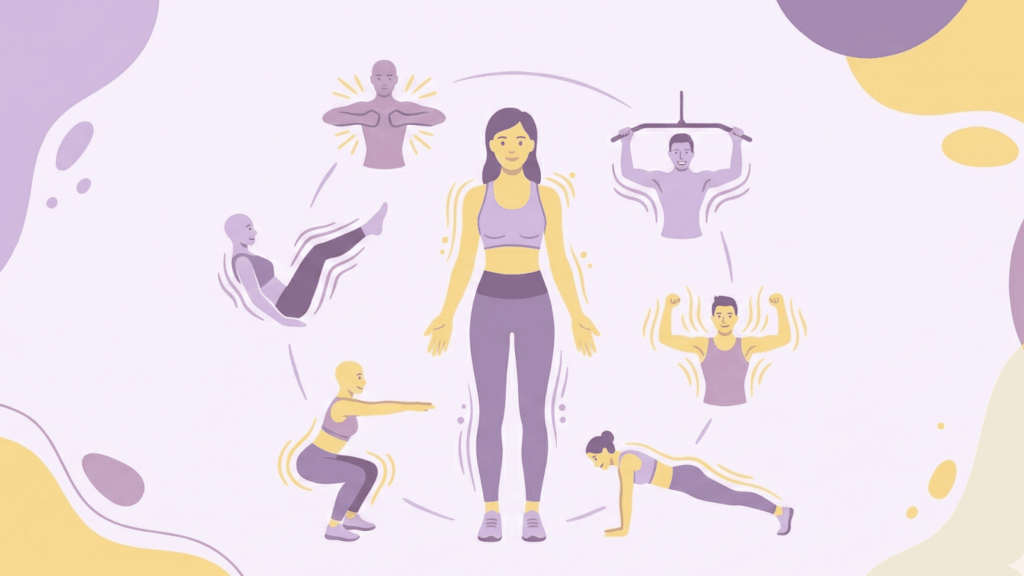
Day1: Full Body workout (machines and bodyweight)
Goal: Establishing movement patterns and engaging all major muscle groups.
Workout Structure:
- Leg Press:- 3 x 10–12 reps
- Chest Press Machine:- 3 sets, 10 reps
- Lat Pulldown 3 sets of 10 reps
- Seated Shoulder Press:- 2 x 12
- Air Squats:- 2 x12 reps
- Plank Hold:- 2x 20-30 seconds
Whole body workouts are perfect for beginners as they stimulate neuromuscular adaptation perfectly (5). Machines are stabilizing, so beginners can concentrate on form without having to think about balance or coordination.
Day 2: Recovering (Active Walk + Stretch)
Use: To alleviate aches and pains, increase circulation, and maintain regularity.
Activity Options:
- 20-30 minutes brisk walking or treadmill walking
- Hips, calves, shoulders and spine) 10 minutes stretching full body
- Active recovery promotes blood flow, which can help remove metabolic waste products associated with muscle soreness (6). It also cultivates daily movement as a habit, with no additional stress.
Day 3: Upper Body Strength
Purpose: To strengthen the chest, back, shoulders and arms.
Workout Structure:
- Chest Press or Push Ups On Incline:- 3 x 10
- Row (Sitting):- 3×10 reps
- Lateral raises:- 2 sets of 12 reps each with dumbbells
- Triceps Pushdown:- 2 sets of 12 reps
- Dumbbell Bicep Curls:- 2×12 reps
Your upper body helps you to maintain posture, stabilize the shoulders, as well as in day-to-day tasks such as hauling bags and lifting items (7). These are controlled movements ; not jerky or high-intensity, meaning less stress on the joints and connective tissues.
Day 4: Lower Body + Core
Goal: To condition the legs and stabilize the spine.
Workout Structure:
- Swiss Ball Goblet Squats:- 3 x 10
- Hamstring Curl Machine 3 x 10
- Glute Bridges:- 2 x 12 reps
- Calf Raises Standing:- 2 x 15[keys]
- Dead Bug Core Exercise:- 10 reps/side x 2 sets
Strength in the lower body supports balance, metabolic health and joint integrity (8). Exercises target the core for stability, not freakin’ crunches that strain your back and alter body alignment.
Day 5: Cardio + Mobility
Goal: To increase the cardiovascular efficiency of your heart and to have better joint mobility.
Workout Structure:
- Cycling, elliptical, or walking on the treadmill for 20-25 minutes
- 10 minutes of hip, shoulder and spine mobility drills
- Moderate-Intensity Cardio Makes your heart and lungs strong, gives you great insulin sensitivity without crushing beginners; incredibly beneficial for recovery (9). It keeps your joints limber and prevents stiffness from sitting all day.
Day 6: Light Full Body
Objective: To firm up the peeps without over-fatiguing them.
Workout Structure:
- Lunges (Bodyweight):- 2 sets of 10 each leg
- Resistance Band Rows:- 2 x 12 reps
- Light Dumbbell Chest Fly:- 2 x 12 reps
- Bird Dog:- 2 sets of 10 reps each side
- Gentle stretching:- 5 minutes
Light training days enhance motor learning and confidence while promoting recovery.This class eases novices to a place of feeling active without overtaxing the body.
Day 7: Rest & Recovery
Objective: The complete recovery of the body and mind.
Rest days allow muscles, tendons and the nervous system to repair. Studies have consistently found that programmed recovery leads to less risk of injury, as well as greater long-term maintenance of an exercise plan (10).
Rest does not mean inactivity. Light walking, breathing exercises or some stretching are perfectly fine if they feel restorative.
Warm-Up and Cool-Down Guidelines
Proper Warm-Up (5-10 Minutes)
Warm parameters help muscles and joints to get ready for an exercise by raising blood flow and muscle temperature.This is a force multiplier and decreasing your chance of injury.
Simple Warm-Up Routine:
- 3-5 minutes light cardio
- Circles basically all around- arms, hips, legs swings
- Gentle spinal movements
Why Cool-Down Reduces Soreness
Letting your heart rate slowly reduce to normal after a workout can also be beneficial, as it might help prevent post-exercise stiffness. Stretching after exercising promotes flexibility and relaxation, which further enhances pleasurable exercise encounters.
Beginner Gym Mistakes to Avoid (And How to Stay Consistent)
Doing Too Much Too Soon
Sore Does Not Mean Progress A lot of newbies associate soreness with progress. But too much intensity increases the risk of fatigue and injury, without added benefit (14). Slow and steady wins the race.
Ignoring Proper Form
Bad technique can put strain on the joints and connective tissues. The use of a lightweight, slower speeds and controlled movements that strengthen good biomechanics .
Skipping Rest Days
If you don’t take the rest days, your body can’t adapt. And without recovery, performance goes down and motivation lags. Sustainable fitness involves planned rests, not continual pushing.
How to Stay Consistent With Your Gym Routine ?
Building Gym Confidence
Confidence grows through familiarity. Most exercises are implemented on a weekly basis which lowers fear level and increases (self-)efficacy towards prescribed exercises over time, as well as the perceived social threat in gym for subjects participating in exercise-based training.
The Small Wins Approach
Consistency matters more than intensity. Studies of habit formation suggest that small, repeatable acts carry more weight than ambitious but inconsistent bursts.
Celebrate showing up. Progress follows presence.
Closing Thoughts : Fitness Is a Habit, Not a Phase
Fitness is not made by ramped up motivation or perfect programs. It is also something that’s developed through repetition, with patience and awareness of the boundaries in your body. This 7-day beginners gym workout offers a step-by-step plan you can follow for the days to come and will make it more likely that you keep going back again and again.
With both reasonable movement and an emphasis on recovery, consistency is automatic. And after all those little, regular things build into strength or confidence … or a better relationship with exercise.
Explore More Health & Wellness Solutions:
Want to stay informed about wellness and everyday health issues? Here are some insightful reads to guide you. Explore the links below for practical tips and solutions.
- How to Prevent Knee Injuries: Proven Tips, and Lifestyle Strategies for Stronger Joints
- How Can Knee Cap Support Help Prevent Injury and Reduce Pain While Running
- 10 Effective Home Remedies for Body Pain Relief Naturally
- Mobility Exercises: Benefits, Techniques & Routines for Better Movement
Frequently Asked Questions
Exercise duration: 45-60 minutes Beginners: Most do best with 45–60 minute workouts that include Warm up and Cool down. An additional benefit of a longer session leads to more fatigue without extra gain.
Yes. Mild soreness (DOMS) is normal in the first few weeks as muscles adapt to new movements. It should ease within 48-72 hours. Sharp pain or joint discomfort is not normal and usually indicates poor form, too much load, or insufficient recovery (1).
No. Beginners build strength mainly through neuromuscular adaptation, meaning the nervous system learns to use muscles more efficiently. Light to moderate weights with proper form are effective and safer than lifting heavy too soon.
Missing a workout won’t ruin progress. Simply continue with the next scheduled session. Consistency over time matters more than perfect attendance, and flexible routines improve long-term adherence.
Beginners do best with 3-4 gym sessions per week, allowing enough time for recovery while building strength and consistency.
References
- Cheung, K., Hume, P., & Maxwell, L. (2003). Delayed onset muscle soreness: Treatment strategies and performance factors. Sports Medicine, 33(2), 145–164.
https://doi.org/10.2165/00007256-200333020-00005 - Schoenfeld, B. J., Grgic, J., Ogborn, D., & Krieger, J. W. (2017). Strength and hypertrophy adaptations between low- vs. high-load resistance training. Journal of Strength and Conditioning Research, 31(12), 3508–3523.
https://doi.org/10.1519/JSC.0000000000002200 - Dishman, R. K., Sallis, J. F., & Orenstein, D. R. (1985). The determinants of physical activity and exercise. Public Health Reports, 100(2), 158–171.
https://www.ncbi.nlm.nih.gov/pmc/articles/PMC1424729/ - Kreher, J. B., & Schwartz, J. B. (2012). Overtraining syndrome: A practical guide. Sports Health, 4(2), 128–138. https://doi.org/10.1177/1941738111434406
- Schoenfeld, B. J., Ogborn, D., & Krieger, J. W. (2016). Effects of resistance training frequency on measures of muscle hypertrophy: A systematic review and meta-analysis. Sports Medicine, 46(11), 1689–1697. https://doi.org/10.1007/s40279-016-0543
- Dupuy, O., Douzi, W., Theurot, D., Bosquet, L., & Dugué, B. (2018). An evidence-based approach for choosing post-exercise recovery techniques to reduce markers of muscle damage, soreness, fatigue, and inflammation: A systematic review with meta-analysis. Frontiers in Physiology, 9,https://pmc.ncbi.nlm.nih.gov/articles/PMC5932411/
- McGill, S. M. (2015). Back mechanic: The step-by-step McGill method to fix back pain. Backfitpro Inc. https://www.backfitpro.com/bo
- RU Training. (2025, October 5). 10 reasons why lower body training is essential. https://www.tru.training/10-reasons-why-lower-body-training-is-essential/
- Swain, D. P. (2005). Moderate or vigorous intensity exercise: Which is better for improving aerobic fitness? Medicine & Science in Sports & Exercise, https://pubmed.ncbi.nlm.nih.gov/15722695/
- Monteiro, E. R., Neto, V. R., & Novaes, J. da S. (2019). Effects of different between-test rest intervals in resistance training on maximal strength performance in trained individuals: A systematic review. Journal of Sports Medicine and Physical Fitness, 59(7),https://pmc.ncbi.nlm.nih.gov/articles/PMC6719818/


