






Let’s face it, when life gets hectic, sleep is usually one of the first things we cut. Late-night work sessions, binge watching our favorite shows or endless scrolling on social media are all cutting into those precious hours of sleep. But the thing is, sleep isn’t a luxury; it’s a biological necessity as essential to our health and well-being as eating or breathing.
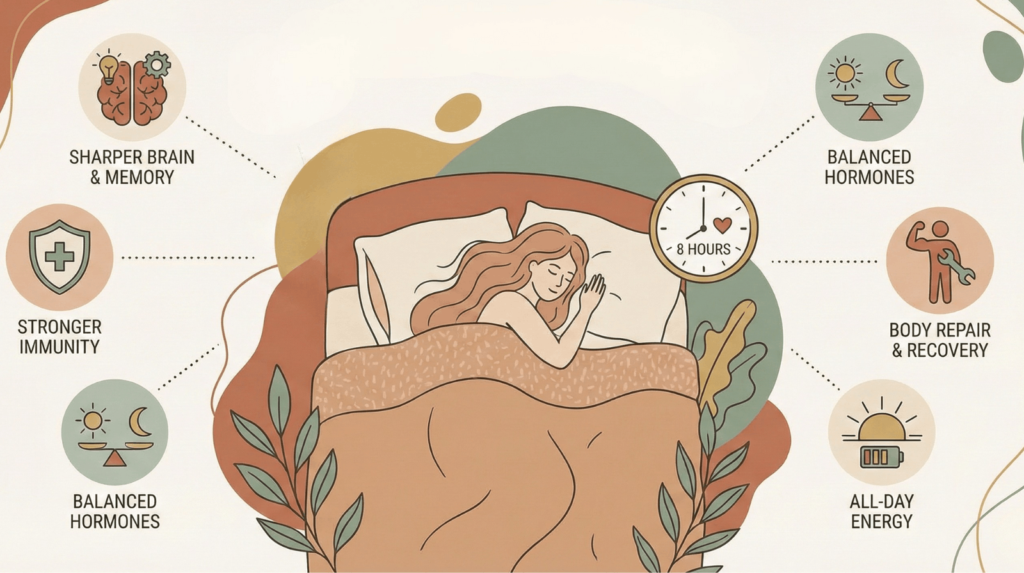
Instead, think of sleep as repair time for your body, when everything from your brain cells to the immune system gets a tuneup. As you’re peacefully dreaming, your body is hard at work repairing tissues, consolidating memories, balancing hormones and getting you ready for the day.
So how much sleep do we need ? Although the amount of sleep one person needs is different from the next, the average adult should be getting 7-9 hours with 8 hours being just about perfect [1]. It’s not just made up: Decades of research on sleep are incredibly consistent in findings that getting about eight hours per night is really valuable for your body and brain.
Want to find out why those eight hours could be the most important health investment you ever make? Here is a look at the science-backed advantages that make making sleep a priority one of the most intelligent wellness decisions you can make.
Physical Health Benefits of Good Hours of Sleep
Boosts Immune System
Did you ever notice that you get sick more when you are not sleeping enough? That’s no coincidence. While you sleep, your immune system releases cytokines, a type of protein that targets infection and inflammation. By sleeping eight hours a night with regularity, you are basically providing your immune army with the reinforcements it needs.
According to research, people who sleep less than seven hours a night are almost three times as likely to get a cold when they’re exposed to the virus than those who sleep eight or more hours [2]. The infection-fighting antibodies and cells are maınly made while you sleep, your body releases proteins which help the immune system work during rest.
Consider sufficient sleep as your body’s natural vaccine and rehearse in the single most powerful way to ready your immune system to fight off assailants from the common cold, which is associated with coronaviruses essentially every year, to more serious pathogens.
Supports Heart Health
So your heart never clocks out, that is not true because it does take a well-deserved rest when you embrace quality sleep. As you snooze, your blood pressure drops, providing the cardiovascular system that hard-charging organ in our chest a chance to relax and regenerate itself, a process known as “nocturnal dipping.”
A large study in the European Heart Journal included more than 1 million subjects, and concluded that those who sleep 7-8 hours a night had a much lower risk of cardiovascular disease and stroke compared to those who slept too little or too much [3]. Not only does sleep deprivation raise stress hormones, including cortisol (which can increase the risk of heart disease), but it also activates inflammatory pathways that damage the heart over time.
You need eight hours not just to feel rested but also to protect the organ that, quite literally, keeps you alive.
Enhances Muscle Recovery
Whether you are working out at the gym, training for a marathon or otherwise just participating in an active lifestyle, sleep is when the real magic of muscle repair and growth occurs. Growth hormone, which is vital for muscle building and tissue repair, is also released during the deep sleep that you would miss out on.
This connection is well-known to athletes. Research published in the Journal of Sports Sciences showed improved athletic performance, reaction times and a decrease in fatigue from extended sleep [4]. But you don’t have to be a pro athlete to enjoy those benefits. Anyone who uses their body actively throughout the day deserves enough sleep for proper recovery.
Helps Maintain Healthy Weight
Here’s an unlikely double feature: sleep and weight management. When you haven’t slept, your body produces more ghrelin (the so-called “hunger hormone”), and less leptin (which is sometimes referred to as the “fullness hormone”), which results in a dual assault of diminished fullness and mounting hunger.
A study in the Annals of Internal Medicine found that when dieters got a full night’s sleep, more than half of the weight they lost was fat. When they were deprived of sleep, their fat loss plummeted 55%, and hunger levels spiked significantly [5]. When your body is deprived of sleep, it behaves as if you are diabetic and becomes insulin resistant.
But beyond hormones, exhaustion just makes it all much harder to make good choices. There is no mystery why, when you are dead tired, that donut starts looking a lot better than a salad and the couch looks more tempting than the gym. A solid eight hours of sleep helps regulate your appetite hormones and boost willpower.
Mental and Emotional Benefits
Improves Cognitive Function
Even while you sleep, your brain is hard at work. At varied sleep stages, your brain consolidates memories, processes information from the day and clears out metabolic waste products that build up when you’re awake.
A Nature Neuroscience study showed that sleep enhances sheer connections between neurons related to learning and making new memories [6]. When you get eight hours, you’re basically hitting the “save” button on everything you learned that day, whether it’s work skills or new life experiences.
Sleep loss, however, dumbs down attention, alertness, concentration, reasoning and problem-solving. Have you ever tried making any accomplishment on slim sleep and felt like your brain was slogging through mud? That’s because it is: Without sufficient sleep, neural processing will be significantly delayed.
Enhances Mood and Emotional Balance
Ever been grumpy and irritable following a night of poor sleep? Emotional regulation is powerfully influenced by sleep. You can better manage stress, have some perspective and respond thoughtfully (versus reacting) from a place of strength when you are well-rested.
UC Berkeley research found that sleep deprivation increases the brain’s anticipatory reactions while decreasing positive emotions [7]. Your amygdala, the emotional center of your brain, becomes 60% more reactive to negative stimuli when you’re sleep-deprived and weakens in its connections to your prefrontal cortex (where rational thought takes place).
Quality sleep helps your emotional thermostat stay well calibrated, so challenges are less likely to feel overwhelming and you can access joy more readily.
Reduces Stress Levels
Sleep and stress are two-way streets; stress can disrupt sleep, while bad sleep increases stress. Incidentally, disruptors to this cycle that increase cortisol levels can be eliminated by following regular eight-hour sleeping patterns.
When you are in deep sleep, your body processes the emotional experiences of the day, essentially allowing you to “reset” your stress response. Think of it as your nightly therapy session; your brain is working through anxieties and worries while you sleep, which can frequently make everything seem more manageable in the morning.
Researches have proven that the well-rested people have lower levels of stress at baseline and recover faster from stressful events than those not-well rested.
Productivity and Performance Improvements
Better Focus and Concentration
If you’ve been turning to coffee as a friend and ally on foggy-headed mornings, know that you are treating the symptom, not the problem. Eight hours of sleep provides amazing benefits in terms of sustained attention and increased capacity for concentration; you’ll be more efficient, stronger, and faster.
Studies show that just one night of sleep deprivation results in attention lapses and performance mistakes. The worse the impact, the more consecutive nights sleep is disrupted, changes are not entirely rectified by “catching up” on weekends.
Being well-rested allows you to stay focused longer, be more resistant to distractions and have better mental clarity overall. The result? You do more in less time, and fewer mistakes.
Improved Decision-Making
Sleep is not just good for helping you think faster, it helps you think smarter. Sufficient sleep builds executive skills, such as planning, organizing and strategizing. It is the insane music of our peaked-out lives that urinates on the brain we need for sound decision-making in the white-knuckle war against maximalized food consumption and under-exertion.
A remarkable study published in the journal Sleep reported that sleep-deprived participants tended to take riskier decisions and had trouble adapting strategies to new differences in the scenarios they encountered [8]. Whether you’re choosing what credit card to use, how much money to invest or which partner to commit to, 8 hours of sleep means a fully functioning brain.
Increased Daytime Energy
This may sound pat, but it’s true: better sleep equals better waking life. When you get eight uninterrupted hours of sleep, it means you wake up with some fuel in your reserves to deal with your day as opposed to always being at war against fatigue.
Natural energy from a good night’s sleep doesn’t have the jitters of caffeine, and unlike caffeine it lasts all day and you never crash. You should feel more inclined to work out, more social and better at actually being present for activities you’re doing (rather than just fighting your way through them).
Yet the energy lift of getting at least that good night’s sleep is a positive cycle, an antidote to snowballing fatigue: being more active during the day leads to better sleep quality at night, which gives you even more energy tomorrow.
Long-Term Health Advantages
Lowers Risk of Chronic Diseases
The link between sleep and long-term health goes deep. Persistent sleep deprivation has also been associated with a higher risk of serious health problems such as type 2 diabetes, obesity, hypertension and some cancers.
Consistent with the latter view, a systematic review published in the European Journal of Preventive Cardiology showed that sleeping 7–8 hours per day was associated with lower risk of developing CVD, stroke and all-cause mortality [9]. The mechanisms are intricate- Poor sleep influences insulin sensitivity, elevates inflammation, impairs appetite hormones and heightens stress hormones, all of which contribute to the development of disease over time.
Eight-hour sleep is to preventive health as the 401(k) is to retirement.
Supports Healthy Aging
Want to age gracefully? Prioritize sleep. Quality sleep helps with cellular repair, hormone balance and cognitive support; necessary components of healthy aging. And you need to get into deep sleep, when your body releases growth hormone, which becomes more and more important for tissue maintenance as we age.
Research has also associated sufficient sleep with telomere length, the protective caps on chromosomes that shorten with age. Better sleep may in fact help maintain the length of telomeres, which could perhaps slow a duskier part of biological aging [10].
In fact, quality rest diminishes inflammation and oxidative stress; two culprits of aging you’d to keep at bay as best we can. For every eight-hour night you focus on now, your future self will thank you.
Strategies to Get 8 Hours of Sleep
Establishing a Bedtime Routine
Your body loves consistency. Developing a pre-sleep ritual cues your brain to shut down. This might include:
- Having a hot bath or shower (contrary to popular belief, the cooling off that follows stimulates sleep)
- Reading a book (the non-screen kind)
- Gentle stretching or relaxation exercises
- Journaling to clear your mind
- Meditation or breathing exercises
The trick is consistency, repeating that same sequence nightly conditions your body to expect sleep, making the transition easier.
Optimizing Sleep Environment
Your bedroom is supposed to be a sanctuary for sleep. Focus on these elements:
Temperature: Put it on too sweet — right around 65-68°F (18-20°C) works well for most folks. For sleep to happen, your core body temperature has to drop and a cool room can help you with that.
Darkness: The main sleep hormone, melatonin, is released in response to darkness. Even low levels of light can interfere with the ability to fall asleep. Try a pair of blackout curtain s or an eye mask. Light inhibits the production of melatonin, your body’s natural sleep hormone.
Silence: Employ earplugs, a white noise machine or fan to cover up disruptive noises.
Comfort: Get yourself comfortable, and that doesn’t mean investing in a Ritz-Carlton-quality mattress and pillows; simply get a pair of accommodating pillows to support the way you like to sleep. Your bed should be solely connected to sleep and intimacy not work or screen time.
Reducing Screen Time
The blue light emitted by phones, tablets and computers causes significant melatonin suppression, making it more difficult to get to sleep. Consider applying a “digital sunset”, turning off your screens at least 60-90 minutes before bed.
If you have to look at devices, turn on blue light filters or wear glasses that block blue light. Better still, swap screen time for analog pastimes such as reading, conversation or gentle hobbies.
Managing Caffeine and Diet
Caffeine has a half-life of about 5-6 hours, meaning if you drink coffee at 4 PM, half of it is still in your system at 10 PM. For better sleep, consider cutting off caffeine by early afternoon.
And steer clear of heavy meals too close to bedtime, they can bring on discomfort and indigestion. If you want an evening snack, go for something light that includes a mix of protein and complex carbohydrates such as whole grain crackers with nut butter.
An aside about alcohol, which may indeed make you sleepy but certainly messes with sleep: It impairs the quality of your sleep and decreases REM time, so even though you spent X number of hours “in bed,” X-amount of those were without any restorative snooze.
Conclusion
Our culture is productivity-obsessed, so sleep too often gets considered “time wasted” or something to sacrifice in our busy lives. But the doctor’s recommendation is unequivocal: eight hours of high-quality sleep isn’t a luxury, it’s not an indulgence; it is simply how you operate at your very best.
From boosting your immune system and safeguarding your heart to sharpening your mind and protecting against mood swings, getting enough sleep affects every aspect of your health. It is as close to a miracle cure as we have in drug treatment: the gift of hope, free of charge and available not only at pharmacies, but on playgrounds, in schools and at midweek church services.
The lovely paradox of sleep is that when you’re doing “nothing,” you’re actually doing everything your body needs to be able to function properly. That’s not eight hours down the drain; that’s eight hours you’re investing in ensuring that all of your waking life is lived at 100 percent of its potential value and enjoyment, because it does.
So tonight, rather than scrolling for “just five more minutes” or powering through another episode, give yourself the one gift of eight hours. Your body, your mind and your future self will thank you. Sweet dreams!
Explore More Health & Wellness Solutions:
Want to stay informed about wellness and everyday health issues? Here are some insightful reads to guide you. Explore the links below for practical tips and solutions:
- Struggling to Breathe? Here’s a Simple Postural Drainage Routine to do at Home
- Acupressure Points in the Foot: Benefits, Chart & Pressure Techniques
- How Can Knee Cap Support Help Prevent Injury and Reduce Pain While Running
Frequently Asked Questions
Eight hours provides enough time to go through 4-5 full sleep cycles and enter deep REM sleep. These are stages necessary for both physical, brain and emotion repair. It’s the right balance of restful recovery.
Yes. With enough sleep, you are better able to manage your emotions and feel less irritable. Better-rested brains are more composed in stressful situations and generally host sunnier moods.
Absolutely. When you’re sleep-deprived, appetite hormones are out of whack and cravings for sugary, high-fat foods follow. It is a good metabolism booster as well, and encourages you to have better energy for movement throughout the day.
Sleep also allows stress hormones like cortisol to reset. When we’re well rested, everyday challenges seem more surmountable and emotional resilience improves.
Yes. While you sleep, your body works to fortify immune defenses and develop infection-fighting proteins. Good sleep reduces the risk of getting sick and promotes recovery.
An occasional short night’s sleep is fine, but chronic sleep deprivation takes a toll on focus, mood, immunity and overall health. The deficit of sleep accumulates far more quickly than most people realize.
Definitely. Restorative sleep enhances focus, memory and performance. People who are well-rested work and of course travel, eat and live; smarter, not longer.
Between shutting down and waking up, the heart needs to recover overnight, as does blood pressure. Heart disease and hypertension risk are lower in those who get regular 7-8 hour beauty rest.
Maintain regular sleep times, relax before bedtime, curb screens and caffeine, and make over your sleep space. The simple, repeated habit for a few weeks can work wonders.
References
- Hirshkowitz, M., Whiton, K., Albert, S. (2015). National Sleep Foundation’s sleep time duration recommendations: methodology and results summary. Sleep Health, 1(1), 40-43. https://doi.org/10.1016/j.sleh.2014.12.010
- Prather, A. A., Janicki-Deverts, D., Hall, M. H., & Cohen, S. (2015). Behaviorally assessed sleep and susceptibility to the common cold. Sleep, 38(9), 1353-1359. https://doi.org/10.5665/sleep.4968
- Wang, C., Bangdiwala, S. I., Rangarajan, S., Lear, S. A., AlHabib, K. Yusuf, S. (2019). Association of estimated sleep duration and naps with mortality and cardiovascular events: a study of 116,632 people from 21 countries. European Heart Journal, 40(20), 1620-1629. https://doi.org/10.1093/eurheartj/ehy695
- Mah, C. D., Mah, K. E., Kezirian, E. J., & Dement, W. C. (2011). The effects of sleep extension on the athletic performance of collegiate basketball players. Sleep, 34(7), 943-950. https://doi.org/10.5665/SLEEP.1132
- Nedeltcheva, A. V., Kilkus, J. M., Imperial, J., Schoeller, D. A., & Penev, P. D. (2010). Insufficient sleep undermines dietary efforts to reduce adiposity. Annals of Internal Medicine, 153(7), 435-441. https://doi.org/10.7326/0003-4819-153-7-201010050-00006
- Rasch, B., & Born, J. (2013). About sleep’s role in memory. Physiological Reviews, 93(2), 681-766. https://doi.org/10.1152/physrev.00032.2012
- Yoo, S. S., Gujar, N., Hu, P., Jolesz, F. A., & Walker, M. P. (2007). The human emotional brain without sleep—a prefrontal amygdala disconnect. Current Biology, 17(20), R877-R878. https://doi.org/10.1016/j.cub.2007.08.007
- Killgore, W. D., Balkin, T. J., & Wesensten, N. J. (2006). Impaired decision making following 49 h of sleep deprivation. Journal of Sleep Research, 15(1), 7-13. https://doi.org/10.1111/j.1365-2869.2006.00487.x
- Itani, O., Jike, M., Watanabe, N., & Kaneita, Y. (2017). Short sleep duration and health outcomes: a systematic review, meta-analysis, and meta-regression. Sleep Medicine, 32, 246-256. https://doi.org/10.1016/j.sleep.2016.08.006
- Jackowska, M., Hamer, M., Carvalho, L. A., Erusalimsky, J. D., Butcher, L., & Steptoe, A. (2012). Short sleep duration is associated with shorter telomere length in healthy men: findings from the Whitehall II cohort study. PLoS ONE, 7(10), e47292. https://doi.org/10.1371/journal.pone.0047292


