






We use our hands for almost everything. From hitting up the snooze button in the morning all the way through to sending last emails at night, cooking dinner and scrolling through our phone screen repeatedly; it’s safe to say our hands do most of our heavy lifting. And because they are so complex; made up of 27 bones, numerous joints and a complex network of ligaments and tendons, they are highly vulnerable to injury and inflammation.
The first step to alleviate and reclaim your dexterity is identifying the root causes for hand pain.Whether you have a dull ache that gets worse in the morning, a sharp shooting sensation when you grab your car’s steering wheel or numbness that wakes you up at night, these symptoms are your body’s way of saying something mechanical is wrong.
At betterhood, we like to get to the core of pain instead of covering it up. As much as we concentrate on “straight” spines and good posture, it’s crucial to remember that your extremities are connected to the same chain of bones, muscles and joints. Stress in the neck and shoulder area can often be converted to problems farther down the arm.
In this guide we will delve into the 10 most common causes for why your hands may be hurting, examine scientifically backed treatment options and illustrate how ergonomic support can prevent against future strain.
1. Arthritis: The Wear and Tear of Life
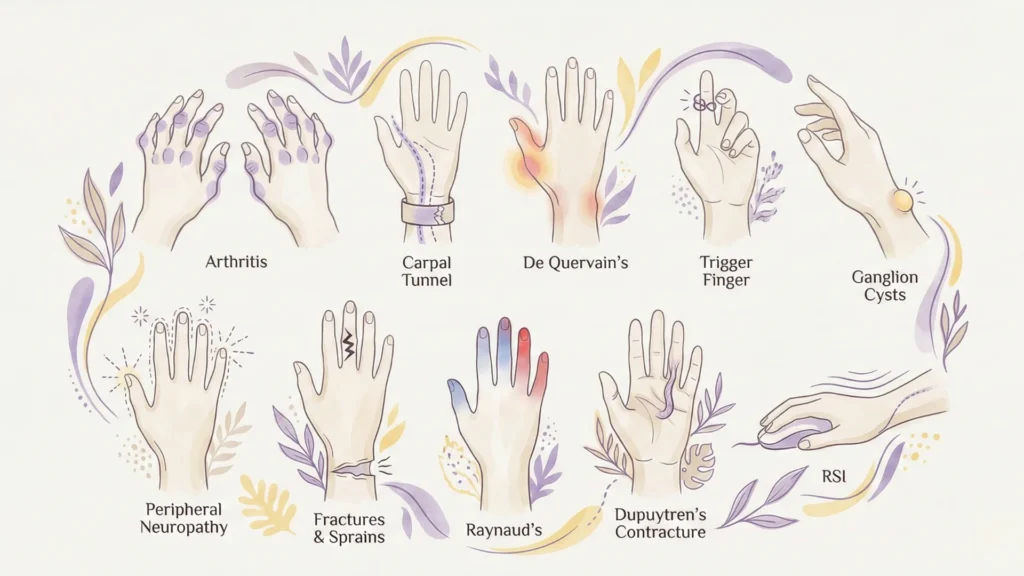
Arthritis is perhaps the number one culprit of hand pain, especially as we get older. It is not a disease but the name given to joint inflammation.
Osteoarthritis(OA): OA is the most common type of arthritis, which is commonly referred to as the “wear and tear” arthritis.The protective cartilage that cushions the ends of your bones wears down over time. You may see bony knobs develop at the middle or end joints of your fingers.
Rheumatoid Arthritis (RA): This is an autoimmune condition rather than wear and tear such as OA, the immune system mistakenly attacks the joint lining. It usually presents as a symmetric involvement of the hands, leading to marked hand joint pain and stiffness particularly in the morning [1].
Treatment:If gently hand pain exercises to keep mobility are essential. Loose them up with heat treatments like a warm soak, or track down some relief controlling flare-ups through anti-inflammatory diets.
2. Carpal Tunnel Syndrome
If you’re like me, and spend your days at a keyboard, you probably know the term. Carpal tunnel syndrome is a condition in which the median nerve which travels from your forearm to the palm of your hand, is pressed or squeezed at the wrist.
Symptoms: You may notice a lack of sensation, tingling, or weakness in the hand, especially at the thumb and 3 fingers. It may be worse in the evenings [6].
Treatment: Rest is essential. Relief for carpal tunnel syndrome often requires wearing a wrist splint at night to keep the joint neutral. It is also vital to improve your workspace ergonomics, to prevent your wrists being bent while you type.
3. De Quervain’s Tenosynovitis (Gamer’s Thumb)
This is a condition in which the tendons become inflamed on the thumb side of your wrist. If you feel pain when you turn your wrist, grasp something, or make a fist, you may have De Quervain’s syndrome. It’s becoming more prevalent in the digital age because of too much texting and gaming.
Symptoms: Pain at the base of the thumb and swelling on the side of the wrist. You may experience sticking or halting when you move your thumb.
What to do for treatment: You need to cut back on anything that is making your eyelid upset with you to stop the irritation. Ice can help reduce inflammation. In chronic cases, a thumb immobilization splint (also termed spica splint) can be worn to allow the tendons to rest and heal [2].
4. Trigger Finger
Medically referred to as stenosing tenosynovitis, this condition is characterized by one of your fingers becoming stuck in a bent position. Then it may bend, or straighten and snap as if a trigger were being pulled and then released.
Why It Happens: The tendons that flex your fingers slide through a protective sheath. When this sheath is inflamed or thickened, it does not allow the tendon to glide easily and it may catch [4].
Treatment: Rest, and refrain from grasping activities are important trigger finger treatments. Soft stretching and splinting of the finger at night can help prevent it from locking while you sleep.
5. Ganglion Cysts
These are benign nodules that usually form at or near the tendons and joints in your wrists or hands. They are circular or obloid and contain a mucoid fluid.
Symptoms: Some cysts are painless but others press against a nerve, leading to pain, tingling or even muscle weakness. Their position can also obstruct joint motion [7].
Treatment: Most cysts go away on their own. If the cyst is painful, a brace that immobilizes it can be useful. In some instances, a physician can aspirate (drain) the fluid.
6. Peripheral Neuropathy
It’s not a joint issue; it is a nerve issue. Neuropathy refers to damage of nerves outside the brain and spinal cord. Diabetes is the most common cause, but it can also develop from traumatic injuries or infections.
Symptoms: It begins as a gradual numbness in the fingers or toes, which can then spread upward into the arms. It can often feel like burning or tingling [5].
Treatment: Optimally, managing whatever is underneath (like blood sugar in diabetes) it the best way to control neuropathy. There are topical creams and drugs that a neurologist can prescribe to help control the nerve pain.
7. Fractures and Sprains
Occasionally, the reasons for hand pain are clear, like a fall or a sports injury. A fracture is typically a break in the bone; a sprain involves stretching or tearing of ligaments.
Symptoms: Sudden (acute) pain, swelling, and bruising; inability to straighten finger or point wrist.
Treatment: Seek medical advice as soon as possible. Treatment includes splinting and casting as well as surgery, and is followed by hand injury recovery physical therapy.
8. Raynaud’s Phenomenon
If your digits go white, blue and then red in response to cold or stress, you may have Raynaud’s. It’s where the tiny blood vessels that feed your skin constrict, stopping blood supply to areas [8].
Symptoms: Fingers that are cold to the touch, red, blue or white color changes in the skin, and throbbing or tingling pain when the hands warm up.
Treatment: Primarily, lifestyle changes such as using gloves to keep your hands warm or identifying stress triggers. In more serious cases, blood vessels may also be dilated through medication.
9. Dupuytren’s Contracture
It is a progressive disorder affecting the tissue underneath the skin in your palm. Upon a returning knot of tissue builds beneath the skin, eventually contracting into a thick cord that can force one or more fingers into a bent position.
Symptoms: Thickening skin in the palm, puckering or dimpling and, in time, fingers that curl toward the palm of the hand and can’t be straightened.
Treatment: In early stages, radiation treatment or injections of enzymes can disintegrate the cord. In advanced cases, the affected tissue may need to be surgically released [3].
10. Repetitive Strain Injury (RSI)
RSI is an umbrella term for pain in the muscles, nerves and tendons due to repetitive movement or overuse. It is the product of tens of thousands of such tiny motions which also include clicking a mouse and using a screwdriver.
Symptoms: Tenderness, stiffness, throbbing and weakness of the hands and forearms [9].
Treatment- What we do in addressing wrist and hand pain treatment for RSI, the focus is on ergonomics. It is important to adapt your workstation, take lots of breaks and use ergonomic equipment.
When to See a Doctor
Although most minor aches clear up with some rest, it’s important to know what the more severe causes of hand pain are. Here’s when you should visit a specialist:
- The pain persists despite home treatment.
- You have severe swelling or redness.
- You experience signs of infection (fever, warmth).
- You have lost range of motion in your fingers.
How Ergonomics and Posture Play a Role
It’s tempting to think of hand pain as a problem that just springs up in isolation, but tension tends to flow downstream. Tightness in the neck and shoulders can put pressure on nerves that travel down the arm to the hand (thoracic outlet syndrome), which may imitate carpal tunnel symptoms.
Sleeping with your spine neutral (an ergonomic pillow helps you do this!) can minimize nerve compression as it takes place at night and will help facilitate overall upper body recovery!
Conclusion: Healing is in Your Hands
Your hands are the unsung heroes of your daily life. They type, text, hold, and create but even the most resilient tools need maintenance. Whether the ache stems from the inflammatory heat of arthritis or the subtle pinch of carpal tunnel, understanding the source is your first step back to freedom.
Start by auditing your rituals. Are you “death-gripping” your phone during the morning scroll? Is your wrist floating awkwardly over a keyboard for eight hours a day? These micro-stressors accumulate, but the fix often lies in simple, mindful adjustments.
At betterhood, we believe that healthy hands are just an extension of a healthy, aligned spine. Our ecosystem of ergonomic support and recovery essentials is designed to treat the body as a whole. From correcting the posture that radiates tension down your arms, to soothing overworked muscles with natural recovery solutions, we help you build a foundation where pain doesn’t stand a chance.
Make gentle stretching a non-negotiable part of your day. Value your recovery as much as your productivity. After all, a life lived pain-free is your ultimate masterpiece and it is built with your own two hands.
Frequently Asked Questions
The most potent natural remedies are rest and heat/cold therapy. Is soaking in warm water with Epsom salts good for loosening stiffness from arthritis, or would ice be better, especially for a condition like tendonitis?
Yes. Radicular pain due to cervical spine (neck) compression can travel down the arm and into the hand. And that’s why correct neck posture is key to the health of your hands.
Yes. Easy hand pain exercises, such as making a fist and then opening it or touching your thumb to each fingertip can help keep tendons gliding smoothly and increase circulation.
Carpal tunnel usually occurs with numbness and tingling in the thumb and first two fingers. Arthritis generally begins with deep, aching joint pain and stiffness, not the tingle.
An inflammatory diet, loaded with processed sugars, can make such conditions as arthritis worse. The anti-inflammatory response in the body may be dropped by consuming Omega-3 and antioxidant containing foods.
References
- Mayo Clinic. (2021). Rheumatoid arthritis – Symptoms and causes. Mayo Clinic. https://www.mayoclinic.org/diseases-conditions/rheumatoid-arthritis/symptoms-causes/syc-20353648
- American Academy of Orthopaedic Surgeons. (2020). De Quervain’s Tendinosis. OrthoInfo. https://orthoinfo.aaos.org/en/diseases–conditions/de-quervains-tendinosis/
- American Society for Surgery of the Hand. (n.d.). Dupuytren’s Contracture. ASSH. https://www.assh.org/handcare/condition/dupuytrens-contracture
- Cleveland Clinic. (2023). Trigger Finger (Stenosing Tenosynovitis). Cleveland Clinic. https://www.google.com/search?q=https://my.clevelandclinic.org/health/diseases/14324-trigger-finger
- National Institute of Neurological Disorders and Stroke. (2023). Peripheral Neuropathy Fact Sheet. National Institutes of Health. https://www.ninds.nih.gov/health-information/disorders/peripheral-neuropathy
- American Academy of Orthopaedic Surgeons. (2022). Carpal Tunnel Syndrome. OrthoInfo. https://orthoinfo.aaos.org/en/diseases–conditions/carpal-tunnel-syndrome/
- American Society for Surgery of the Hand. (2021). Ganglion Cysts. ASSH. https://www.assh.org/handcare/condition/ganglion-cyst
- National Institute of Arthritis and Musculoskeletal and Skin Diseases. (2023). Raynaud’s Phenomenon. NIH. https://www.niams.nih.gov/health-topics/raynauds-phenomenon
- Cleveland Clinic. (2022). Repetitive Strain Injury (RSI). Cleveland Clinic. https://my.clevelandclinic.org/health/diseases/17424-repetitive-strain-injury


