




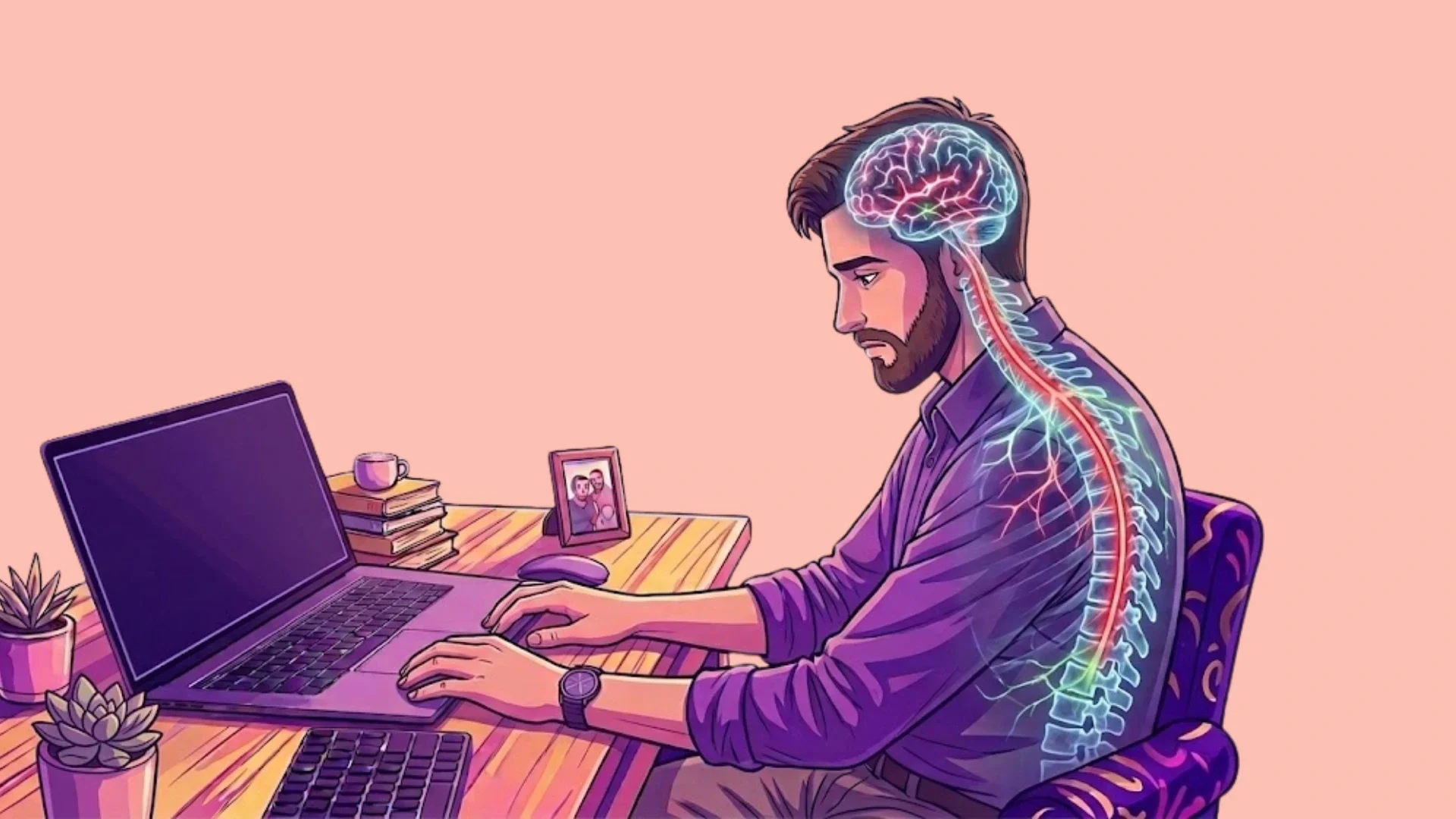
So you sit up straight and a few minutes later slouch again. Or maybe you’ve drawn your back straight several times in a day and still your body keeps recommitting itself to that same position without even being conscious of it. When to learn Neuroplasticity definition.
It can feel frustrating.
You know what good posture looks like. You have been told to sit up straight, pull your shoulders back and don’t slouch. But knowing how and doing are two different things. Your body doesn’t always do what you think it will when you give it instructions.
Your body is not just a material thing. It is presided by a system, capable of learning from data, adapting to the new information and keeping records throughout the course of time. The way you sit, stand and move every day is the result of design. It is a skill your brain learned how to do, then stored.
These tendencies are ingrained in time.
This is also the reason bad posture can seem so normal, even when it’s less than stellar. Your body isn’t resisting change. It is simply spitting out what it has been trained on.
And sometimes it even forgets proper forms of movement.
What Is the Neuroplasticity Definition?

Neuroplasticity definition: The brain’s ability to modify connections or re-wire itself. That is how your brain learns and rewires itself, depending on what you’re doing, be it walking the dog, getting up from a chair or going through trauma. That means your body is getting trained at what you do on a very most often basis, even when you’re not thinking about it in conscious ways.
How Neuroplasticity Works
Every repetitive action you take creates a neural pathway. The brain becomes more used to patterns it practices over and over; they become automated.
- Every day you assume that sunk posture your brain erodes it further
- Constantly shifting to one side your body compensates for the imbalance
- Sunday to Thursdays with fixed people hours less movement variety
As we do more of those seemingly normal gestures, they start becoming increasingly variable but now there is something in that random pattern which requires those actions. What is a temporary situation slowly becomes the default setting, just because that has been practiced in your brain more than anything else.
Why This Matters for Posture
Postural balance is more than muscle. It is about memory.
Your brain remembers how you sit and how you stand, how you move and then it just does it, right? It is not surprising, then, that after addressing poor posture a few times you sometimes find yourself in the same position again.
Improving posture is not merely a matter of trying harder or sitting straighter for 10 minutes. It’s a question of resetting your nervous system to different norms. Through enough repetition and focus, your brain can relearn what it means to be in a balanced, efficient posture and begin to make that its new baseline.
Sensory Motor Amnesia: Your Body Doesn’t Remember
Sensory motor amnesia is one of the most overlooked components of Neuroplasticity definition. It explains, for instance, why your body sometimes feels stiff or unresponsive or stuck in certain positions even though you may be trying to correct it.
What Is Sensory Motor Amnesia?
While these patterns can be incredibly useful, however, they can also create sensory motor amnesia. That’s the point at which your brain literally forgets how to fully sense or control the muscles involved in a particular movement through repetition. This is a gradual accumulation, not a sudden breaking off.
That is to say, your body literally forgets how to properly engage or relax certain muscles because it has not been using them symmetrically. Some muscles are always engaged, some hardly at all. Over time, this imbalance becomes increasingly hard to see and even harder to change.
How It Develops
- If you sit for prolonged hours, nothing will change.
- Repeating the same posture daily
- Keep your workout plan the same in your training.
Repeated over time, some muscles become underutilized and less responsive while others become overworked and contracted. The brain, learning to adapt, treats this imbalance as normal.
The Result
- Reduced awareness of the body, especially areas not commonly engaged
- Poor coordination also affects another aspect: the ability to control movement.
- Habits of posture that have become nearly automatic over a lifetime
And this is why simply trying to fix posture rarely succeeds. If your brain can’t experience enough discomfort or regulate a few muscles, moving it to a new position isn’t going to hold it won’t shift.
Why Do You Keep Coming Back to Poor Posture
You are not lazy. Your body is not broken.
It’s simply responding to how it’s been conditioned to for the past many months or years through neuroplasticity.
Automatic Movement Patterns
Do this enough times and it becomes a habit. It is not you that is consciously chosen anymore. Your mind returns to what it knows best, even if it isn’t the best course of action. That’s also why you can sit up straight in one moment and then slip back into that same position a few minutes later without even realizing it.
Muscle Imbalance Reinforcement
Muscles, like those used frequently, never get released as they are engaged almost permanently.
Weak, unused muscles waste away, growing both dormant and less responsive
The imbalance is taken to a new level day after day and it’s getting harder for your body to simply return to balance naturally. These stronger patterns ultimately take over your movement and posture.
Lack of Awareness
Control one thing we know is fighting the muscle, which if your brain can’t register it fully, it cannot control. Due to this lack of awareness, these musculature pieces are very difficult to target when you try and fix up your posture.
And this is where sensory motor amnesia comes into play. It creates a disconnect between what you want to do and what your body is willing to have done, where you may know how you want to move but your body can’t deliver in full the way that you envision.
Rewiring Your Body Through Neuroplasticity
The good news is that neuroplasticity works both ways.
As with any great pattern, there is muscle memory or neuroscience at work here as well: your body learned (and reinforced) the negative patterns for years, yet can also forget and create a much healthier one given enough time, effort and the proper execution. It takes time, but if you can handle gradually tackling them head on it does wonders.
Step 1: Increase Awareness
You have to stop disappearing not only when the pain hits but before, right? Because most postural habits are not conscious, the first step in moving toward change is awareness of how you sit, stand and move.
Small interventions noticing, whether you’re bending to one side or slumping over can go a long way in time.
Step 2: Slow Down Movements
This, in turn, is what comes to mind the next time that an offending situation arises because accelerated or aggressive corrections do not create lasting change: they fail to give your brain enough time to imprint a new pattern.
Slow, gradual movements allow your nervous system to notice the difference between an old position and a new one, which is vital when you’re retraining. The learning begins here in earnest.
Step 3: Repeat Consistently
Knowing is what creates and strengthens new neural pathways. With each repetition of controlled movement and good posture, that is the norm; it becomes more automated.
Intensity matters less than consistency. It’s the tiny, incremental things you do consistently over the course of your day most of which may feel a bit annoying in the moment that ultimately shift you back to new defaults and settle your body into a new place.
The Important Role of Movement in Reprogramming
Movement is one of the most effective means we have to reverse sensory motor amnesia.
Why Movement Matters
- Activates underused muscles
- Improves coordination
- Enhances body awareness
Types of Helpful Movements
- Gentle mobility exercises
- Controlled stretching
- Postural resets
These motions help your brain reconnect with your body.
How betterhood Supports Neuroplastic Change
betterhood products are designed to help your body reconnect with better patterns.
betterhood Lumbar Support
Delivers repeated feedback to your lower back, so that your body learns what a neutral spinal position feels like.
betterhood Seat Cushion
Promotes even weight distribution protecting against asymmetric habits.
Passive Reinforcement
Instead of going fully active or reactive and just correcting bad posture when it happens, these devices provide a passive way to promote proper posture throughout the course of a normal day.
This is important for neuroplasticity. Because the longer your body is in a better position, the more it learns that position.
Sensory Motor Amnesia: A daily practice
You don’t have to overhaul your life to reset your body.
Morning
- Light mobility exercises
- Awareness of posture
During Work
- Regular posture checks
- Some helpful tools like betterhood products
Evening
- Gentle stretching
- Relaxation exercises
Consistency builds new patterns.
Mistakes Made in an Effort to Fix Posture
Most people try to correct their posture, but such results are often temporary and that has a lot to do with how they do it. A posture shift is not merely a physical change, it’s neurological, which means you have to integrate it into you and not impose on you.
1.Forcing Position
But in order to maintain an ideal posture, you must hold a rigid position, which can work short term but is not sustainable. The body is for motion not for being stuck in one posture. Once you crash out into stiffness, the muscles are soon exhausted and your mind reverts to its old configurations of comfort.
2.Ignoring Comfort
Posture is not about deploying a precise position, if it feels rigid or unnatural your body will rebel against it. This resistance isn’t laziness, it’s your nervous system fighting back against a pattern it doesn’t recognize. For the change in posture to occur, it needs to feel gradually more natural over time not forced all at once.
3.Lack of Consistency
Neural patterns cannot be changed without continued effort. What you do all the time and not just some of the time, determines what your posture is. Yet without repeated reinforcement, your mind will slide back into its old habits.
The Bigger Picture: Posture Is a Learned Behavior
You don’t just have posture. That comes from repetition and daily habits over many weeks, months, years.
Now, the neuroplasticity root means your body’s behavior. Your default processing is determined by the patterns you practice most, whether beneficial or harmful.
Your habits dictate your posture, which is to say by the way you sit over time, how you stand from day to day, the duration within a given day that you remain in this position or that. Over time, what you do little by little adds up and becomes your habitual body posture.
Last but not least, your posture is a habit. Change the habits inside of you and so will begin to change your posture.
Conclusion
Your body is not stuck. It’s just spitting out the data that it was trained on, all those many hundreds of examples that it practiced on and repeated.
And the same system that contributed to bad posture can help correct it. For once you understand how this process works, change is less annoying and more pragmatic.
While it is going to take some time and a fair bit of effort to re-wire these patterns, by learning the Neuroplasticity definition and understanding how sensory motor amnesia works and regularly supporting your body in movement as well as with our betterhood products, you will be able to slowly relearn this. Over time your body starts to become more and more responsive naturally without any heavy correction necessary.
Because posture isn’t something you push yourself into and stay there.
It’s about reacquainting your body with a new normal one that registers as organic and reasonable and sustainable.
FAQs
The Neuroplasticity definition refers to the brain’s ability to reorganize and form new neural connections based on repeated experiences and habits.
Neuroplasticity reinforces repeated postural habits, making certain positions feel automatic over time.
Sensory motor amnesia is the loss of awareness and control over certain muscles due to repeated patterns and lack of movement variation.
Yes, consistent awareness, movement, and repetition can help retrain the brain and improve posture over time.
It varies, but noticeable changes can begin within weeks with consistent practice.
Exercises help, but daily habits and consistent positioning play a bigger role in long-term change.
They provide consistent support and alignment, helping reinforce better posture patterns throughout the day.
Because your brain defaults to familiar patterns that have been reinforced over time through neuroplasticity.
References
1.Doidge, N. (2007). The Brain That Changes Itself. http://www.normandoidge.com/normandoidge/the-brain-that-changes-itself
2.Merzenich, M. M. (2013). Soft-wired: How the new science of brain plasticity can change your life. http://www.softwiredthebook.com
3.Hanna, T. (1988). Somatics: Reawakening the mind’s control of movement, flexibility, and health. http://somatics.com
4.Kolb, B., & Whishaw, I. Q. (1998). Brain plasticity and behavior. http://dx.doi.org/10.1146/annurev.psych.49.1.43
5.Nudo, R. J. (2006). Mechanisms for recovery of motor function following cortical damage. http://dx.doi.org/10.1016/j.conb.2006.08.004
6.Shumway-Cook, A., & Woollacott, M. (2007). Motor control: Translating research into clinical practice. http://www.lww.com
7.Proske, U., & Gandevia, S. C. (2012). The proprioceptive senses: Their roles in signaling body shape and movement. http://dx.doi.org/10.1152/physrev.00048.2011


