




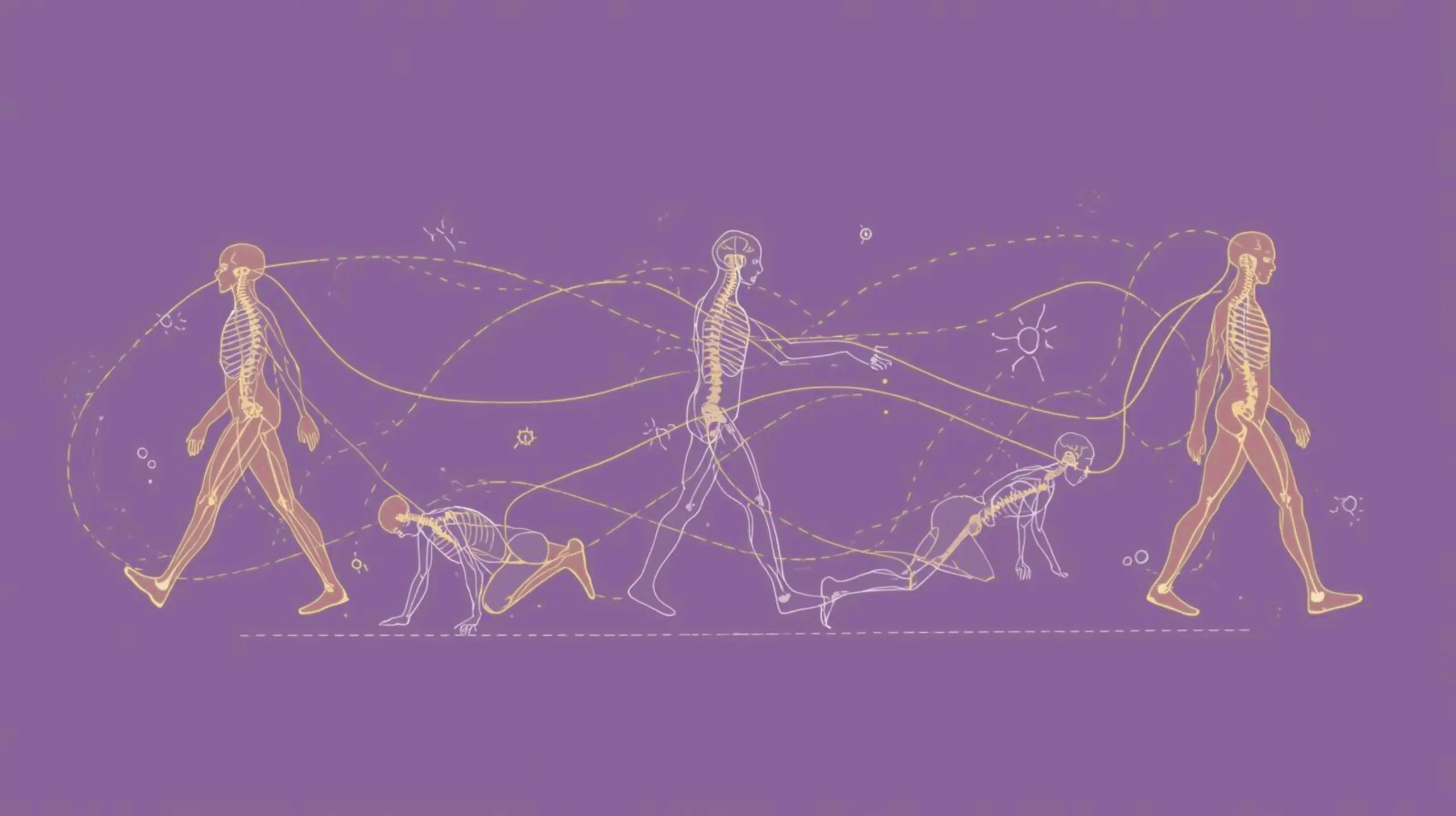
Modern life rewards efficiency. We sit in the same postures, walk the same routes, train the same muscles, and repeat the same movements day after day. While routine may feel productive, the human body doesn’t thrive on repetition alone. It thrives on variety.
Longevity isn’t just about how long you live, it’s about how well you move while you’re alive. And movement variety is one of the most underestimated drivers of long-term vitality.[1]
The Body Was Designed for Diversity
Humans evolved to move in rich, unpredictable environments- climbing, squatting, twisting, crawling, carrying, and walking on uneven ground. These varied demands shaped a body that expects complexity.
When movement becomes repetitive, the body adapts by narrowing its options. Certain tissues become overused, others under-stimulated. Over time, this imbalance shows up as stiffness, pain, poor coordination, and reduced resilience.[2][3]
A diverse movement diet keeps the system adaptable.
Fascia Loves Variety
Fascia- the connective tissue web that wraps every muscle, organ, and nerve, responds directly to how you move. Repetitive, linear motion causes fascia to thicken and lose elasticity. Varied movement, on the other hand, hydrates it, improves glide, and maintains its spring-like quality.[4]
Spirals, side bends, and multi-directional movements load fascia in different vectors, keeping it pliable and responsive. This elasticity is essential not just for athletic performance, but for everyday ease- reaching, turning, bending, and reacting without strain.[5]
Healthy fascia is youthful fascia.
Movement Fuels the Brain
Cross-crawls and contralateral movements (where opposite limbs work together) do more than strengthen the body, they challenge the nervous system.[6] These patterns enhance communication between the brain’s hemispheres, improving coordination, balance, and cognitive agility.
When movement becomes too predictable, neural stimulation decreases. Variety keeps neurons firing, refining motor control and maintaining neuroplasticity. In simple terms: the more ways you move, the more adaptable your brain remains.[7]
This is why playful, exploratory movement often feels energizing, it wakes the nervous system up.
Mitochondria Thrive on Change
Mitochondria, the energy factories of your cells, respond to movement intensity and diversity. [8] Different movement patterns create varied metabolic demands, signaling mitochondria to grow stronger and more efficient.
Repetitive, low-variation movement sends a weaker signal. Diverse movement changing planes, speeds, loads, and rhythms creates a richer stimulus for cellular renewal.
Longevity at the cellular level is built through movement novelty.
Repetition Dulls Vitality
This doesn’t mean repetition is bad. Walking, strength training, and skill practice are valuable. But when repetition becomes exclusively then vitality fades.
The body becomes efficient but fragile. Efficient at one thing, vulnerable everywhere else.
Variety builds resilience. It prepares you not just for your workouts, but for life’s unpredictability: a sudden slip, an awkward reach and a long day on your feet, or simply aging with grace.
Youth Is in Your Movement Patterns
Youth isn’t preserved by chasing intensity or aesthetics. It’s preserved by maintaining options.
Can you rotate your spine smoothly?
So can you move side to side with ease?
Can you crawl, twist, reach, and balance confidently?
These aren’t party tricks. They’re indicators of biological age.
A movement buffet- rich in cross-crawls, spirals, side bends, and exploratory motion, keeps your body curious, adaptable, and alive.
Because true longevity isn’t about adding years to life.
It’s about adding life to your years, one varied movement at a time.
Where Betterhood Fits In
At Betterhood, this philosophy of movement diversity extends beyond exercise into everyday living. The way we sit, rest, and recover plays a crucial role in how our bodies move throughout the day. Prolonged static postures can limit movement variability, reinforcing stiffness and reducing adaptability.[9]
By designing ergonomic solutions that support natural alignment without restricting movement, Betterhood aims to complement an active, varied lifestyle. The goal is not just to provide comfort, but to create an environment where the body can reset, recover, and stay ready for movement in all its forms.
Because true wellness is not built only in moments of activity, but also in how we support the body in between.
Co- authored by: Shayamal Vallabhjee
Chief Science Officer: betterhood
Shayamal is a Human Performance Designer who works at the intersection of psychology, physiology, and human systems design, for the last 25 years he is helping high-performing leaders, teams, and athletes thrive in environments of stress, complexity, and change. His work spans across elite sports, corporate leadership, and chronic health and is grounded in the belief that true performance isn’t about pushing harder, but designing better.
References
[1] Booth, F.W., Roberts, C.K., Laye, M.J., 2012. Lack of Exercise Is a Major Cause of Chronic Diseases. Available at: https://doi.org/10.1152/japplphysiol.00124.2012
[2] Lieberman, D.E., 2013. The Story of the Human Body: Evolution, Health, and Disease. Available at: https://www.penguinrandomhouse.com
[3] McGill, S., 2015. Low Back Disorders: Evidence-Based Prevention and Rehabilitation. Available at: https://www.humankinetics.com
[4] Schleip, R., Findley, T.W., Chaitow, L., Huijing, P., 2012. Fascia: The Tensional Network of the Human Body. Available at: https://www.elsevier.com
[5] Wilke, J., Krause, F., Vogt, L., Banzer, W., 2016. What Is Evidence-Based About Myofascial Chains? Available at: https://doi.org/10.1016/j.jbmt.2016.02.003
[6] Koziol, L.F., Budding, D.E., Chidekel, D., 2012. From Movement to Thought: The Development of Executive Function. Available at: https://link.springer.com
[7] Ratey, J.J., 2008. Spark: The Revolutionary New Science of Exercise and the Brain. Available at:https://www.hachettebookgroup.com
[8] Hood, D.A., 2009. Mechanisms of Exercise-Induced Mitochondrial Biogenesis. Available at:https://doi.org/10.1152/japplphysiol.90438.2008
[9] betterhood, 2026. Correct Ergonomic Sitting Position at Work for Pain Relief. Available at: https://betterhood.in/learn/ergonomic-sitting-position/


