






If you’ve ever woken up in the morning and glanced at your wearable to see, “Wait… is my bpm during sleep really supposed to be that low?” you’re not alone. A standard sleeping heart rate is generally lower than your daytime number: On average, it’s between 60 and 80 bpm for most people. And it increases or decreases as you move through different stages of sleep (light sleep, deep sleep and REM).
So what is “normal,” what’s a statement from just you, and when should you really pay attention?
For most healthy adults, the sleeping heart rate can fall within the range of 50-75 bpm [1], although it can drop lower especially among individuals in good physical fitness as well as spike briefly during REM sleep.
Studies suggest that a normal sleeping heart rate of healthy young adults and most adults at rest is typically between 50 to 75 bpm and also emphasizes that for children this rate is different [1].
Why it matters: Your overnight sleep heart rhythm and nighttime BPM trends can be an indicator of recovery, stress, hydration, illness and sometimes underlying heart rhythm issues. It is not a diagnosis tool itself but it can be a valuable signal.
What is a “Normal” Sleeping Heart Rate?
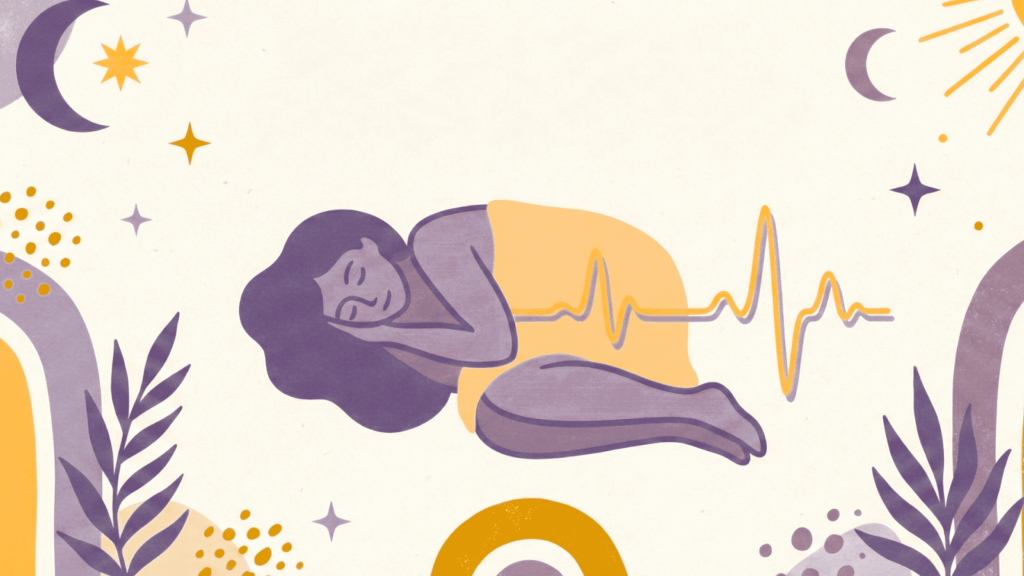
General BPM range for a healthy adult during sleep.
After you fall asleep, your heart rate normally slows down, reflecting a shift from the sympathetic nervous system (sometimes also called “fight or flight”) to the parasympathetic system (often referred to as “rest and digest”). Most adults will have a lower sleeping HR than resting HR during the day (RESTING is normally in the range of 60 to 100 bpm for most adults) [2].
A useful “big picture” landscape anyway that many see:
Resting heart rate during the day: 60–100 bpm in adults [2]
Nighttime (sleeping) heart rate: commonly lower than daytime normal values, typically between 50–75 bpm in a healthy adult [1]
The role of REM and deep sleep on heart rate
It’s not that your heart rate is flat throughout the night, it follows a pattern corresponding to your sleep phases. According to the Sleep Foundation, heart rate slows down during early sleep, when deep sleep occurs it is at its slowest and heart rate can change more in REM (dream) sleep and at times will beat faster [3].
What can your resting heart rate say about your health ?
Sleeping HR is interesting because it’s where you are measured at during a time when you aren’t moving, aren’t talking, and ideally not stressed out. That, then, is a clearer reflection of:
- Recovery status
- Recent training load (for athletes)
- Sickness or swelling (frequently increases HR)
- Alcohol, dehydration, or late meals large meal (HR generally goes up)
Natural variations during sleep cycles
You can even see spikes and dips overnight in someone who is in very good health. REM-related bumping is frequent and even waking up for a short period of time (for which we may have no memory) will cause BPM to go higher.
Sleeping Heart Rate by Age (Normal Ranges by Fitness Level)
Important: most “by age” graphs you’ll see are for resting/awake heart rates. By age, there are no true “sleeping HR norms” because sleep stage and methodological considerations differ. Still, age-based pulse levels offer some context and a helpful adult sleep range [1]. Here is a reader-friendly, pragmatic guide that takes known reference ranges and context them in terms of sleep.
Average heart rate in infants and children
Babies and toddlers have naturally faster heart rates than adults.
Resting ranges from a nursing reference table (widely used clinical teaching resource: NIH/NCBI) are:
- Newborn (0-1 month): 100-160 bpm
- Infant (1-12 months): 80-140 bpm
- Preschooler (3–5 years): 80-120 bpm [4]
Most babies/toddlers dip lower when asleep compared to their awake baseline but still higher than adult sleep rates.
Typical BPM in children and adolescents
Children tend to become less active as they mature.
The same NIH/NCBI table lists:
- Preschool (3-5 years): 80-110 bpm
- Children 6-12 years: 70-100 bpm
- Teenagers (13-18 years): 60-100 bpm [4]
Normal BPM for adults
Resting heart rate is typically referred to in adults as 60–100 bpm by the AHA [2].
During sleep, the sleeping heart rate is normally 50-75 beats per minute (bpm) in a healthy adult [1]. And some healthy adults, especially very fit people may dip into the 40s during deep sleep without it necessarily being an issue.
Athletes’ sleeping heart rate differences
Active people typically have lower resting heart rates, and that can roll over into sleep. Resting heart rate is lower in people who are more physically active, such as athletes; a well-trained athlete’s resting heart rate may be 40 beats per minute. If you’re an athlete, a reduced sleeping HR may be normal and more important is the trend over time and if you have symptoms.
Normal BPM for seniors
In the adult, many seniors are found in the resting heart rate (HR) range of 60–100 bpm [2], and yet medication use, cardiovascular responses, and periodic sleep arousals can all impact nighttime HR. If you’re older and seeing a new consistent increase in average bpm sleep, it’s something to bring up with your clinician.
Factors That Affect Sleeping Heart Rate
Physical fitness levels
Better cardiovascular condition (fit vs un-fit) often leads to a reduced RHR and / or SHR. Lower is not always “better,” but in a healthy, symptom-free person, it can be an indicator of good fitness adaptation.
Stress, anxiety, and emotional factors
The switch doesn’t always turn off at bedtime. Rumination, doomscrolling, or even just a stressful day can keep your sympathetic nervous system online and ready for action, driving up heart rate at night and slowing HR recovery.
Diet, caffeine, alcohol, and medications
A few common patterns:
- Late in the day caffeine can maintain HR and delay deep sleep.
- Alcohol might make you sleepy at first, but as your body metabolizes it throughout the night, it can also increase heart rate.
- Some drugs (such as stimulants like asthma meds, thyroid meds, decongestants) can raise heart rate and some (like beta blockers) can lower it.
Illness, infections, and dehydration
Your heart may beat faster to help circulation while you’re fighting something off — or dehydrated. One of the “something’s up” signs you’re looking for is a sudden, sustained increase in nighttime BPM over a period of multiple nights.
High Or Low Sleeping Heart Rate Symptoms
Signs of Abnormally High or Low Sleeping Heart Rate
Symptoms and warning signs to watch
Numbers are less important than symptoms plus trends. If you observe the following, rather than simply “treat and hope”:
- dizziness or fainting
- chest pain
- shortness of breath
- unusual weakness
- confusion or severe fatigue
Studies presents the clinical symptoms and signs of bradycardia (too slow) as dizziness, fatigue, confusion, chest pains [5] and also raises caution over tachycardia and recommends immediate medical care if fast heart rate is associated with chest pain, dizziness or fainting [6].
Possible Dangers of Erratic BPM levels
- If you have a consistently high sleeping heart rate, that could be considered indicative of stress load, illness, perhaps risk for sleep apnea or even in some cases arrhythmias (not always but worth checking).
- A low sleeping HR, associated with symptoms, can be indicative of bradycardia requiring medical intervention [5].
How To Accurately Measure Sleeping Heart Rate ?(Wearables Vs Medical)
Smartwatches and fitness trackers
Wearables are great for trends. They’re not as good, but are useful to view changes over time (like “my average bpm sleep is 10 bpm higher this week”).
Sleep Foundation describes how heart rate varies by sleep stage and offers some general advice on what to make of your sleeping heart rate [3].
Research continues for clinical-grade sleep/oxygen measurement. The Journal of Clinical Sleep Medicine (AASM journal) has now released its assessments of wrist-worn monitors for accuracy at monitoring overnight oxygen levels—a good reminder that consumer sleep metrics are best suited to tracking patterns not diagnosing conditions [7].
Pulse oximeters, ECG devices, manual technique
If you want more accuracy:
- Finger pulse oximeter: spot-check of HR and oxygen saturation.
- ECG devices (such as consumer ECG add-ons): more accurate for rhythm detection than optical sensors.
- Manual pulse: good for spot checks if wearable reading seems off (count beats over 30 seconds × 2).
How to Keep Heart Rate Low During Sleep (Heart Health + Better Sleep)
Here’s the real answer: you typically don’t “hack” your sleeping heart rate directly, you optimize the conditions that allow it to settle really naturally.
1. Relaxation techniques before bed
A 5-10 minute wind-down (like slow breathing, light stretching, or warm shower) helps shift you into parasym-pathetic mode to bring a slowly decreasing pulse.
Dimmer light + less stimulation translates to decreased “it’s still daytime” signaling that would otherwise keep your heart and brain more alert.
2. Hydration and nutrition improvements
Hydrate in the earlier part of the day, then taper off over the final 1-2 hours so you don’t need to wake up to pee (sleep fragmentation can elevate overnight HR).
Limit heavy late meals if you can (digestion may raise both your heart rate and body temperature).
3. Light exercise and breathing habits
Moderate consistent exercise is good for overall heart fitness and lowers resting HR in the long run.
Things like breathing practices (such as longer exhales) can help calm the nervous system which can be helpful if you feel “high pulse sleeping” nights after stressful days.
When to Consult a Doctor ?
Seek medical advice if you have:
- Frequent unexplained high or low sleeping BPM for you (low is not necessarily better but if your sleeping HR is 40 and you feel fine skip this).
- Symptoms related to heart disease or an arrhythmia, such as dizziness, passing out, chest pain, difficulty breathing or unusual tiredness.
Studies lays out potentially worrying symptoms of bradycardia [5] and tachycardia [6] and those symptom checklists are something to heed.
A sleep environment that supports recovery (position+support)
This is nuanced, but crucial: When the neck and shoulders aren’t properly supported, the body continues to make thousands of micro-adjustments all night long. These small, unconscious movements can disrupt sleep and prevent the body from recovering as fully as it might, perhaps even pushing nighttime heart rate higher.
Properly supportive, well-designed pillow that puts your neck in a neutral position, keep it that way and let your body relax back to its normal place instead of constantly compensating. Stabilizing cervical spine positioning and providing a stable mechanical environment for the neck reduces pain-related awakenings and help to protect sufficient REM restorative sleep time [8].
In short, the right sleep support helps the body stop “bracing” throughout the night so that rest feels deeper, calmer and really restoring.
Conclusion
A “regular” or normal sleeping heart rate for an average adult is between 50-75 bpm, while resting daily daytime readings are in the higher 60-100 range. Naturally, kids would run higher, and well-trained athletes might find it shoulder friendly on the low end. It’s not about hitting a perfect number every night, it’s about coming to notice patterns over time.
Rather than obsessing about a single reading, notice what changes your baseline: stress, alcohol, illness, late meals or erratic sleep. The small, steady habits make the crucible- regular sleep hours; thoughtful ruminations or subdued evening habits; good hydration and a sleep setup for which it’s easy to ideally relax the body. When you don’t give your body the proper support, it works overtime through the night and your heart frequently does too.
Explore More Health & Wellness Solutions:
Would you like to be up-to-date on everyday health and wellness issues? Here are some interesting pieces to help you. Follow the links below if you want practical tips or solutions:
- What Causes Back Pain? Understanding Root Triggers & Prevention Tips
- 10 Effective Home Remedies for Body Pain Relief Naturally
- Wrist Support Braces Explained: Protocols for Pain Relief
- Pillow for Neck Pain: Best Contour Pillow Every Side Sleeper Needs
Frequently Asked Questions:
Generally yes, particularly if you’re healthy and not experiencing symptoms. Cleveland Clinic says the normal for healthy adults is between 50-75 bpm [1]. If 50 has dizziness, fainting or chest pain, with a significant feeling of tiredness, discuss it with a clinician [5].
It is higher during REM sleep; however, it fluctuates from stage to stage. 3 explains that heart rate slows in deep sleep and may speed up and rise during REM. It can also increase with stress, alcohol, dehydration and short waking times.
They’re essentially only good for trends, not diagnosis. During an era of evidence-based medicine evaluating sleep medicine research examines wearables’ performance in overnight monitoring; think “pattern tracking,” not medical certainty.
Athletes tend to have a lower heart rate when resting; the AHA says some athletes can have a resting HR of 40 bpm [2]. Sleeping HR will also be lower for many athletes—concentrate more on your baseline and symptoms.
Yes. Anxiety has the potential to keep your nervous system turned on, which could increase night-time pulse and result in HR being less regulated.
Yes. Dehydration may increase heart rate because the body has to operate at a higher temperature to effectively move blood volume around.
Not automatically. It can be normal — especially in healthy people. When it’s very low and associated with symptoms like feeling lightheaded, faintness, chest pain or confusion [5], then I’d be worried.
It can. Poor sleep can increase stress hormones and decrease recovery, which can lead to rest/sleep HR elevation. Disruptions of sleep regularity have been associated with elevated resting HR levels during sleep in the literature on sleep medicine [9].
Higher. Normal pulse ranges for pediatric are higher than that in adults and decrease with increasing age [4].
It can provide hints (high nighttime HR during times of stress or illness), but it can’t rate sleep quality perfectly. Add HR trends with how you’re feeling, duration of sleep, and consistency.
References
- Cleveland Clinic. (2024, January 23). How sleep affects your heart rate. https://health.clevelandclinic.org/sleeping-heart-rate
- American Heart Association. (2024, May 13). All about heart rate (pulse). https://www.heart.org/en/health-topics/high-blood-pressure/the-facts-about-high-blood-pressure/all-about-heart-rate-pulse
- Sleep Foundation. (2025, September 10). What is a normal sleeping heart rate?https://www.sleepfoundation.org/physical-health/sleeping-heart-rate
- National Center for Biotechnology Information. (n.d.). Table 1.3b, Normal heart rate by age (Nursing Skills). https://www.ncbi.nlm.nih.gov/books/NBK593193/table/ch1survey.T.normal_heart_rate_by_age/
- Mayo Clinic. (2024, December 13). Bradycardia—Symptoms and causes. https://www.mayoclinic.org/diseases-conditions/bradycardia/symptoms-causes/syc-20355474
- Mayo Clinic. (2023, December 15). Tachycardia—Symptoms and causes. https://www.mayoclinic.org/diseases-conditions/tachycardia/symptoms-causes/syc-20355127
- Journal of Clinical Sleep Medicine. (2024). Performance of a commercial smart watch compared to…https://jcsm.aasm.org/doi/10.5664/jcsm.11178
- Gordon, S. J., Grimmer, K. A., & Trott, P. H. (2021). Ergonomic consideration in pillow height determinants and evaluation. Healthcare (Basel). https://pmc.ncbi.nlm.nih.gov/articles/PMC8544534/
- Sleep Health. (2023). The importance of sleep regularity: a consensus statement…https://www.sleephealthjournal.org/article/S2352-7218(23)00166-3/fullte