






In this age of instant gratification and viral health hacks,the most basic science of nutrition tends to get overlooked. We constantly receive conflicting advice. One day fats are the enemy, the next they will save us, one week we need carbohydrates to provide us energy, the next they’re toxic. Yet, nutrition is not, at its essence, a trend, it’s the fundamental biological process through which we take in and derive sustenance from food for growth, cellular repair, as well as the energy necessary to keep our hearts beating.
Learning about the different types of nutrition is not just an intellectual exercise. It is a crucial life skill for the 21st century. Whether you are a professional athlete seeking that extra 1% performance boost, a busy parent who needs to sustain energy levels for long durations throughout the day, or an individual coping with chronic health conditions, achieving your optimal quality of life will depend not only on genes but also on your own nutritional IQ. From the minute, microscopic manner in which a plant cell absorbs a single photon of light to the nebulous way in which a human brain thinks about and digests a meal, principles of nutrition control every moment of our lives.[1]
This guide aims to take you behind the scenes of the science, functionality and medicine of the nutrition world. We’re talking about transcending dieting altogether and diving deeply into how to best fuel your unique body for optimal performance long term.
The Biological Basis (Two Main Type Of Nutrition)
But before we get into meal prep and calorie counts, we have to zoom out for the big picture of how life on Earth sustains itself. From a biological perspective, everything that is living on planet earth can be categorized into two groups.
1. Autotrophic Nutrition: The Producers
The primary energy providers on Earth are autotrophs. These organisms which include mostly plants, algae and certain types of bacteria are the only life forms that can directly turn inorganic material into food for themselves.
Plants, through an incredible process called photosynthesis, take sunlight, water and carbon dioxide and produce glucose (some call it sugar). This glucose is the base energy for the food chain of the entire planet. Autotrophs are essential because without them life couldn’t exist as we know it. They are the most effective clean energy factories, translating raw environments into life-sustaining fuel.
2. Heterotrophic Nutrition: The Consumers
All animals, including humans, are heterotrophs. We don’t have the biological machinery to convert sunlight into snacks. Instead, we need to live on the organic matter of living things, plants or other animals.
Heterotrophic nutrition is very wide, which can be further classified into specific survival strategies:
What do humans actually do?
Holozoic Nutrition We also swallow solid or liquid organic material, separate it in ourselves, and absorb what we need.
Saprophytic Nutrition: These organisms, such as fungi and certain bacteria, feed on dead and decaying organic matter. They are nature’s recyclers, disassembling waste into its constituent elements.
Parasitic Nutrition: In this type, the organism takes in nutrients from a living host, often harming the host in the process.
In our case, we focus on Holozoic nutrition. Because we “ingest” our fuel, it determines what our internal biological “infrastructure” relies upon for good or ill. THAT OLD ADAGE? You are what you eat, digest and absorb.
To be or not to be Macros vs. Micros.
In human health, we divide nutrients based on how much our bodies need. Macronutrients, which are required in large quantities to supply the raw materials for energy and physical structure, while Micronutrients must maintain very small and accurate doses to function as the “keys” that open various chemical reactions.
Macronutrients: The Big Three
It refer to the energy-producing elements of our diet. They are the “fuel” in our tank and the “bricks” in our walls.
Carbs (The Energy Source): Carbohydrates are the body’s preferred fuel source, particularly for the brain and during high-intensity exercise.[3]
Simple Carbs: Present in fruits and refined sugars, they offer swift energy.
Complex carbohydrates: Present in whole grains, sweet potatoes, and legumes, these take longer to decompose, supplying steady, sustained fuel and essential fiber for gut health.
Proteins (The Building Blocks): Also known as the “workhorses” of the body, proteins are composed of amino acids. They play a role in muscle repair, making important enzymes, producing hormones and keeping the frame of every cell in your body intact.
You have higher protein requirements if you are active or recovering from injury.
Fats (The Regulators): For so long, fat was wrongly vilified. The truth is that healthy fats are actually needed. They guard your vital organs, serve as a compact source of energy and are necessary for the production of hormones such as testosterone and estrogen.
The Focus: Go for Unsaturated fats (in avocados, nuts and olive oil) and Omega-3 fatty acids (in fatty fish and flaxseeds) to reduce internal inflammation.
Micronutrients: The Essential Supporters
And a lack of micros can bring even the strongest body to its knees, even though they are needed in milligram or microgram doses.
Vitamins are organic substances that the body cannot synthesize in adequate amounts.
Water-soluble: Daily consumption of vitamins B and C is necessary because they are excreted through urine.
Fat-soluble: Vitamins A, D, E and K are stored in your body’s fatty tissues and liver for later use.
Minerals: Nutrients that are inorganic elements essential for life. Calcium & Magnesium are so important in bone density and muscle function (like your heartbeat). Iron delivers oxygen through your circulation, and Zinc is the frontline defense of your immune system.[4]
What About Water: It literally has no calories or nutrients,but it’s probably the most important macronutrient. It’s the medium for all of your body’s chemical reactions, it’s a lubricant in your joints and it’s your main method of regulating body temperature.
Strategy: If you’ve tried a clean diet but still experience persistent muscle tension or brain fog, micronutrient gap could be your issue. Supplementing internal nutrition with recognized external support, say a Magnesium body cream or Recovery minerals come to many users into play providing gap closure for the body to return to balance.
Functional Categories of Nutrition: What Fuels You
Nutrition is not a static one size fits all plan. It should be a living tool that can respond to the shifting demands of your life.
Sports and Performance Nutrition
This is the science of fuelling to maximise physical output. It’s not just about eating a lot, it’s about nutrient timing.
- Pre-workout: Loading up on carbs to fuel your muscles with glycogen.
- After workout: High-quality protein and electrolytes to immediately start muscle protein synthesis and repair the damage done in training.
By 2026, the emphasis had shifted toward Recovery Nutrition, which focuses on anti-inflammatory foods that allow athletes to train harder and more often without crashing.
Clinical and Therapeutic Nutrition
This is nutrition as medicine. Clinical nutrition is the practice of using certain dietary protocols to treat or even reverse chronic disease.
- Low-Sodium (DASH) Diet: For high blood pressure and heart strain.
- Ketogenic Medical Diet References: Most of the time used in a clinical setting for treating epilepsy or specific metabolic disorders.
- Anti-Inflammatory Protocols: Managing conditions such as arthritis, chronic joint pain using foods high in antioxidants, curcumin and ginger.
Pediatric vs. Geriatric Nutrition
Our nutritional requirements evolve as we age.
- Pediatrics: Compared to their body weight, children need large amounts of energy and protein to facilitate rapid bone growth and brain development.
- Geriatrics: While our metabolism slows as we age, our demands for high-quality nutrients (such as Vitamin D and Protein) actually increase to combat muscle wasting (sarcopenia) and sarcopenic bone fragility.
Holistic and Mindful Nutrition
Holistic nutrition takes the whole person into account. It acknowledges that food is intricately linked to our mental health, our stress (cortisol) and our sleep. It advocates intuitive eating paying attention to your body’s hunger cues instead of rigidly following a stressful, calorie-tracking counter.
The Best Diets: What Type is Right for You?
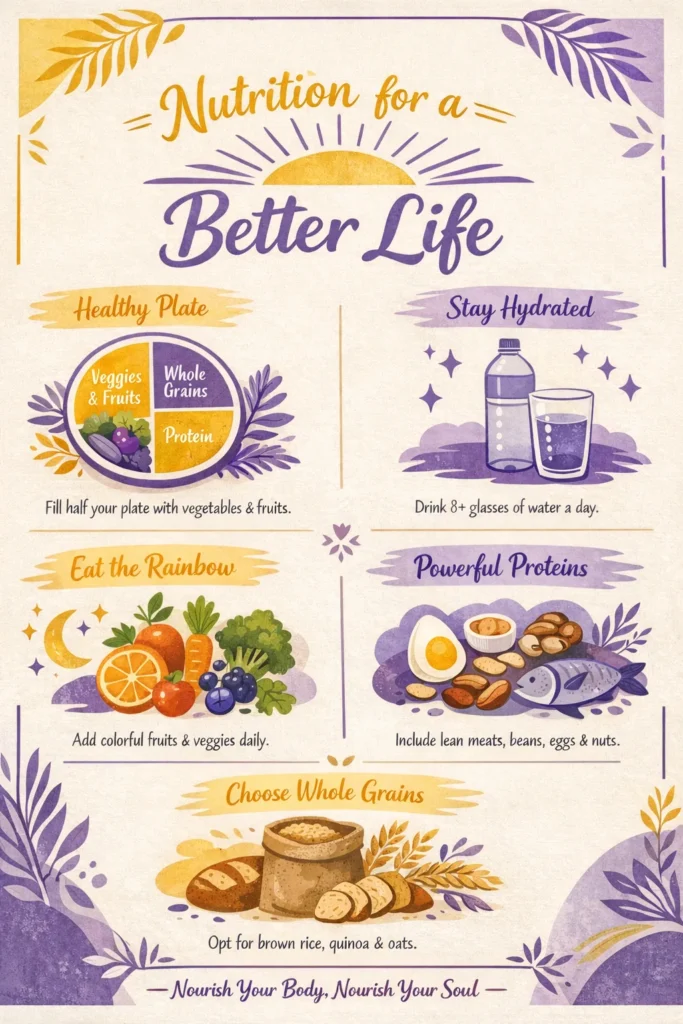
Though there are hundreds of so-called diets, the most successful forms of nutrition generally fall into a handful of scientifically studied patterns:
- Plant-Based (Vegan/Vegetarian) : Emphasis on high-fiber, nutrient-dense plant foods. If properly executed, it is good for the heart, good for digestion, however care should be taken to not become deficient in Vitamin B12 and Iron.
- The Mediterranean Diet: Often referred as the “Gold Standard” for longevity. It encourages whole grains and fruits, vegetables and lean fish plus a lot of olive oil. It is also naturally low in processed sugars and high in anti-inflammatory compounds.
- Low-Carb and Ketogenic: Carbohydrates are drastically reduced so that the body enters a state of “ketosis,” burning fat for fuel rather than glucose. This does help with weight management and blood sugar control, but to make it sustainable, you have to take in a lot of “healthy” fats.
- Paleo and Whole Food Plans: In these diets, all processed modern foods (certainly refined flours and sugars) are eliminated. Instead it’s all about what our ancestors might have eaten: meats, vegetables, nuts and seeds.
Confronting Medical Nutrition: The Say We Cannot Eat Normally
Sometimes, the body cannot process food through the mouth or stomach because of illness or surgery. For these high-stakes cases, doctors use specialized delivery systems:
- Enteral Nutrition: Also referred to as tube feeding, a concentrated liquid formula is delivered directly into the stomach or small intestine. This helps keep the digestive tract active even if the patient cannot swallow.
- Parenteral Nutrition: This is an intravenous feeding.An IV directly injects nutrients into the bloodstream. This is only for patients whose digestive systems are totally non-functional or require complete rest to heal.
The essence of nutritional success Core Principles
Deep health mastery relies on a few high-level concepts which you would want to grasp.
- Bioavailability: The gap between “what you put in your mouth” and “what your cells actually receive. For instance, your body has a hard time absorbing the calcium from certain greens unless it’s cooked or the iron found in plants unless paired with Vitamin C: The takeaway: Pair food groups to ensure maximum absorption.
- Nutrient Density: Go for the most bang for your buck. A 500-calorie bowl of berries and Greek yogurt is chock-full of vitamins and protein; a 500-calorie pastry is nearly all “empty” energy, leaving you hungry in an hour.
- The 80/20 Rule for Mental Sanity: When all-or-nothing fails. Strive to consume 80% nutrient-dense, whole foods. The other 20% lets you eat out and indulge guilt-free. Every single time, consistency beats perfection.
Common Misconceptions: Debunking Nutrition Myths
- Supplements can make up for a bad diet: You cannot supplement your way out of a poor lifestyle. Whole foods also come with complex food matrices combinations of fiber and enzymes and phytonutrients that a pill can never replace.
- Fat makes you fat: It’s extra calories and metabolic dysfunction, not healthy fats. In fact, healthy fats allow you to stay full and satisfied.
- Starvation Mode: Your metabolism does adjust to fewer calories, but your body doesn’t suddenly stop burning energy. But consistently under-eating can cause muscle loss and hormonal crashes, rendering long-term health far more difficult to realize.[5]
Figuring Out Your Individual Needs
Ready to get started? Start with data, not guessing, on your journey.
- Find out your BMR (Basal Metabolic Rate): This number tells you how many calories you need simply to survive while lying in bed.
- Work out your TDEE (Total Daily Energy Expenditure): This takes into account your job, your workouts and how active you are in a day.
- External Support: For those with musculoskeletal strain or “sitting-heavy” jobs, nutrition can be supported by topical aids like Magnesium Body Lotion, which targets muscle tension directly
- Vitamin D and Iron Deficiency: This prescription will give you blood work. Don’t guess if you are deficient in Vitamin D or Iron, get a test. Knowing your markers enables you to target your nutrition with surgical precision.
Conclusion
Your choice to eat well is the most significant factor that determines your future. Every meal is a chance to fuel your health or feed a problem for later. By learning about the various types of nutrition from the macros that fuel your muscles to the micros that safeguard your brain you become a more active participant inside your own body. You are the pilot.
True health isn’t a fad or trend we see on our favorite celebrities; it’s balance, nutrient density and knowing what your individual body needs to nourish and flourish.
Frequently Asked Questions
Carbohydrates, Proteins, Fats, Vitamins, Minerals, Fiber & Water all come together to make a truly balanced diet.
Generally, yes. Plant-based diets have been associated with lower levels of saturated fats and high fiber and antioxidants, the building blocks for cardiovascular health.
These are things like lectins or phytates that occur naturally in plants. But simple cooking, soaking or fermenting foods (like beans and grains) mostly neutralizes them.
Some foods drive inflammation (sugar, trans-fats), and some reduce it (Omega-3s, leafy greens). One of the most important tools to help you live a pain-free life is managing your “inflammatory load” through nutrition.
References:
1.World Health Organization (WHO). (n.d.). Nutrition overview.https://www.who.int/
2.U.S. Department of Agriculture (USDA). (2026). Historic reset of U.S. nutrition policy.https://www.usda.gov/
3.Betterhood. (n.d.). 5 supplements for muscle repair.https://betterhood.com/
4.PubMed Central (PMC). (2026). Clinician’s guide for cardiovascular nutritional controversies.https://www.ncbi.nlm.nih.gov/pmc/
5.Harvard T.H. Chan School of Public Health. (2026). Dietary guidelines progress 2026.https://www.hsph.harvard.edu/
6.Vedantu. (n.d.). Modes of nutrition: Autotrophic & heterotrophic.https://www.vedantu.com/
7.Kerry Health and Nutrition Institute (KHNI). (2026). 2026 health megatrends.https://khni.kerry.com/
8.MDPI Nutrients Journal. (2026). Volume 18: Obesity & nutrition interventions.https://www.mdpi.com/journal/nutrients
9.Betterhood. (n.d.). Anti-inflammatory diet guide.https://betterhood.com/
10.ICMR-National Institute of Nutrition. (n.d.). Analytical services and research briefs.https://www.nin.res.in/


