
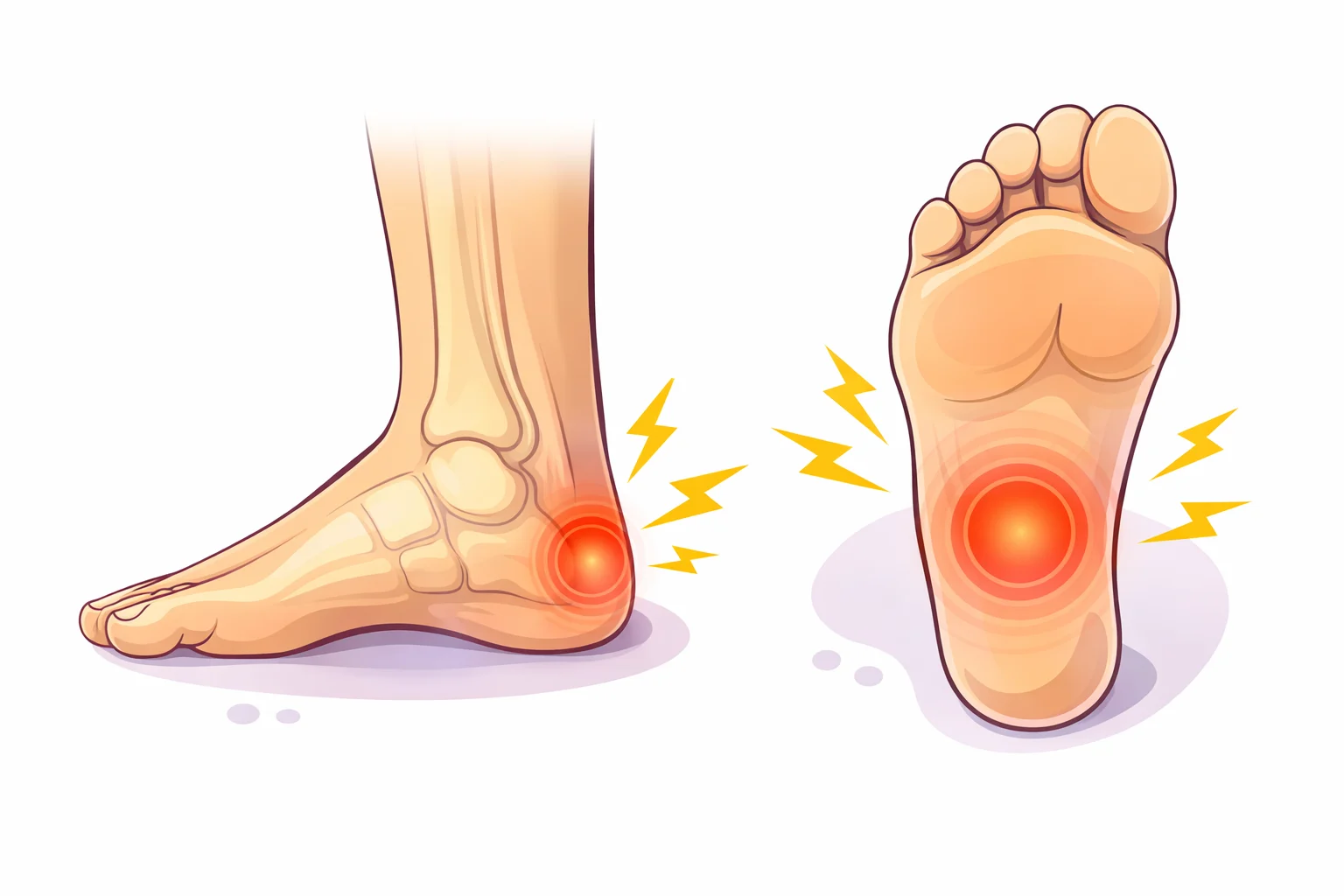
Living with back of heel pain can make you feel like you’re walking on eggshells literally. Whether it’s a searing stinger the second you hop out of bed or a dull, nagging throb that sets in after an extended shift spent on your feet, pain in the back (posterior) of the heel is more than an annoyance.It impacts how you interact with your children, how you do at your job and frankly your general mood.
We at Betterhood believe that a better life starts from the ground up. When your foundation of the feet beneath you hurt, it’s hard to concentrate on everything else in your wellness. In this detailed, deep-dive article we’re going to discuss everything from the biological why through to the practical. how We want to make sure that you don’t just find something temporary, but rather a long-term solution, so they can all get their stride back.
What is Back of Heel Pain exactly?
Just to clarify when we say back of heel pain we don’t mean the bottom of foot (this is typically Plantar Fasciitis). We’re talking about the region where your Achilles tendon attaches to your heel bone or bump at the very back of your shoe.
This type of pain is commonly referred to as posterior heel pain. To make sense of it, though, we have to consider the anatomy of the foot. Your heel is a complex nexus of the calcaneus (heel bone), Achilles tendon (the thickest tendon in the body) and a number of bursae (fluid-filled sacs that serve as cushions).
When any of these elements gets stressed, inflamed or injured, the result is that nagging pain at the back of the heel. In the morning, it’s often worse because while you sleep, the tissues tighten up. But after you make that first motion, you’re essentially asking a stiff, cold rubber band to stretch and it resists.
Straight Talk About Your Discomfort: Common Causes
The why is the first step toward the how of healing. Here’s a breakdown of the most common culprits.
Achilles Tendinitis (Insertional)
The Achilles tendon links your calf muscles to your heel bone. Insertional Achilles Tendinitis occurs at the site that actually attaches the tendon to the back of the heel. Insertional pain, which is felt directly at the bone, is distinct from mid-portion tendinitis higher up the leg.
- The Symptoms: Morning stiffness and pain that worsens during or after exercise.
- The Cause: Typically as a result of sudden ramp-ups in activity, tight calf muscles or shoes that lack proper heel support.[1]
Retrocalcaneal Bursitis
A small, fluid-filled sac known as a bursa rests between your heel bone and the Achilles tendon. Its task is to eliminate friction. When it becomes inflamed, it is known as Retrocalcaneal Bursitis.
- The Sensation: Bump in back of heel and pain when you point your toe up or down. It may feel like the back of your heel is burning.
- The Cause: Frequently caused by shoes that are too tight, or rub against the heel, or due to repetitive overuse in athletes.
Haglund’s Deformity (The “Pump Bump”)
Have you ever seen a bony lump on the back of your heel? That’s Haglund’s Deformity. This is indeed a bone structure change.
The Feel: A protruding “bump” that, when you rub your heel against the back of your shoes, becomes painful and red and inflamed
The Cause: Years of wearing stiff, high-backed shoes (think pumps or work boots) that rub against the bone, prompting it to grow more bone in self-defense.
Sever’s Disease (Calcalcaneal Apophysitis)
If your child or teenager is experiencing back of heel pain, it’s probably Sever’s Disease.
- The Feel: Pain when doing sports involving jumping or running, often forcing the child to limp.
- The Cause: Growth spurts during which the bones grow more quickly than the tendons, leading to a tug-of-war on the growth plate in the heel.
The Invisible Connection: Why Your Entire Body Counts
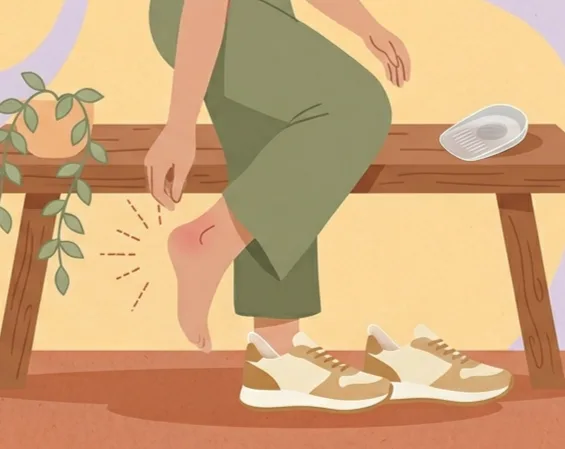
Focus on the “Kinetic Chain”. Your body is a collection of interrelated systems. If you have heel pain, it may be due to one of the following causes:
- Overpronation: Your ankles turn inward, twisting the Achilles tendon.
- Weak Glutes: Weak hip muscles force your feet to work overtime to keep you steady, putting undue pressure on the heels.
- Bad Gait: If you trample down “hard” on your heels, well, you are basically trying to pound the back of your foot into the soil thousands of times a day.
With betterhood Full Length Insoles, your whole posture can be straightened out so that your body weight won’t just sit on the back of the heel but spread out across the entire foot, for that you need proper foot support.
Step-by-Step Home Recovery Plan
There are simple solutions: If you are in pain right now, do these 4 steps
Step 1: The Cool Down (Days 1 to 3)
Focus on reducing inflammation. Follow the R.I.C.E method (Rest, Ice, Compression and Elevation).
- Ice for 15 minutes every 3 hours
- Do not undertake any activity where you feel a “sharp” pain.
Step 2: Gentle Mobility (4 to 7 days)
After the sharp pain has decreased, begin moving the tissue gently.
- The Towel Stretch: While seated on the floor, take a towel around your toes and gently draw back.
- Ankle Circles: Rotate your ankles to promote blood flow to the tendon (which is inherently avascular).If you’ve recently twisted something, check the guide for Ankle Sprain to ensure you aren’t dealing with a ligament tear.
Step 3: Support Integration (Ongoing)
This is where you stop the hurt from reoccurring.
- Place Betterhood Heel Pads in your favorite footwear.
- Don’t walk barefoot on hard floors at home and wear supportive indoor slippers.
Step 4: Strengthening
When you are pain-free, do “Eccentric Heel Drops.” Hang off the edge of a step and lower your heels slowly. Not only does this lengthen the tendon, it also strengthens it.[3]
Recognising the ‘Red Flags’: When to Consult a Doctor
Betterhood products offer amazing relief for common heel problems, but some situations need the attention of a qualified medical professional:
- The “Pop” Sound: If you feel a zap or hear a pop, it is possible you have ruptured an Achilles. Seek an ER immediately.
- Numbness: If you have “pins and needles,” it could be Tarsal Tunnel Syndrome (a nerve issue).
- Inability to Walk: If you cannot bear weight on the foot, an X-ray is required to exclude a stress fracture.
FAQs
Your feet tend to point down as you sleep, which shortens the Achilles. When you rise, you abruptly stretch that contracted, cold tendon, resulting in micro-tears and pain.
With running, about 3x your body weight goes through your heel. Try low-impact swimming or the elliptical instead.
Not necessarily but it’s pretty common, because people feel better. When your tendon is healed and your calves flexible, you might need them only for long walks or heavy activity.
Yes. Magnesium relaxes the muscle fibers in your calves. Because the calf muscle attaches directly to the back of the heel, loosening it helps ease some of that stress on the bone.
Actually, no. Shoes that are completely flat (like flip-flops) stretch the Achilles to its full length. A shoe that gives a small lift of 1-2 cm is usually much better for poster heel pain.
Yes! Heel Pads provide great relief for children with Sever’s disease, as they soften the impact on the growth plate when playing sports.
Conclusion
Back of heel pain doesn’t have to play a permanent role in your life story. Although the daily sting of a stiff Achilles or burning sensation from bursitis can be extremely frustrating to endure, your body is very resilient if it receives the correct tools. Recovering from ouch to active is usually not a one-night fix, but with strategic rest, stretching and structural support, you can get your mobility back.
Here at Betterhood, we want you to take control of your foot health! We’ve witnessed how small, simple changes like putting on a Magnesium Recovery Lotion before you go to bed or sliding PosturePro Heel Pads into your favorite office footwear can result in massive ripples in overall quality of life. When your foundation is supported, you have more energy, you feel better and the world opens up again.
Before it gets too painful for you to do something about it. Today, begin by listening to your heels. Whether you’re a serious athlete, a busy parent, or you just spend every day standing on your feet you deserve to walk with confidence and comfort.
References
- American Orthopaedic Foot & Ankle Society (AOFAS). (2023). Achilles Tendinitis and Foot & Ankle Conditions. https://www.aofas.org/footcaremd/conditions/ailments-of-the-achilles-tendon/achilles-tendinitis
- Mayo Clinic. (2024). Haglund’s Deformity (Pump Bump): Symptoms and Causes. https://www.mayoclinic.org/diseases-conditions/haglunds-deformity
- Betterhood Learn Portal. (2025). Proper Foot Support for Foot Pain. https://betterhood.in/learn/proper-foot-support-for-foot-pain/
- Journal of Orthopaedic & Sports Physical Therapy (JOSPT). (2025). Efficacy of Heel Lifts for Managing Midportion Achilles Tendinopathy. https://www.jospt.org/doi/10.2519/jospt.2025.13422
- Betterhood Blog. (2025). Real Cost of Ignoring Foot Pain at Work. https://betterhood.in/learn/real-cost-of-ignoring-foot-pain-at-work/
- American Academy of Family Physicians (AAFP). (2018, January 15). Heel Pain: Diagnosis and Management. https://www.aafp.org/pubs/afp/issues/2018/0115/p86.html
- Springer Nature / Journal of Orthopaedic Surgery and Research. (2021). Nonoperative Treatment of Insertional Achilles Tendinopathy: A Systematic Review. https://link.springer.com/article/10.1186/s13018-021-02370-0
- Cleveland Clinic. (2023). Haglund’s Deformity: Causes, Symptoms & Treatment. https://my.clevelandclinic.org/health/diseases/25134-haglunds-deformity


