




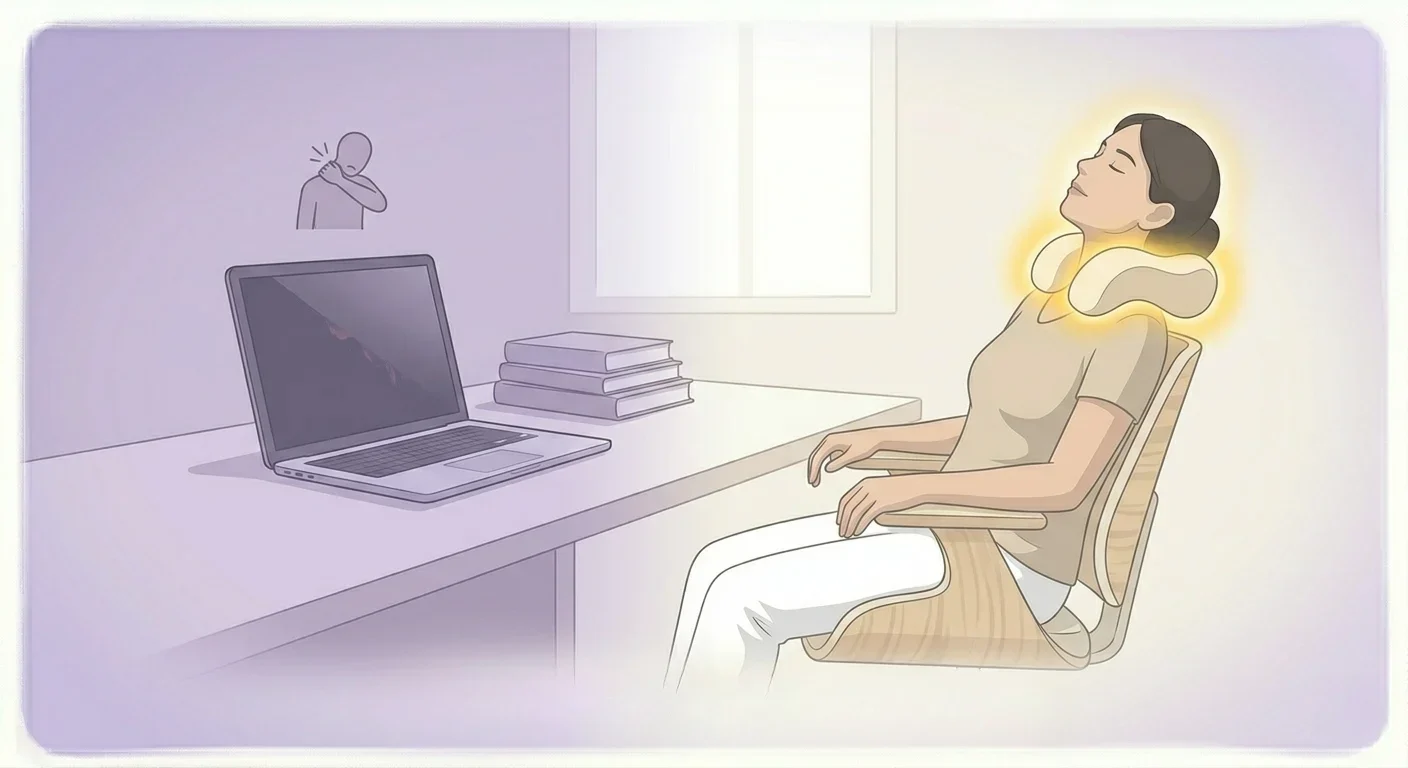
A tight feeling in the neck can interfere with a lot more than sleep. It can make work seem longer, travel feel less comfortable and even turn a simple stop for rest into an experience your body fights against. That is why an often-overlooked neck support pillow can come in handy far more than one might think. It is not only for bedtime. In addition, it can be used to make more effective breaks at the office, long trips and comfort of home [1].
The basic idea is simple. The neck should remain in a neutral position rather than bending forwards, backwards or sideways too much. When support is improved, muscles can relax more easily. As suggested by the Mayo Clinic, Cleveland Clinic, NHS, and MedlinePlus; neck alignment, firm neck support as well as avoidance of pillow positions that would strain the cervical spine are highly emphasized.
This guide examines how a neck support pillow can play a role in office life, travel routines and home use. It also covers why alignment is important, what makes a pillow effective, and how slight changes in comfort can have an outsized impact over time [4].
Why should you care about neck support in everyday life
Most neck pain does not start with a single dramatic event. It often builds slowly. Long hours of sitting at a desk, looking down at a phone, hauling bags around, or sleeping in a poor position all contribute extra pressure to the cervical spine ref-4. Hence support means more than one place.
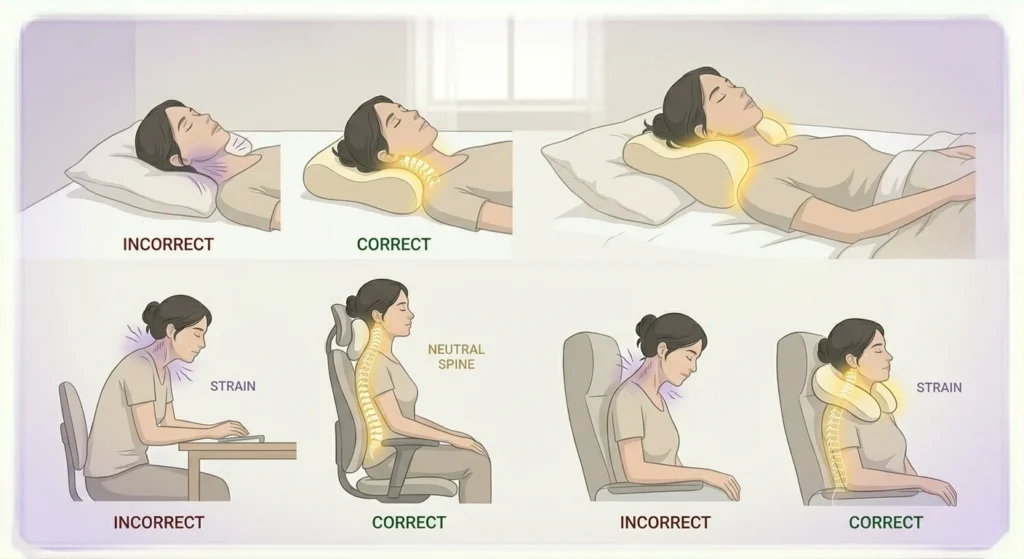
Neck support pillows help keep the head and neck closer to a neutral line. The head and neck should remain aligned with the body while sleeping, according to Mayo Clinic, and a proper pillow should keep the neck parallel to the mattress rather than tilted up or down . The same rule holds true outside the bedroom: When the neck remains supported, those muscles contract less [1].
That matters, because neck strain tends to manifest as stiffness, decreased comfort or tension that radiates into the shoulders and upper back. More support could mitigate those effects, and make everyday tasks feel easier [4].
The actual function of a neck support pillow
A neck support pillow is meant to help maintain the natural curve of the cervical spine. It’s usually shaped or structured so that the head doesn’t sink too far, and the neck doesn’t collapse into an unfortunate angle. MedlinePlus writes that sleeping on a firm mattress with a pillow supporting the neck and Mayo Clinic advises to keep the neck aligned with the chest and back [5]
Such support should not have to feel rigid. Indeed, the best pillow can often feel stable without being hard. The plan is to maintain balance in the body. The neck muscles are able to relax, instead of bracing all night or during extended periods of sitting when the head is held at the appropriate height [2].
Pillow design research also shows that contour and support affect neck pain, waking symptoms, sleep quality, and spinal alignment [6]. And so comfort is not the only value of a neck support pillow. It is also how consistently it supports the body in real life.
Office use vs home use: How they differ
Using it at the office leaves the neck in a far different position than sleeping. The body is seated at a desk, the gaze moves straight ahead, and the shoulders are often locked in place for too long. Posture is a common factor associated with neck pain . Which means the office is often where the unease begins.
Neck support pillows can enter the fray here, though they’re quite different from desk chair pillows or lumbar cushions. During breaks, brief rests or lunch intervals, it may help the neck relax to lean back and sit still or take a recovery pause. The main idea is to relieve stress whenever the body has an option to rest [3].
At home, it’s a different ball game because you can control more factors. You can lie flat, change the angle, and work on a better sleep routine. That simplifies the use of the pillow on an ongoing basis. In the office, support means fast relief and posture change. At home, it’s a matter of recovery and improved sleep [1].
What to look for in office comfort
If the cells you are considering work related to comfort, the main goal is to prevent oxygen tensions before they form. Neck support pillows are helpful during downtimes since keeping the neck in this position will help it to be more relaxed than unsupported or bent. The wrong pillow can tug the neck forward or to one side, and that strain can accumulate quietly over time, Cleveland Clinic says [2].
In office settings, people generally want something user-friendly, quick to set up and supportive enough to make a difference during short breaks. The most practical support keeps the head and neck neutral rather than abruptly shifting them to a new position [1].
This matters because the strain of working around an office is often cumulative. It is not a long, painful moment. It has lots of little stress-injection moments. Markup that is contextually compatible with places you take tactical breaks serves to flatten the rest of the day [4].
Travel comforts: support matters while on the move
Travel changes the game again. On a plane, in a car or on a long train journey, people tend to doze off then wake up crumpled and uncomfortable. The head may tilt to the right or left, the chin may drop forward, or the neck may remain twisted for extended periods. And that can contribute to stiffness at the end of a trip. The same alignment principles apply: The neck is happiest when it remains supported and neutral [1].
When traveling, a neck support pillow can assist with how much the head moves around during transfers. That may not make every irritant disappear, but it can help the neck feel more stable and less strained. This is less fatiguing for travel, since the neck muscles do not have to readjust so much [5].
The broader lesson is simple. Regardless of whether you are in bed at home or enjoying restorative sleep on a long journey the neck prefers stability. Properly positioning the supports provides a better opportunity for the body to relaxing rather than trying to fight against surrounding movement [1]
At home: where the pillow usually does its best work
Home is where a neck support pillow might slot in most comfortably. At home, you can wear it during sleep, naps, rest breaks or quiet recovery time. That makes it easier to take advantage of constant support than would be the case in a busier environment.
The biggest home advantage is consistency. If the pillow provides you with good support for your neck each night, you could wake with less stiffness and overall feel better. Mayo Clinic states neck alignment while sleeping is important, for neck pain a low firm pillow . These are straightforward rules, but they add a lot when applied consistently.
Home use is also where people figure out if a pillow really fits them. When it works, it feels rarely visible. If it doesn’t, the body typically lets you know by morning [2].
Different support for side sleepers and back sleepers
Not everyone sleeps the way you do. That’s why a single pillow style doesn’t fit every person. For side sleepers, you typically need more height as the pillow has to provide support in the gap created between the head and shoulder. “Too low of a pillow drops the neck down. If it is too high then the neck bends back [2].
Back sleepers typically require balanced support. An appropriate pillow to use should support the curve of the neck without forcing the head too far forward. Mayo Clinic recommends that the neck be aligned with the chest and back, while Cleveland Clinic advises that the neck should remain parallel to the mattress [1].
So when someone asks for the best neck support pillow, the actual answer depends on how they sleep and how rigid of a structure they need [1]. The best pillow is one that suits the body, not one that looks pretty on a shelf.
Signs the pillow is helping
A good pillow should help you wake up feeling easier, not harder. If you wake with less stiffness, fewer shoulder aches and a more relaxed neck, that is a sign the pillow is doing its job [3].
Another sign? Less restless repositioning. When the neck is well-supported, the body does not require continued repositioning throughout the night. As Cleveland Clinic makes clear, a pillow that bends the neck forward or to one side can create issues, even if it feels fine right at first [2].
Neck support pillows should ideally be firm. You shouldn’t have to wrestle with it every evening. Rather, it should silently support the neck and allow the body to settle [1].
Common mistakes people make
A frequent error is using too many pillows. That can lift the head too high and form an unnatural angle in the neck. NHS specifically advises the use of a low, firm pillow for neck pain instead of piling up several pillows [3].
Choosing softness over support is another mistake. An initially plush pillow may too easily flatten overnight, as with a design that is not constructed to maintain its shape [2].
Mistake three is to ignore sleep position. A pillow that works for a back sleeper might not work for a side sleeper. Thus the personality of the neck support pillow is to correspond with its body, the position and type for relaxation a person needs [1].
The relationship between postural habits throughout the day and neck comfort
The neck lives not in isolation. It responds to the way you sit, stand and move throughout the day. Some of their causes include posture and daily strain (Mayo Clinic) [ref-4]. So the neck may be more sensitive by the time you lie down from prolonged screen time, phone use and desk work.
A neck support pillow can help, but it’s much more effective as part of healthier habits. Moving often, slouching less and getting up out of fixed positions all help alleviate strain. A well-nurtured home, office and travel routine combine to make one cycle rather than three solutions [4].
When to take neck pain seriously
Most neck pain gets better with good support, good posture and time. But some symptoms require more consideration. states to seek medical attention if neck pain persists a couple weeks, does not get better or is accompanied with numbness, pins and needles, or a cold arm. For more severe or unusualS symptoms, medline plus also recommends evaluation [5].
That’s significant because support is useful, but pillow choice alone does not cause every problem. The use of the pillow with neck support increases daily comfort, though persisting agitation or pain would need to be appropriately checked [3].
How betterhood can help
betterhood supports a more palatable comfort routine for daily life.It can be incorporated seamlessly into home, office and travel routines.
That matters, because comfort is easiest to keep when it’s simple.Establishing a healthier sleep and rest routine will decrease daily stiffness in the long run.
If you support similar things consistently, then you’ll have better chances of predictably feeling comfortable.
Conclusion
The best neck support pillow for office, travel and home use is the one that keeps the neck aligned and comfortable in places where real life takes place. At home, that might mean improved sleep. At work, it could lead to faster relief on breaks. When on the move, that can translate to less post-travel stiffness [1] [3].
Conversion to support is not supposed to be rocket science. It is to make it consistent. In fact, when the neck is supported properly in more than one context, helping the whole day be easier [4].
FAQs
Neck support pillow maintains your head and neck in an aligned position so that the muscles have to go under less strain. It helps to ease the discomfort at home, sleep and travel environments [1].
Yes. Better support can help ease the strain that accumulates from prolonged sitting and bad posture. It is most effective as part of a larger comfort routine [4].
Yes. Travel often causes stiff neck positions, so support can help alleviate stiffness and maximize comfort during rest [2].
Sometimes. The right pillow is position dependent, because most side sleepers need more height and back sleepers generally require balanced support [1].
When pain persists for weeks, is worse or associated with numbness, tingling sensation or cold arm, one should seek medical advice [3].
References
- Mayo Clinic. (2024-01-19). Sleeping positions that reduce back pain. https://www.mayoclinic.org/diseases-conditions/back-pain/in-depth/sleeping-positions/art-20546852
- Cleveland Clinic. (2020-12-10). Is Your Pillow Giving You a Stiff Neck While You Sleep? https://health.clevelandclinic.org/is-your-pillow-hurting-your-neck-7-tips-for-better-sleep
- NHS. (n.d.). Neck pain and stiff neck. https://www.nhs.uk/symptoms/neck-pain-and-stiff-neck/
- Mayo Clinic. (2022-08-25). Neck pain: Symptoms and causes. https://www.mayoclinic.org/diseases-conditions/neck-pain/symptoms-causes/syc-20375581
- MedlinePlus. (2024-02-08). Neck pain: Medical Encyclopedia. https://medlineplus.gov/ency/article/003025.htm
- Chun-Yiu, J. P., et al. (2021). The effects of pillow designs on neck pain, waking symptoms, neck disability, sleep quality and spinal alignment in adults: A systematic review and meta-analysis. https://pubmed.ncbi.nlm.nih.gov/33895703/