




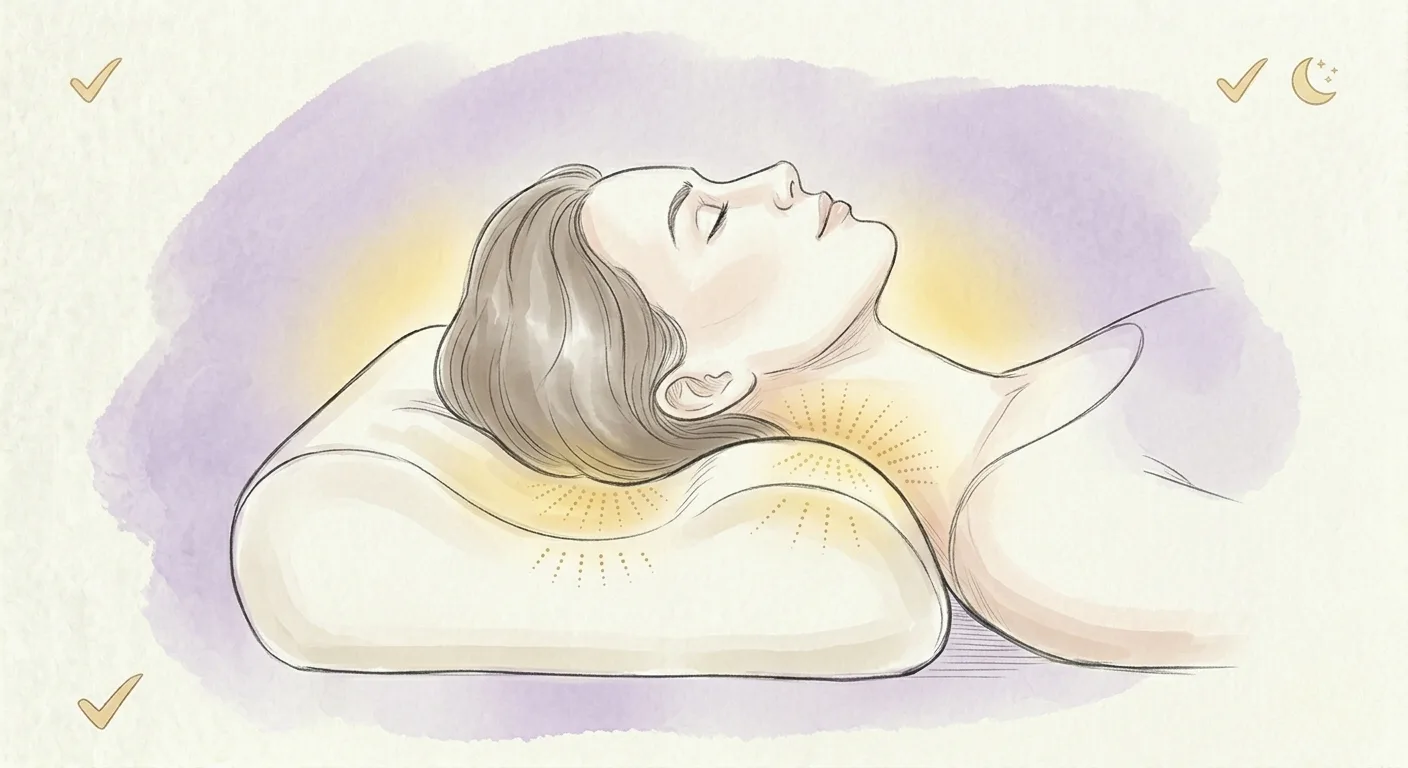
You might not give your pillow much thought until your neck starts complaining. One morning it feels stiff. Here’s another day your shoulders are tense. Then sleep ceases to feel restorative, and instead becomes just another pressure. Enter the memory foam neck support pillow, which solves that problem by supporting the natural curve of your neck and keeping your head in a more neutral position throughout the night [1].
That matters, because alignment makes a difference to comfort. When the neck is bent for long periods too far forward, backward or to one side, the muscles have to work more than it needs to. A properly constructed pillow that supports the neck helps relieve that pressure and allows the body to rest more comfortably . And this is the reason memory foam is a popular material because it absorbs and retains shape, molds to fit body contours, and provides support throughout the night [6].
What to know about spinal alignment during sleep
Your spine should be supported in a neutral position. That does not mean it is perfectly linear.” It means balanced. The head, neck, shoulders and back should all work in harmony so that no one area is under undue strain. Mayo Clinic advises maintaining a line between the neck and the chest and back while sleeping, while Cleveland Clinic says that a good pillow will not allow for bending, with the neck parallel to the mattress instead [1].
When that alignment is out, the body does not completely decompress. Muscles around your neck and upper back can remain tight all night. Best diet for elderly people:Over time, that can translate into waking stiffness and discomfort, together with restless sleep.ref-4 A memory foam neck support pillow helps to stabilize and hold the height of your head, while offering better continual curvature support for your neck compared to a soft, flattening pillow that loses its shape over time [2].
What makes memory foam useful
Neck support pillows are commonly made using memory foam which adjusts to contour and pressure. It forms around the head and neck, yet still provides support instead of shredding immediately. That can be especially helpful for people looking for a pillow that feels structured but not hard [6].
Memory foam is all about comfort, but it’s much more than that. It is consistent. A pillow that maintains its shape throughout the night is more likely to provide spinal alignment from bedtime until morning. The design of pillows has been studied to find a better suitable pillow structure for the treatment of neck pain, waking symptoms, sleep quality and spinal alignment [ref-6]. Which is why memory foam has become a go-to material in supportive pillow design.
What causes neck pain after sleeping
Do you feel neck pain most intensely in the morning? It’s not always coincidental. The position in which we sleep and the height of our pillows can place a strain on the neck for hours, particularly if the pillow is too high, too low or even worse, too soft. common causes of neck pain to posture, sleep position, and daily strain.[6]
If a pillow allows the head to sink too deep, the neck can slump forward. If it turns the head up too far, the neck can angle upwards. Both positions can lead to rigidity. As for neck pain, NHS guidance recommends a low, firm pillow, and advises that too many pillows can dynamically bend the neck out of its natural alignment . This is where a memory foam neck support pillow helps alleviate that issue by keeping the head and neck more stable overnight [2] .
How Does A Memory Foam Neck Support Pillow Work?
How Memory Foam Neck Support Works. It cradles the natural curve of the neck and prevents the head from leaning too far in any direction. For back sleepers, that typically means the neck remains aligned with the chest and back. For side sleepers, that generally means the head remains in line with the shoulders .
The pillow does not need to feel extreme to perform effectively. The best support is hardly noticeable over time, after all. The head stays supported, the neck remains neutral, and the muscles don’t have to keep compensating. That is the whole point. A good pillow is one that makes your body work less during sleep [1].
Memory foam and spinal alignment
One of the primary benefits that draws people towards memory foam is spinal alignment. The rest of the spine tends to follow more organically when the head and neck have good support. Mayo Clinic suggests that the correct pillow support maintains your neck in alignment with both your chest and back, while Cleveland Clinic says you should be able to keep your neck parallel to the mattress if it is placed correctly [1].
This is even more critical if you tend to wake up already stiff or with upper-back tension. A supportive pillow can decrease the degree of twisting and bending that occurs overnight. Studies have shown that pillow design is a contributing factor to pain and sleep quality, so the theory with neck support in improving comfort, as mentioned above, may eventually lead to better spinal alignment and reduced discomfort [6].
Side sleeper: support height, and what it means
Side sleepers typically require more loft than back sleepers. That’s because the pillow needs to fill the gap between your ear and your shoulder. If it is too thin, the head sinks down and causes the neck to bend. When it is too high the head tilts up. In either event, the neck can become strained [2].
A memory foam neck support pillow also helps side sleepers because these ones hold shape better than most soft pillows on the market. This means the pillow is more likely to hold its height throughout the night, even if the sleeper shifts slightly. According to Cleveland Clinic, the right pillow should keep your head in a neutral position, neither pointing down or up. That principle is particularly important for side sleeping.
Back sleepers: why contour matters
This is the kind of support that back sleepers require. The pillow needs to maintain support of the neck curve, but not push the head farther forward. Mayo Clinic states that it is best if the neck remains aligned with the chest and back, while NHS suggests a low, firm pillow for neck pain .
For back sleepers, memory foam can be beneficial because it provides a cervical cradle while allowing the head to maintain stability. That matters because a pillow that is too soft may collapse and leave the neck unsupported. A memory foam neck support pillow may help keep the head from dropping too low and allow enough insulation to keep the neck relaxed while sleeping on one’s side during sleep [1].
Warning signs your pillow is not effective
A pillow problem is one that often looks clearer by morning than it does at bedtime. If you awaken with stiffness or tight shoulders and a neck that feels “off,” your pillow may not be receiving adequate support . If you’re constantly tweaking your pillow throughout the night, this may also indicate that it does not suit your body or sleep position well .
The other symptom is the sense that your sleep is non-restorative despite getting enough time in bed. Bad pillow support leads to tiny adjustments all night that could break up deeper restorative sleep. A memory foam neck support pillow means to relieve such strain by supporting the head and neck in a more uniform way [6].
How to choose a neck support pillow
Not all supportive pillows are created equal. The best one for you is often based on height, firmness and your sleep style. For side sleepers, the pillow needs to be high enough to keep the head aligned. For people who sleep on their back it should be formed to support the neck without pushing down the chin .
Firmness matters too. A pillow that’s too soft may sag down too much. A pillow that is too firm can feel uncomfortable. MedlinePlus suggests a neck-supportive pillow and NHS recommends using a flat firm pillow to avoid stacking bunches of pillows . That balance is exactly what people are often seeking when they opt for memory foam.
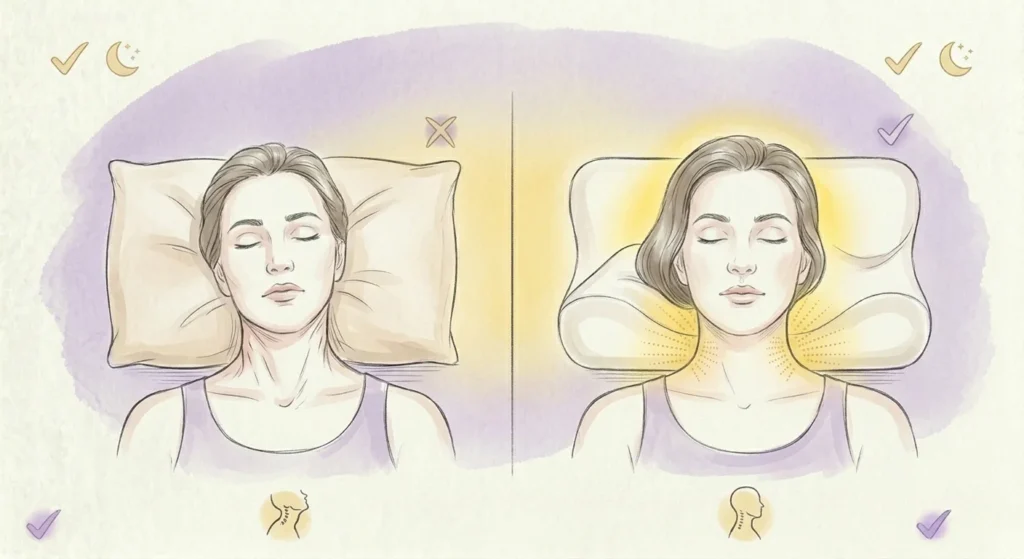
The importance of pillow shape as well as material
Memory foam helps, but so does shape. It’s as important as material. Some are contoured to cradle the neck curve. Others are flatter with consistent support. Different shapes of pillows affect neck pain, sleep quality, waking symptoms, and spinal alignment according to research findings addressing pillow design [6].
So the best memory foam neck support pillow isn’t just the one with the most foam. It’s the one with just the right combination of shape, firmness and height for how you sleep. Although both use the same material, a well-designed pillow might conform to your body better than a generic one [6].
What too many pillows can do to make things worse
It’s natural to want to pile pillows until things feel cushy, but that usually causes more problems than it solves. Excess height can put the neck in a flexed position. The NHS clearly mentions that if many pillows are kept under the head, then it can cause unnatural bend of the neck [3].
That matters because the point is not to lift the head up. The object is to keep the neck neutral. A neck support pillow made of memory foam is most effective if it supports the head without adding more pressure or altering the angle too much [2].
Noise and sleep habits and their effect on neck comfort
A pillow is part of the story. The daily routine also plays a role in neck comfort. Mayo Clinic names among the common causes of neck pain posture, sleep position and daily strain . That means a lot of screen time, bad sitting posture and heavy bags can all render the neck more sensitive by the time bedtime rolls around.
For that reason, a memory foam neck support pillow is most effective as part of a more expansive practice. Improved posture, more regular movement and a supportive sleep setup all do their work. The pillow will never be a cure-all, but it can alleviate one of the most common causes of daytime tension at night [4].
When to pay closer attention
If your neck pain keeps coming back, becomes intense or is accompanied by numbness, weakness or other atypical symptoms, it ought to be checked out by a health care professional. Both MedlinePlus and NHS recommend seeking medical care when neck pain does not resolve or warning signs develop .
A memory foam neck support pillow may help comfort but is no substitute for seeing a doctor when symptoms point to something more serious. That’s especially true if the pain began following an injury or affects movement during the day [3].
How Betterhood can help
Betterhood can promote sleep routines for comfort and alignment.
- It’s part of a practical approach to nightly recovery.
- For those looking to ease stiffness, structure is as important as softness.
- Waking up feeling more rested is easier with a better sleep setup.
That’s the type of uncomplicated change that can seamlessly fit into daily life.
Conclusion
For those seeking improved spinal alignment and reduced morning stiffness, a memory foam neck support pillow could be a wise choice. It works by propping up the neck curve which keeps the head more neutral and helps relieve the kind of strain that can accumulate overnight [1] [6].
The primary advantage is not comfort alone. It is consistent. Proper support for the neck night after night means sleep comes more easily and mornings are smoother. If, however, neck pain is significant or chronic that the advice of a medical professional appropriate ref-3.
FAQs
A cervical support cushion serves the purpose of supporting the natural curve of your neck while maintaining spinal and head alignment during sleeping [1].
It can be, particularly if the pillow maintains its shape and leaves the neck in a neutral position. Studies imply that pillow characteristics can impact neck pain and sleep quality [6].
It can work for both, but the correct height and shape depends on whether you’re a stomach, back or side sleeper. The loft requirements for side and back sleepers differ, with the former often requiring more while the latter needing balanced contouring [1].
Yes. The right type of pillow can help maintain some alignment between the neck and chest/back, which is more conducive to neutral spinal positioning throughout sleep [1].
Medical evaluation is important if pain continues, worsens or is accompanied by numbness, weakness or other unusual symptoms [3].
References
- Mayo Clinic. (2024-01-19). Sleeping positions that reduce back pain. https://www.mayoclinic.org/diseases-conditions/back-pain/in-depth/sleeping-positions/art-20546852
- Cleveland Clinic. (2020-12-10). Is Your Pillow Giving You a Stiff Neck While You Sleep? https://health.clevelandclinic.org/is-your-pillow-hurting-your-neck-7-tips-for-better-sleep
- NHS. (n.d.). Neck pain and stiff neck. https://www.nhs.uk/symptoms/neck-pain-and-stiff-neck/
- Mayo Clinic. (2022-08-25). Neck pain: Symptoms and causes. https://www.mayoclinic.org/diseases-conditions/neck-pain/symptoms-causes/syc-20375581
- MedlinePlus. (2024-02-08). Neck pain: Medical Encyclopedia. https://medlineplus.gov/ency/article/003025.htm
- Chun-Yiu, J. P., et al. (2021). The effects of pillow designs on neck pain, waking symptoms, neck disability, sleep quality and spinal alignment in adults: A systematic review and meta-analysis. https://pubmed.ncbi.nlm.nih.gov/33895703/


