





Pain around your lower back, pelvis, buttock, or sacrum can be frustrating to deal with and tricky to pinpoint. Because so many muscles, nerves, and joints in your lower body work together, a problem in one spot often feels like it is coming from another. The sacroiliac (SI) joint (SI joint pain) is one common and frequently overlooked source of lower-body discomfort.
Understanding where the SI joint is, what it feels like when it hurts, what causes irritation, and how doctors evaluate it can help you make sense of your symptoms and talk knowledgeably with your healthcare provider.
What Is the Sacroiliac (SI) Joint?
The sacroiliac (SI) joint connects the base of your spine to your pelvis. You have two SI joints one on the left side and one on the right side of your lower back. [1]
Specifically, each SI joint sits where two key bones meet:
- The Sacrum: The triangle-shaped bone at the base of your spine, right above your tailbone. [1]
- The Ilium: The large bone that forms your hip and the sides of your pelvis. [1]
Unlike flexible joints such as your shoulder or hip, the SI joints allow only a small amount of movement and are supported by strong ligaments. Their main job is to help transfer and distribute loads between your upper body and your legs whenever you stand, walk, or run. [1]
Where Is the SI Joint Located?
The SI joints sit deep within the back of your pelvis. On the outside of your body, this corresponds to the area just below your natural waistline, right beneath those small skin dimples on your lower back or upper buttocks. [1]
While the joint sits under those dimples, feeling pain in that spot does not automatically mean the SI joint is injured. Surrounding muscles, tendons, and spinal nerves can send pain signals to the exact same area.
What Does SI Joint Pain Feel Like?
SI joint pain usually feels like a deep, dull ache localised to one side of your lower back, upper buttock, or the back of your pelvis. For some people, it stays constant; for others, it comes as sharp, sudden jabs during certain movements. [3]
Common Symptoms to Watch For
While symptoms vary depending on what is affecting the joint, common patterns include:
- One-Sided Pain: Discomfort is most commonly felt on just one side of the lower back or buttock, though both sides can be affected.
- Deep Buttock Ache: Pain feels deep inside the pelvis rather than near the surface of the skin.
- Leg and Thigh Pain: Discomfort can sometimes travel down into your thigh or leg.
- Pelvic Stiffness: A tight, stiff feeling in your lower back or hips, especially when getting out of bed or standing up after resting.
- A Sensation of Instability: Feeling as though your lower back or pelvis is unsupported or might “give way” when bearing weight. [1]
Note: These symptoms alone do not confirm an SI joint issue, as lower back and hip problems can feel almost identical.
What Activities Can Make SI Joint Pain Worse?
Because the SI joint helps transfer your weight when you move, activities that put uneven or extra load on your pelvis tend to irritate it:
- Uneven Weight-Bearing: Standing mainly on one leg, stepping off a curb, or walking on uneven ground.
- Climbing and Striding: Going up stairs, walking uphill, or taking long steps.
- Position Changes: Getting up from a chair, rolling over in bed, or twisting your body.
- Staying in One Position Too Long: Sitting or standing motionless for long stretches.
- High-Impact Movement: Running, jumping, or lifting heavy loads unevenly.
Can SI Joint Pain Cause Sacrum, Pelvic or Lower Back Pain?
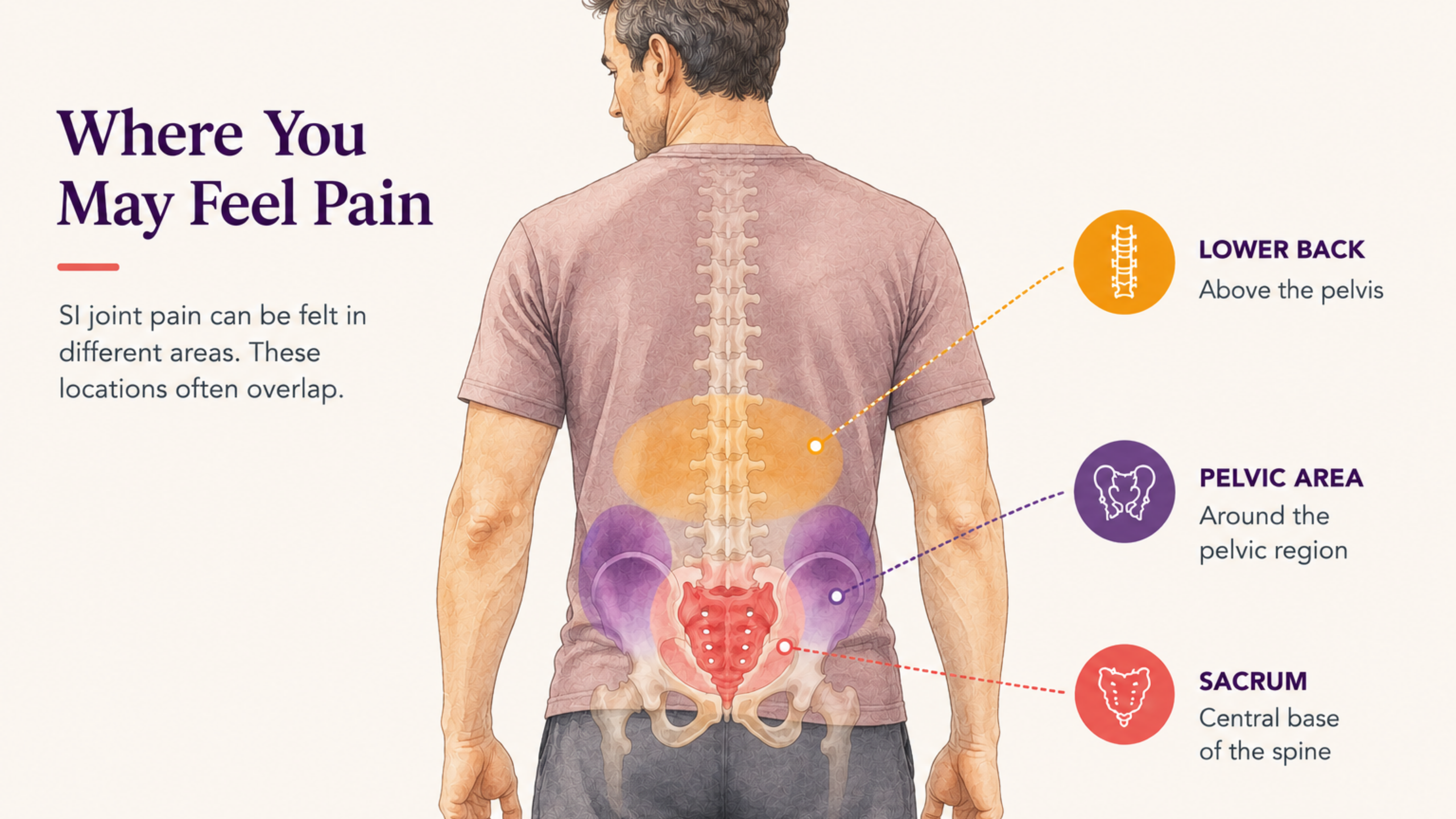
Yes. Because internal nerves in your lower back and pelvis share overlapping pathways, people experience a phenomenon called referred pain, as they often feel SI joint issues as sacrum, pelvic, or lower back pain.
SI Joint Pain and Sacrum Pain
The sacrum sits right between your two SI joints, so it’s not always easy to tell where pain in this area is coming from. An irritated or strained SI joint can cause pain that spreads toward the centre of the sacrum. However, similar pain can also be caused by tailbone irritation, stress fractures, or irritated spinal nerves.
SI Joint Pain and Pelvic Pain
The SI joints connect your spine to your pelvis, so pain from these joints can sometimes be felt in nearby areas. You may notice discomfort in your groin, upper hip, or around the pelvis rather than directly over the SI joint.
SI Joint Pain and Lower Back Pain
Your lower spine sits just above the sacrum, so pain from the spine can sometimes be felt in the same area as SI joint pain. The SI joint can cause lower back discomfort, but muscle strains and spinal disc problems can cause similar symptoms too. That’s why the location of your pain alone cannot tell you exactly what’s causing it.
What Causes SI Joint Pain?
SI joint pain can develop for several reasons, including injury, changes in how forces are distributed through the pelvis, pregnancy-related changes, or inflammatory conditions.
- Injury and Trauma: A direct fall onto your buttocks, a car accident, or stepping unexpectedly off a curb can strain or stretch the joint’s supporting ligaments.
- Pregnancy and Postpartum Changes: Pregnancy hormones loosen pelvic ligaments to prepare for childbirth. For expecting mothers experiencing this discomfort, using a specialised pregnancy pelvic back pain belt can provide temporary joint stabilisation.
- Repetitive or Uneven Load: Jobs or activities that involve constant twisting, uneven lifting, or carrying heavy loads on one side can wear on the joint over time.
- Altered Walking Pattern: Limping or changing how you walk because of foot, knee, or hip pain can change how forces are distributed through the pelvis and place additional stress on the SI joint.
- Joint Wear or Inflammation: General wear-and-tear arthritis can affect the joint cartilage, while inflammatory conditions like ankylosing spondylitis frequently target the SI joints.
- Previous Spine Surgery: Fusing bones in the lower back restricts movement in the spine, which can pass extra stress downward onto the SI joints.
What About a “Misaligned” Pelvis or SI Joint?
It is common to hear people describe a “misaligned pelvis” or an SI joint that feels “out of place”. However, this language can be misleading.
The SI joints are held together by some of the strongest ligaments in the body and allow only minimal movement under normal conditions. [1]
For most people with SI joint pain, feeling “out of alignment” does not mean that the joint has physically slipped out of place.
What “Misalignment” Usually Means
When people feel like their pelvis or SI joint is “misaligned”, “locked”, or “catching”, they are usually describing a feeling of unevenness, stiffness, or muscle tension around the hips.
Daily posture, altered walking habits, or tight muscles can cause one side of the pelvis to feel asymmetric or stiff. Read our complete guide on how pelvic alignment affects lower back health to understand how posture changes force distribution across your joints
This can lead to:
- A physical sensation that your hip or lower back is stiff or catching when you move.
- Feeling uneven when standing or walking.
- Sharp or aching pain near the skin dimple on your lower back. [2]
These sensations can be related to irritated joint tissues, muscle tightness, or soft-tissue strain. They do not necessarily mean that a bone needs to be mechanically put back into place. [1]
How Can You Tell If Back Pain Is From the SI Joint?
While only a healthcare professional can evaluate your symptoms, paying attention to specific pain patterns can offer helpful clues.
Clues That May Point Toward SI Joint Pain
- Pain Below the Beltline: Discomfort is centred over the upper buttock or pelvic dimple area rather than higher up in your lower back.
- One-Sided Discomfort: Discomfort is noticeably worse on one side.
- Pain During Single-Leg Movement: Activities like standing on one leg, climbing stairs, or stepping off a curb trigger your symptoms.
- Pain When Turning in Bed: Twisting or rolling over while lying flat brings on the ache.
- Difficulty Getting Up from Sitting: Standing up from a deep chair causes a sharp catch or deep ache.
Why Symptoms Alone Are Not Enough
Because your lower spine, hips, and SI joints share connected nerve pathways, conditions like a herniated disc, sciatica, or hip arthritis can feel almost identical to SI joint pain. These patterns can suggest SI joint pain, but they cannot confirm the source on their own. [4]
SI Joint Pain vs Sciatica and Disc-Related Back Pain
Telling the difference between these common sources of lower-body pain helps ensure you get the right care.
| What to compare | SI Joint Pain | Sciatica / Disc-Related Pain |
| Where is the pain? | Often around one side of the lower back, buttock, or back of the pelvis | Often travels from the lower back or buttock down into the leg |
| How does it travel? | May spread into the thigh but usually stays relatively close to the pelvis | May travel farther down the leg, sometimes into the calf or foot |
| Numbness or tingling? | Uncommon; may suggest nerve involvement | More common, especially when a nerve is pinched or irritated |
| What can make it worse? | Standing on one leg, climbing stairs, turning in bed, or getting up from a chair | Sitting, bending forward, coughing, or sneezing can aggravate sciatica nerve symptoms |
| What does this mean? | The pattern may suggest SI joint involvement but cannot confirm it on its own. [4] | Leg symptoms with numbness or tingling point more toward nerve or disc involvement. |
Note: This comparison is for educational purposes. It is possible to have an SI joint issue and a lower spine problem at the same time.
How Is SI Joint Pain Diagnosed?
Because standard X-rays and MRIs often cannot show whether an SI joint is actively causing pain, clinicians use a complete approach to evaluate your symptoms. [4]
- Medical History and Physical Exam: Your doctor will review your symptoms, daily movements, and health history while checking your spine, hips, and pelvis.
- Physical Movement Tests: A clinician may perform gentle movement and pressure tests on your legs and pelvis. When a combination of three or more of these physical stress tests recreates your familiar pain, it increases the clinical likelihood that the SI joint is contributing to your symptoms.
- Diagnostic Imaging: X-rays, CT scans, or MRIs may be used to look for joint wear or to rule out other problems (like bone fractures, disc herniations, or arthritis), but imaging alone cannot prove the SI joint is the cause of pain. [4]
- Diagnostic Injections: If the source of pain is still unclear, a doctor may inject a small amount of numbing medicine directly into the SI joint using live imaging guidance. [4] Significant temporary pain relief following an image-guided numbing injection can provide strong evidence that the SI joint is contributing to the pain. [4]
When Should You See a Doctor?
If your back or pelvic pain lasts more than a few weeks, limits your movement, or interferes with daily life, it is a good idea to consult a healthcare provider. [5]
Seek Prompt or Immediate Medical Attention If You Experience:
- Bowel or Bladder Changes: Sudden loss of bowel or bladder control, or difficulty urinating. [5]
- Numbness Around the Groin: Sudden loss of feeling around your genitals, buttocks, or inner thighs (saddle area). [5]
- Progressive Leg Weakness: Sudden or worsening weakness in your legs or feet (such as trouble lifting your foot). [5]
- Fever or Unexplained Weight Loss: Back pain accompanied by a fever, chills, or unexpected weight loss. [5]
- Major Trauma: Severe pain immediately following a serious fall or car accident. [5]
Frequently Asked Questions
What does SI joint pain feel like?
It usually feels like a deep, dull ache localised to one side of your lower back or upper buttock. It can occasionally feel sharp during movements like stepping off a curb or standing up from a chair.
Can SI joint problems cause pelvic pain?
Yes. Because the SI joints form part of the pelvic connection, irritation in the joint can send referred pain forward toward your groin or upper hip.
Is SI joint pain the same as sciatica?
No. True sciatica happens when a spinal nerve root is pinched or irritated, which typically causes shooting pain, numbness, or tingling down the leg. [6]
How do I know if my pain is coming from the SI joint?
Patterns like one-sided pain below the beltline aggravated by climbing stairs or standing on one leg suggest possible SI joint involvement, but a clinical exam is needed to tell it apart from spine or hip pain.
References
- Vleeming A, Schuenke MD, Masi AT, Carreiro JE, Danneels L, Willard FH. The sacroiliac joint: an overview of its anatomy, function and potential clinical implications. J Anat. 2012;221(6):537-567. doi:10.1111/j.1469-7580.2012.01564.x https://doi.org/10.1111/j.1469-7580.2012.01564.x
- Fortin JD, Dwyer AP, West S, Pier J. Sacroiliac joint: pain referral maps upon applying a new injection/arthrography technique. Part I: Asymptomatic volunteers. Spine. 1994;19(13):1475-1482. doi:10.1097/00007632-199407000-00010 https://doi.org/10.1097/00007632-199407000-00010
- Cohen SP, Chen Y, Neufeld NJ. Sacroiliac joint pain: a comprehensive review of epidemiology, diagnosis and treatment. Expert Rev Neurother. 2013;13(1):99-116. doi:10.1586/ern.12.148 https://doi.org/10.1586/ern.12.148
- Simopoulos TT, Manchikanti L, Singh V, Gupta S, Hameed H, Diwan S, Cohen SP. A systematic evaluation of prevalence and diagnostic accuracy of sacroiliac joint interventions. Pain Physician. 2012;15(3):E305-E344. https://pubmed.ncbi.nlm.nih.gov/22622915/
- National Health Service (NHS). Back pain. NHS UK. Last reviewed March 5, 2026. https://www.nhs.uk/conditions/back-pain/
- Alexander CE, Weisbrod LJ, Varacallo MA. Lumbosacral Radiculopathy. In: StatPearls. Treasure Island (FL): StatPearls Publishing. https://www.ncbi.nlm.nih.gov/books/NBK430837/
Disclaimer: This content is for informational purposes only and does not substitute professional medical advice, diagnosis, or treatment. Always consult a physician or physical therapist for persistent pain.


