




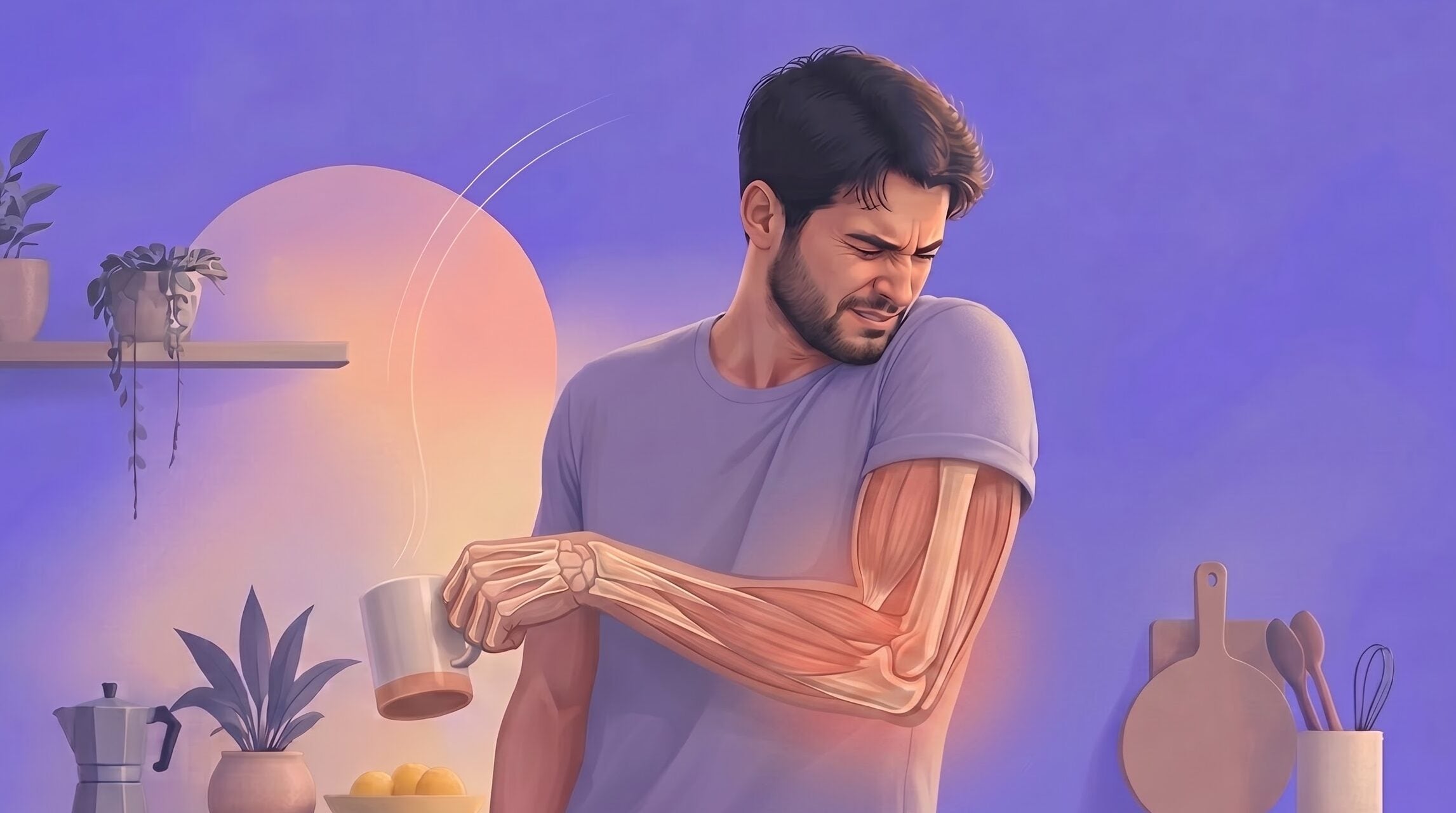
Why does lifting your coffee mug hurt? If you have outer elbow pain when lifting a mug, you are not alone. If outer elbow pain when lifting coffee or twisting a doorknob hurts, you likely have tennis elbow.
You know that feeling when you’re just trying to start your morning?
You reach for your coffee mug, pour it, and lift it up to take a sip, and then it hits. That sharp, hot pull on the outside of your elbow that runs straight down the top of your forearm. It’s annoying, but you ignore it and keep going anyway, dishes, laundry, emails like it’s not a big deal.
By mid-morning, the frustration sets in because the pain keeps catching you off guard during the most innocent moment. Turning the front doorknob, carrying groceries, feels like pulling a strained rubber band.
We all know that exact frustration all too well. The moment a nine-ounce coffee mug feels like a fifty-pound dumbbell, forcing you to rethink how you move.
So, how do you know if that dull ache has officially crossed into tennis elbow territory?
When you pay attention to how your elbow reacts, like extending your wrist backward against weight triggers a burn right at the outer bone. If your morning coffee suddenly feels like a ten-pound weight, your forearm extensor tendons are telling you they’ve reached their limit.
Once you realize that tennis elbow isn’t just a sports injury, you start seeing its hidden triggers everywhere. The trick to healing isn’t putting your life on total pause. It’s learning to spot and modify the high-friction movements you repeat every single day [2]
If the outer elbow pain feels like sudden sharp zings, your body might be dropping subtle hints that the tendon is overworked.
It usually doesn’t happen all at once. It starts as a quiet, localized tenderness a sharp little hot spot right on the outer bump of your elbow when you push against it.
At first, you only notice it when you pinch a heavy book, wring out a dishcloth, or shake someone’s hand firmly.
But then the subtle signals stack up a surprisingly, that distinct aching fatigue running down the top of your forearm after holding your phone or steering wheel for too long.[1]
Why Outer Elbow Pain Happens When Lifting Your Coffee Mug or turn a doorknob?
Imagine your forearm muscles are ropes that all tie off to one spot. That spot is your outer elbow bone like a nail in the wall. Lift, twist, or grip too much and you’re yanking all those ropes against that one nail.
Daily activities that might take a toll on your elbow:
Racket Sports & Late Backhands.
Why does a simple backhand stroke cause outer elbow pain?
Instead of transferring power through your core and shoulder, you flick your wrist to catch up. The ball clears the net, but a sharp, burning zing shoots right down the outside of your elbow.[3]
Using Plumbing Tools
Why does tightening a simple pipe fitting make your arm feel completely drained?
Wrenching requires you to squeeze a hard handle while violently twisting your forearm, a dual-action move that places maximum twisting torque directly on your elbow’s anchoring tendon.[3]
Painting Walls or Trim
How can holding a lightweight paint roller cause so much joint damage?
It’s not the weight, it’s the relentless repetition. Flicking your wrist hundreds of times an hour exhausts your extensor muscles, forcing the tendon to absorb every stroke
You’ve been rolling the paint roller back and forth for three hours straight, dipping, lifting, and flicking your wrist to smooth out the edges near the ceiling. It felt easy at first, but now your outer elbow throbs with a dull, heavy ache. When you try to set the paint roller back in its tray, your fingers feel weak, and your forearm muscles feel locked up like tight cables[3]
Chopping Food in the Kitchen
Chopping tough meat or hard vegetables forces your wrist extensors to contract forcefully upon every blade strike to keep the knife from wobbling in your hand.[3]
Extensive Computer Mouse Use
Resting your hand flat while hovering your fingers over buttons puts your forearm in a state of continuous static extension depriving the tendon of blood flow while you micro-click for hours, which causes outer elbow pain.[3]
Age
Tennis elbow affects people of all ages. But it’s most common in adults between the ages of 30 and 60.
How do you stop these flare-ups?
Recovery doesn’t mean putting your entire life on pause. Instead of forcing your inflamed tendon to handle heavy torque. You can make a few high-impact ergonomic replacements to reduce mechanical strain across your daily routine.
You don’t even notice it at first.
At your desk, your hand’s stuck palm-down on a flat mouse all day, and by evening that outer elbow starts to ache.
At home, it’s the little things, twisting a stubborn screwdriver, turning a round doorknob and suddenly your forearm’s doing all the work.
Then at the gym or on court, you grab that thin racquet or barbell and squeeze way too hard. It’s all small stuff, but together it adds up to one tired elbow.
What Happens During Your Doctor’s Visit?
When you visit a specialist or physiotherapist, they check how you move. Their goal is to find why your tendon is overloaded.
Your doctor will consider a few factors to make a diagnosis:
Symptom history: Did pain build up slowly? Or did it flare after one intense activity?
Daily risks: This includes computer work, manual labor, or racket sports.
Health history: This includes prior elbow injuries or conditions like arthritis.
You Don’t Have to Just “Live With It”
If those checks sound familiar, don’t worry. Many people feel pain while lifting a simple coffee mug. It is frustrating. But a diagnosis does not mean you must stop your hobbies. It is just the first step. It helps you support your arm so it can heal.
Reclaiming Your Grip: A Journey Through Physical Therapy with Your Companion in Recovery.
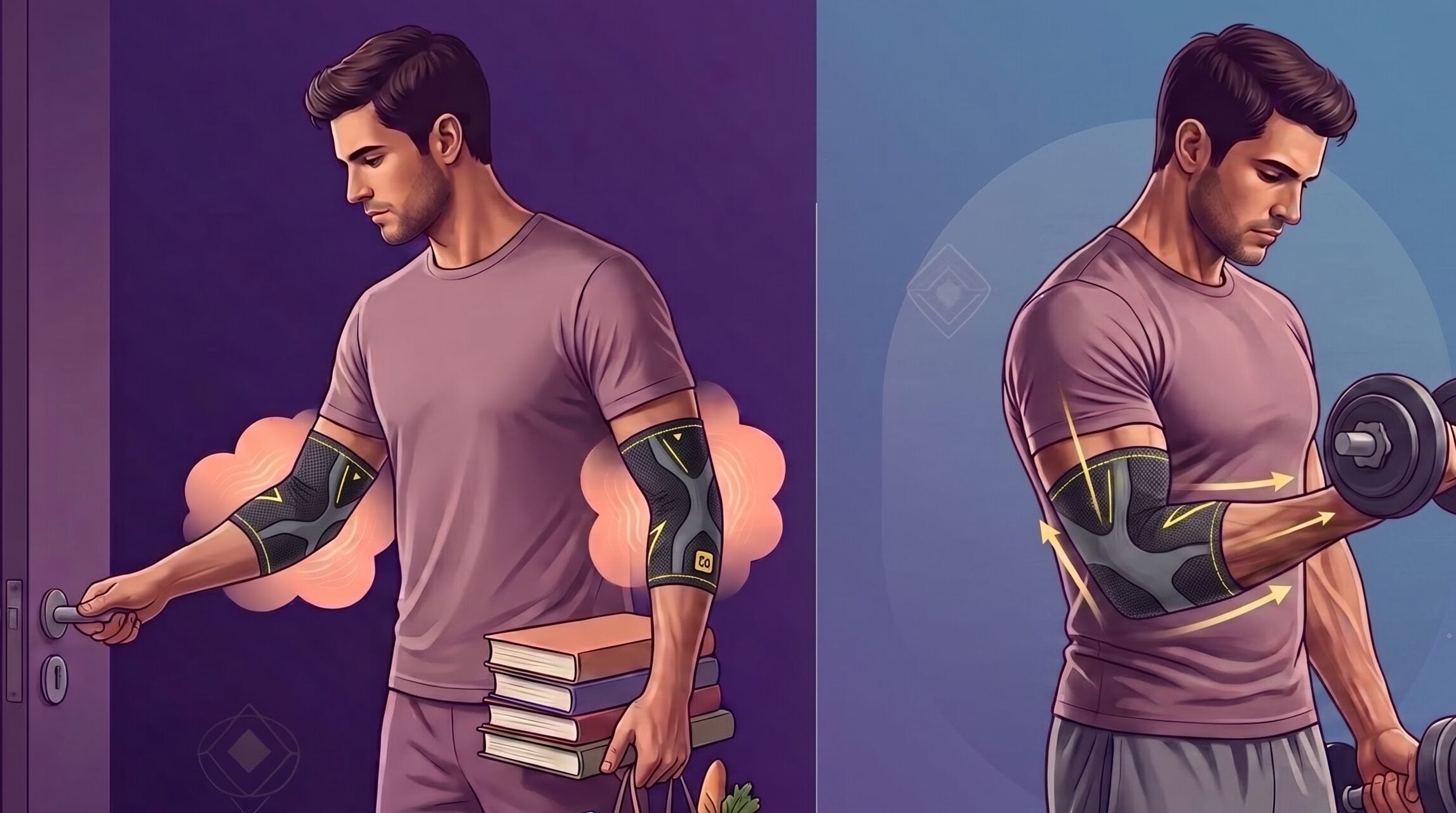
Whether you are stepping back onto the tennis court, tackling a weekend DIY home project, or simply working through spreadsheets at your desk. Recovering from outer elbow pain (lateral epicondylitis) requires a dual approach: improving your biomechanics and offloading peak strain from the tendon anchor.
While making smart physical adjustments during everyday tasks protects your joint from unnecessary wear, wearing a dedicated support. The Betterhood Elbow Support Compression Sleeve provides the continuous joint stabilization, shock absorption, and thermal warmth.
Physio-Approved Recovery Support: The Betterhood Compression Sleeve
Recognizing your symptom triggers and performing clinical checks are critical first steps. However, navigating daily chores while managing tendon discomfort requires continuous joint stabilization.
An elbow compression sleeve serves as an essential companion to your professional care, working alongside your doctor or physiotherapist’s treatment plan to provide targeted stability during daily movement.
The Betterhood Elbow Support Compression Sleeve features an anatomical 4-way stretch blend that delivers calibrated, non-restrictive pressure directly around the lateral epicondyle.
Equipped with an adjustable tension strap and breathable, moisture-wicking fabric, this doctor-approved support sleeve helps offload peak mechanical stress from inflamed tendons during tennis matches, gym workouts, or routine home tasks. By dampening micro-vibrations and promoting local blood flow, it gives your elbow the steady support it needs to heal safely under clinical guidance.
Betterhood Elbow support compression Sleeve: Targeted Support for Tennis Elbow Recovery.
The Betterhood Compression Elbow Sleeve is engineered to provide medical-grade joint stabilization, offload tendon strain, and accelerate recovery from lateral epicondylitis (tennis elbow) and general forearm overuse. Designed for active individuals, office professionals, and athletes, it combines targeted pressure with all day comfort.
Who should consider using the elbow support sleeve?
This elbow support is ideal for gym-goers, athletes, individuals with repetitive arm usage, office workers, drivers, and anyone seeking added elbow stability during daily activities
Key Features
Anatomical 4-Way Stretch Fabric: Crafted from a high-grade elastomer knit that conforms snugly to the unique contours of your forearm and elbow joint.
Targeted Counterforce Compression: Delivers focused pressure over the Extensor Carpi Radialis Brevis (ECRB) tendon mass and lateral epicondyle to dampen impact shock.
Adjustable Support Strap: Features an integrated tension strap allowing you to customize compression levels based on activity intensity.
Moisture-Wicking & Breathable: Advanced ventilated weave wicks sweat away from the skin, preventing heat build-up and irritation during long workdays or intense workouts.
Core Benefits
Pain Relief: Offloads mechanical tension from inflamed tendon anchors, making daily tasks like lifting cups, turning doorknobs, or clicking a mouse pain-free.
Enhanced Performance & Proprioception: Improves local blood circulation and sensory feedback, helping maintain proper wrist alignment during physical therapy, gym reps, or court play.
Active Muscle Retention: Unlike rigid splints, the flexible sleeve allows full range of motion, ensuring forearm muscles stay active without risking muscle atrophy
FAQ
How does a compression sleeve actually help my tennis elbow if the injury is inside the tendon?
Tendon recovery requires offloading peak mechanical tension. The Betterhood sleeve applies calibrated, targeted compression directly over the forearm extensor mass and lateral epicondyle. By compressing the muscle belly slightly below the joint, it acts like a soft brake, reducing the force transmitted to the tendon anchor every time you squeeze, lift, or twist. Additionally, it retains natural body heat, which keeps the tendon fibers pliable and improves local micro-circulation for faster healing.
Can I wear the Betterhood compression sleeve during my physical therapy exercises and gym workouts?
Yes, in fact, it is highly recommended! During active rehabilitation such as eccentric wrist drops or light resistance band work, the sleeve provides neuromuscular feedback (proprioception) that helps you maintain proper wrist positioning. It dampens micro-vibrations across the elbow joint during movement, allowing you to complete your strengthening reps with greater confidence and reduced discomfort.
Will wearing a sleeve make my forearm muscles weaker over time?
No. Unlike rigid braces or full-arm splints that completely immobilize the joint and lead to muscle atrophy, the Betterhood sleeve uses a flexible 4-way stretch blend. It allows full, natural range of motion while gently supporting the joint. Because you continue moving, lifting, and exercising normally, your muscles stay active and continue building strength alongside your recovery program.
How long should I wear the sleeve each day?
You should wear your sleeve during activities that typically trigger or aggravate your symptoms, such as playing sports, typing at work, cooking, or performing household chores. It is also beneficial to wear it during physical therapy sessions. You can comfortably wear it for several hours at a time, but it is best to remove it while sleeping to allow your skin and muscles to rest completely.
How Does Tennis Elbow Support Work?
A tennis elbow support (or counterforce brace) works by applying targeted compression to the forearm extensor muscles. This compression creates an “artificial anchor point” that redistributes pull forces away from the inflamed tendon attachment on the lateral epicondyle. By dampening muscle vibrations and absorbing shock during gripping or twisting. It reduces strain on the tendon and allows the tissue to rest while staying active.[5]
References:
- https://www.orthoinfo.org/diseases–conditions/tennis-elbow-lateral-epicondylitis/
- https://www.sciencedirect.com/science/article/abs/pii/S0972978X1930248X?via%3Dihub
- https://www.mayoclinic.org/diseases-conditions/tennis-elbow/symptoms-causes/syc-20351987
- https://www.google.com/search?q=https://doi.org/10.1016/j.jor.2019.08.005
- https://www.google.com/search?q=https://doi.org/10.1177/0363546518759542
- Physica Role of Elbow Braces
Disclaimer: This content is for informational purposes only and does not substitute professional medical advice, diagnosis, or treatment. Always consult a physician or physical therapist for persistent joint pain.


