




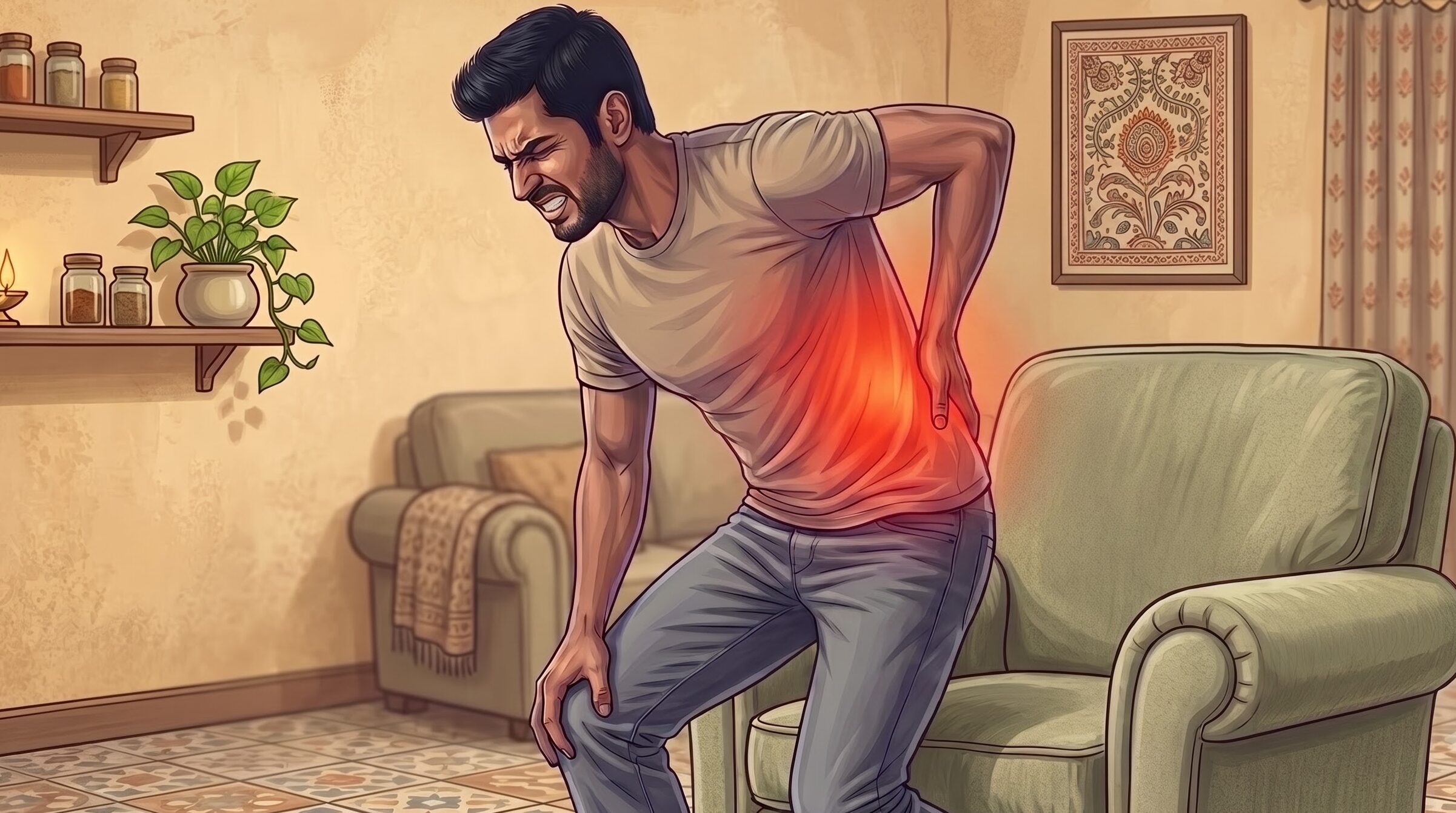
Have you ever stood up from a comfortable armchair, taken your first step, and felt a sudden, strange “catching” sensation in your lower back, almost like a piece of your spine briefly clicked out of alignment? If rolling over makes muscles clamp down, you may have spondylolisthesis. Spondylolisthesis is when one vertebra slips forward, often called a slipped vertebra. This guide explains why spondylolisthesis causes that giving-way feeling.
If you have experienced these unpredictable shifts, you might be dealing with spondylolisthesis.
Unlike general lower back aches or bulging discs, where a soft internal cushion becomes compressed, spondylolisthesis involves a physical, structural shift. One of your spinal bones (a vertebra) glides slightly forward over the bone directly beneath it. This movement creates a minor alignment shift in your lower spine.
The good news is that understanding how this structural shift happens empowers you to take charge of your mobility. By pairing pain relief topicals, rigid external bracing, and deep core rehabilitation exercises, you can stabilize your spine, soothe overactive muscle spasms, and move through your day with ease.
What Is Spondylolisthesis? Why Your Back Feels Unstable
To understand why spondylolisthesis creates such a unique, alarming sensation when you move.
We need to look at how your spine handles weight and shear forces.
Your lower spine (the lumbar region) is designed to stack neatly, carrying your body weight straight down toward your pelvis. Your vertebrae are held in perfect alignment by three structural safeguards:
Intervertebral Discs: Thick, fibrous pads that act as shock absorbers between the bones.
Facet Joints: Paired, inter-locking bony hinges at the back of each bone that act as natural physical brakes.
Spinal Ligaments & Core Muscles: High-tensile bands and deep muscular braces that wrap around the column like a tight corset.
The Concept of “Shear Stress”
When one vertebra loses its structural anchor, then gravity constantly tries to pull that bone forward. As a result, it tries to slide off the edge of the lower vertebra. This forward sliding force is called shear stress.
Instead of your body weight pressing straight down evenly through the column, the weight pushes the slipped bone forward. This stretches surrounding spinal ligaments, pinches nerve pathways exiting the spine, and forces your back muscles into constant, exhausting spasms to keep the bone from sliding further.
Why Position Changes Trigger “Transitional Pain”
When you lie flat or sit quietly, shear stress on the spine is relatively low. But the moment you transition, such as standing up from a sofa, bending forward to tie your shoes, or arching back to reach a high shelf, the slipped bone shifts forward slightly on its lower neighbor.
This micro-movement produces transitional pain, a sharp, sickening “catching” sensation. The feeling that your lower back is suddenly collapsing or giving out, or even a physical clunk as your deep muscles frantically contract to catch the slipping bone.
Isthmic vs Degenerative Spondylolisthesis Types
Spondylolisthesis is not a one-size-fits-all condition. How and why the bone slides forward depends heavily on which type of structural breakdown occurs in your spine.
Isthmic Spondylolisthesis (The Structural “Crack”)
Who it affects: Frequently begins in teenagers, athletes (gymnasts, football players, weightlifters), and active young adults.
The Root Cause: Caused by a stress fracture or structural flaw in a tiny bony bridge at the back of the vertebra called the pars interarticularis. This fracture (known as spondylolysis) weakens the natural back brake of the spine.
The Result: Without that bony brake holding the top vertebra in place, repetitive arching or heavy impact causes the bone body to slowly slide forward, most commonly awhere your lowest lumbar bone meets your tailbone.[1]
Degenerative Spondylolisthesis (Wear and Tear)
Who it affects: Most common in adults over age 50, particularly women.
The Root Cause: Does not involve a broken bone. Instead, years of natural wear and tear cause the spinal discs to dry out and flatten while the stabilizing facet joints become loose and arthritic.
The Result: As the joint surfaces wear smooth and the disc loses its height, the entire vertebra slowly glides forward under normal body weight, most commonly at the L4-L5 level.[2]
Differentiating Spondylolisthesis From Discs and Muscle Sprains
Because back conditions can feel similar on the surface, understanding how structural slippage differs from other issues helps guide proper care.
Spondylolisthesis vs. Disc Issues
Disc Changes: Primary cushion wear where discs flatten or bulge down vertically, but the surrounding vertebrae remain directly stacked above each other.
Spondylolisthesis: A horizontal shift where the upper bone physically glides out of alignment over the bone below.[9]
Spondylolisthesis vs. Soft Tissue Sprains
Muscle Sprain: A temporary stretch or micro-tear in muscle tissue or ligaments. The underlying bony stack remains fully aligned, and tissues heal with short-term rest.
Spondylolisthesis: An alignment shift of the bone itself. Secondary muscle spasms happen as your nervous system tries to hold the unstable segment still.[10]
Physical Examination: The “Step-Off” Sign
During a clinical evaluation, a physician or physical therapist checks spinal alignment by running their fingers down your spinal bones. In moderate cases, they may feel a physical drop-off where one bone has shifted relative to another, known clinically as a palpable step-off sign.[8]
Building deep core endurance forms an internal corset that stabilizes your vertebrae during movement.
Exercises to Avoid
Avoid Extension Stretches (Cobra / Upward Dog): Arching your lower back backward pushes the shifted bone further forward and compresses local nerve roots.
Avoid Heavy Unsupported Lifting: Bending forward under heavy loads increases forward shear forces across the lower spine.[6]
How to Stabilize Spondylolisthesis With Core Exercises
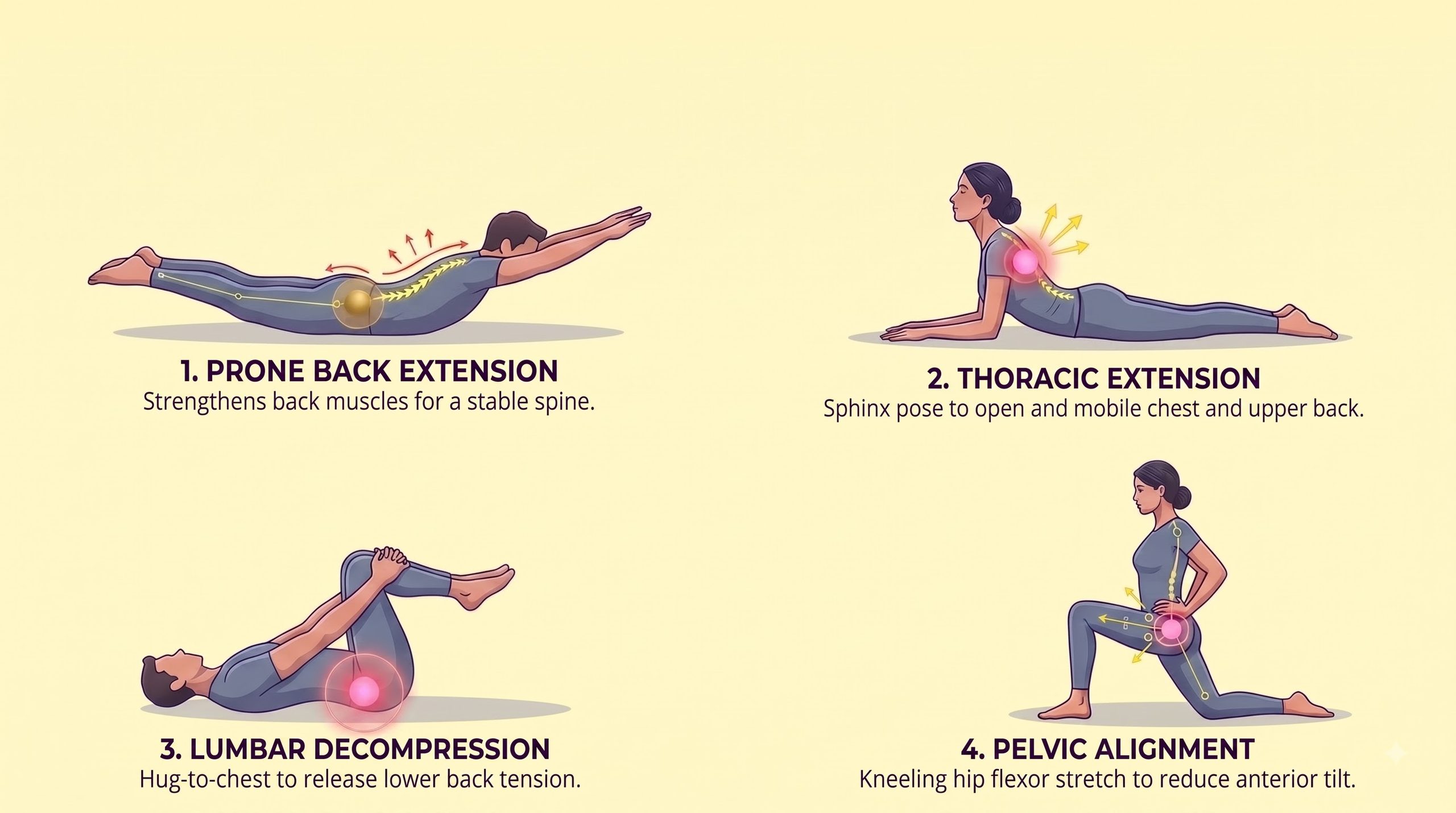
Abdominal Draw-In: Lie on your back with knees bent and feet flat. Gently pull your lower abdomen toward your spine as if zipping tight clothing, keeping your breath steady. Hold for 5–10 seconds to engage deep stabilization muscles (transversus abdominis).
Modified Dead Bugs: Lie on your back, engage your deep draw-in to keep your lower back resting flat against the floor, and alternate slowly tapping one heel to the ground at a time.
Tabletop Bird-Dog: On hands and knees with a flat back, engage your core and slowly extend one leg straight behind you, focusing on stability rather than lifting the leg high.[5]
Clinical Options & Care Pathway
For persistent symptoms, medical specialists use a step-by-step clinical pathway:
Targeted Epidural Injections: If nerve root inflammation causes traveling leg discomfort or numbness, corticosteroid injections reduce swelling around the nerve.
Surgical Options: If conservative care does not provide adequate relief or if progressive nerve weakness develops, surgical options like lumbar spinal fusion can permanently stabilize the vertebral segment.[7]
How Betterhood’s pain relief topicals and ergonomic supports work mechanically alongside physical therapy and core stabilization to manage spondylolisthesis.
Betterhood’s 3-Layer Comfort & Support System
Managing structural spinal issues like spondylolisthesis requires a balanced approach. While physical therapy builds your internal muscle support over time, Betterhood products provide immediate symptomatic comfort and physical support to make daily movement and rehab exercises manageable.
Topical Pain Relief (Patches, Sprays, & Roll-Ons)
When a spinal bone experiences micro-movement or shear stress, your brain orders the surrounding lower back muscles to contract continuously, a protective reflex called muscle guarding. Over time, this constant contraction creates painful, ischemic muscle spasms on top of your joint discomfort.
Key Formulations: Betterhood’s pain relief lineup, including Betterhood Menthol Magnesium Pain Relief Patches, Betterhood Cryoboost Pain Relief Roll-On, and Betterhood Pain Relief & Recovery Spray, combines active Menthol (for instant cryotherapy cooling), Magnesium (for muscle relaxation), and Boswellia (for joint comfort).
How They Work: They stimulate cold and warm sensory receptors on your skin. According to the nervous system’s Gate Control Theory, these fast sensory signals temporarily block deeper spinal pain paths from reaching the brain.
Role in Rehab: By calming surface-level muscle spasms, these topicals lower your pain threshold. Applying a patch or spray 15 minutes before your physical therapy routine allows you to perform deep core draw-ins and pelvic tilts without fighting tight muscle resistance.
Ergonomic Lumbar Support Belts & Bracing
Unlike general soft-tissue muscle strains where bracing is optional, structural conditions involving forward vertebral slippage clinically benefit from external stabilization during active movement.
Restraining Shear Forces: A firm, rigid Betterhood Lumbar Support Belt compresses the abdominal cavity and restricts extreme forward bending (flexion) and backward arching (extension). This acts as an external scaffolding that physically restrains forward shear forces on the slipping bone while you stand, walk, or perform chores.
When to Use: Wear the support belt during periods of standing, walking, or physical activity to prevent transitional “catching” sensations, and remove it during seated rest and core exercises.
Ergonomic Cushions for Seated Posture
Sitting in unsupportive office chairs or soft sofas often causes the pelvis to tilt backward (posterior pelvic tilt), flattening the natural lower back curve and placing high pressure on the unstable spinal segment.
Postural Protection: Placing a contoured Betterhood Memory Foam Lumbar Support Cushion behind your lower back fills the gap between your spine and the chair. It gently maintains a neutral pelvic position, taking direct mechanical strain off your lower back joints and preventing nerve irritation while you sit at your desk or drive.
FAQ
Is high-impact exercise safe with spondylolisthesis?
High-impact activities, such as running on hard pavement, jumping, heavy squats, or gymnastics, apply significant axial loading and repetitive extension forces to the spine. For Isthmic spondylolisthesis, high-impact activities can accelerate forward slippage. Low-impact alternatives like swimming, stationary cycling, elliptical training, and walking on flat surfaces are much safer for maintaining cardiovascular fitness without loading the unstable joint.[11]
What is the difference between spondylolysis, spondylolisthesis, and spondylosis?
These three medical terms sound similar but refer to distinct conditions:
Spondylolysis: A hairline stress fracture or structural defect in the pars interarticularis bone bridge (the crack itself without any bone movement).
Spondylolisthesis: The physical forward slippage or displacement of the vertebra over the bone below.
Spondylosis: General age-related osteoarthritis or wear-and-tear of the spine (bone spurs and disc degeneration) without any slippage.[12]
Reference:
Reference:
- Physiopedia – Spondylolisthesis Overview & Biomechanics
- Samitivej Hospitals – Degenerative Spondylolisthesis Overview
- Cleveland Clinic – Spondylolisthesis Causes & Symptoms
- Cleveland Clinic – Facet Joint Hypertrophy & Degeneration
- NCBI Bookshelf – Physical Therapy & Lumbar Stabilization Exercises
- NCBI Bookshelf – Physical Therapy Precautions & Contraindications
- NCBI PubMed Central – Clinical Interventions & Management Review
- NCBI PubMed Central – Physical Examination & Grading Systems
- NCBI Bookshelf – Non-Surgical Care & Differential Diagnosis
- Cleveland Clinic – Lower Back Pain & Muscle Strain Differentiation
- NCBI Bookshelf – High-Impact Exercise Precautions
- Cleveland Clinic – Spondylolysis vs. Spondylolisthesis vs. Spondylosis
Disclaimer: This content is for informational purposes only and does not substitute professional medical advice, diagnosis, or treatment. Always consult a physician or physical therapist for persistent joint pain.


