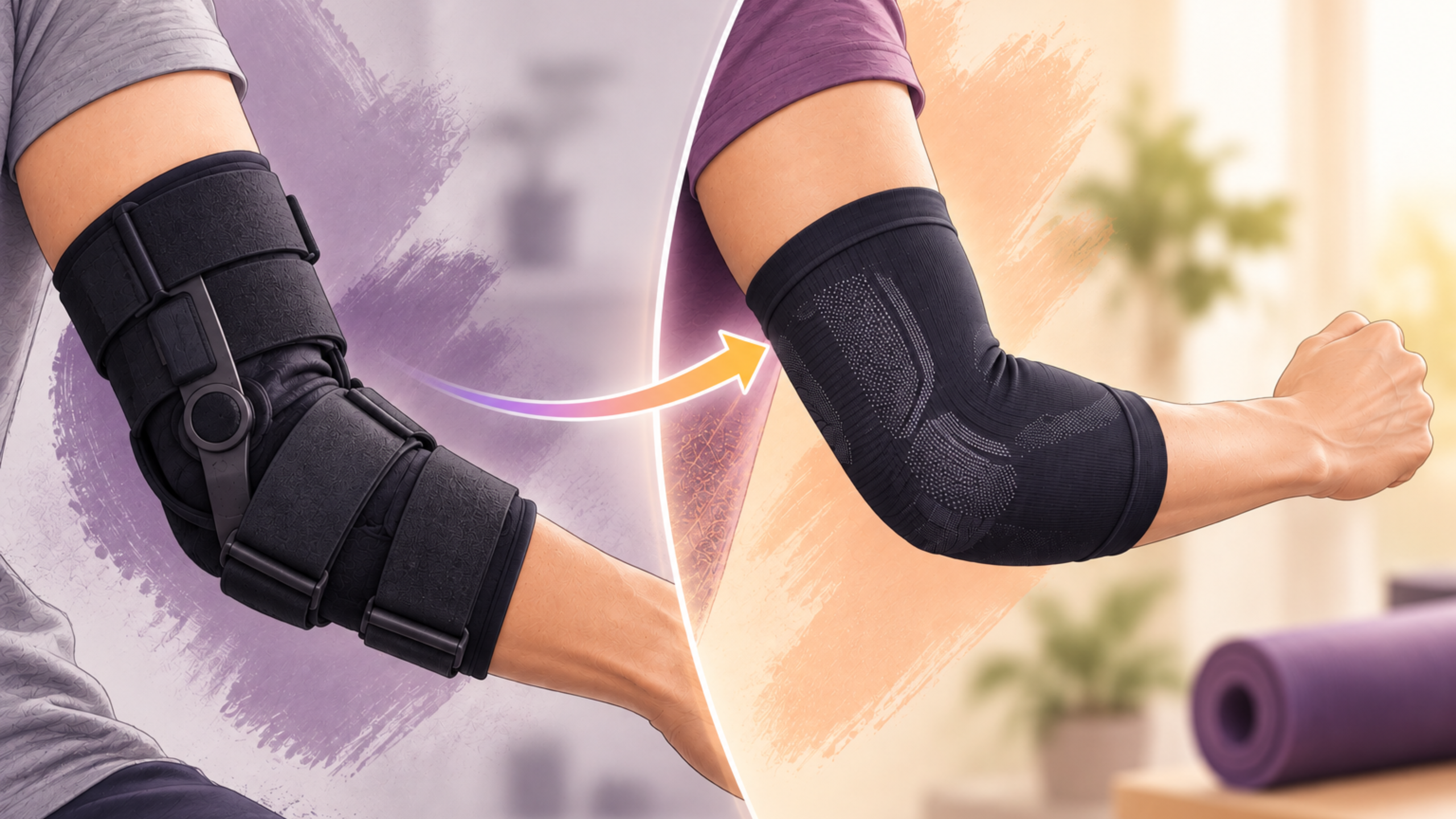




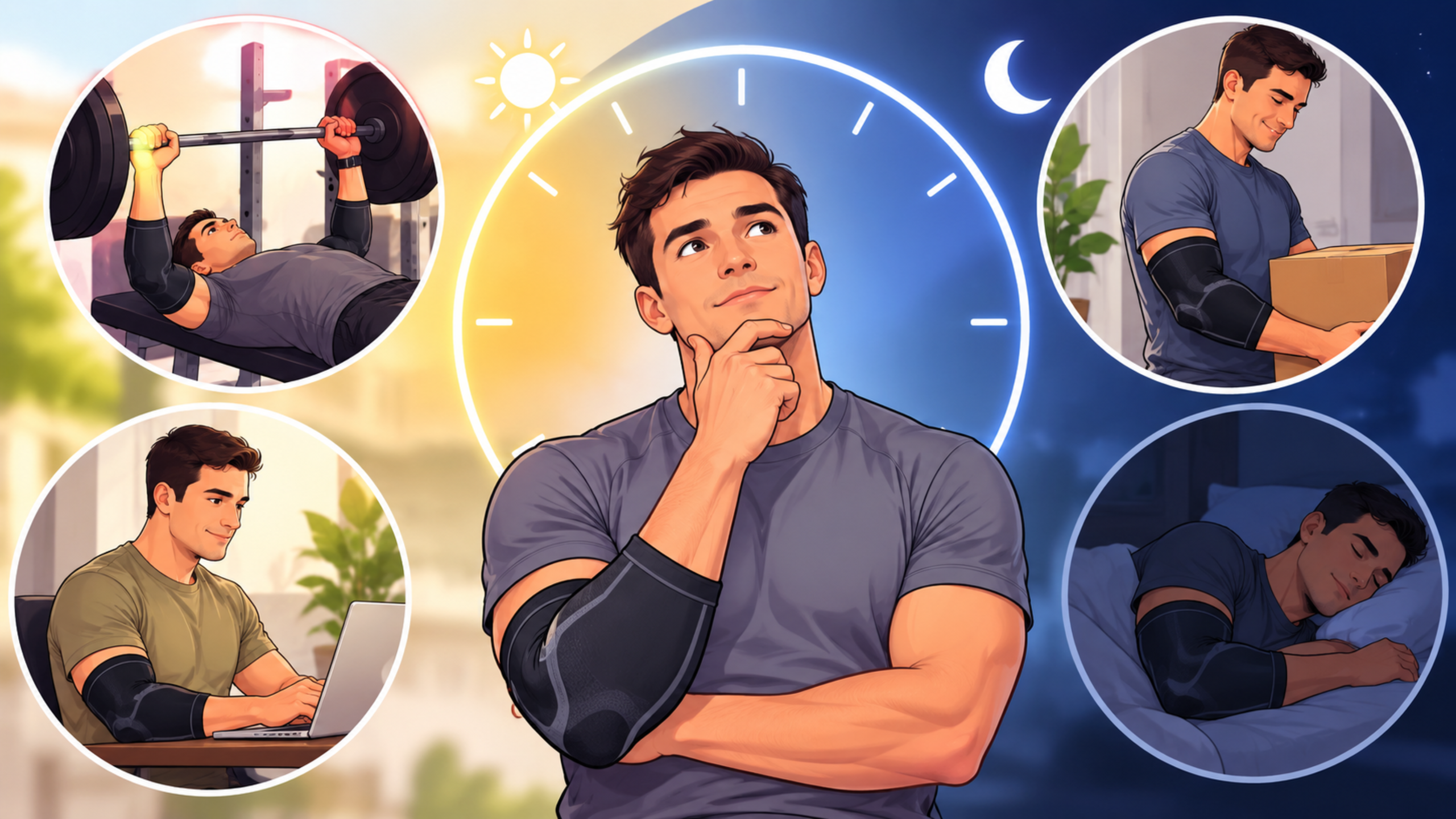
How long should you wear an elbow compression sleeve? There is no universal number of hours that applies to everyone. Your ideal wear time depends on what you are doing, why you are wearing the sleeve, and how comfortable it feels during use.
Is There a Maximum Time Limit for Wearing an Elbow Sleeve?
If you are looking for an exact number of hours, standard daily use does not require a strict schedule. For ordinary, day-to-day use, there is no single hourly limit that applies to everyone [1].
How long you wear an elbow compression sleeve depends on your physical demands. Non-prescription elastic compression provides light mechanical support and helps you stay aware of how your elbow joint is moving [2].
Because of this, you generally only need to wear the sleeve while doing activities that put strain on your elbow.
Key Rule of Thumb: Wear the sleeve when you want physical support, check how comfortable it feels while using it, and take it off when your task ends or when you no longer need it.
Unless a doctor or physical therapist has given you specific instructions for recovery from surgery or a medical condition, you do not need to follow a mandatory minimum or maximum wear time.
When to Wear an Elbow Sleeve: An Activity-Based Approach
Rather than putting a sleeve on at 9:00 AM and leaving it on until 5:00 PM regardless of what you are doing, match your wear time to what your day looks like.
Active Tasks & Exercise
Wearing a sleeve during busy parts of your day can support the tissue around your joint by reducing muscle vibration and extra movement during active motion [3].
- Daily Tasks & Work: Light compression can offer comfortable joint awareness during long sessions of typing, driving, gardening, or physical chores.
- Exercise & Workouts: Wearing a support sleeve during training improves joint position awareness and offers external support while your arm moves under load. Keep the sleeve on through your warm-up, workout, and cool-down, then take it off when your session is finished. [4]
There is limited evidence that keeping a sleeve on long after exercise provides continuous recovery or performance gains [5].
It is also important to have realistic expectations: while an elastic sleeve offers comfort and light support during movement, non-prescription compression garments are not proven to prevent acute injuries or make heavy lifting inherently safer [6].
Rest & Relaxation
Once your active tasks are finished and you sit down to relax, your elbow no longer faces physical strain or repetitive movement. At this point, keeping the sleeve on is usually unnecessary.
During rest, your muscles relax and no longer need external support. While wearing a sleeve while watching TV or reading is generally harmless if it feels comfortable, taking it off lets your skin breathe. It also avoids continuous pressure over the olecranon, which is the bony point at the back of your elbow [7].
When you sit down to rest, take that as your visual cue to slide the sleeve off.
Can You Sleep in an Elbow Compression Sleeve?
When bedtime arrives, you might feel tempted to wear the sleeve overnight to wake up feeling restored. However, routine overnight use is not recommended for ordinary daily support.
When you sleep, your arm stays still for long periods. Elastic sleeves designed for daytime activity can shift position, bunch up, or feel overly tight when pressed against bedding for hours without you realising it.
If a healthcare professional has explicitly instructed you to wear a specialised brace or medical garment overnight, such as keeping the joint still after an injury, follow their guidance. For ordinary daily support, let your arm rest free of compression overnight.
How Fit Affects Safe Wear Time
How long you can comfortably wear a sleeve depends directly on getting the right fit [8].
A well-fitting sleeve stays comfortable during an active task, while a poorly fitting sleeve quickly feels restrictive.
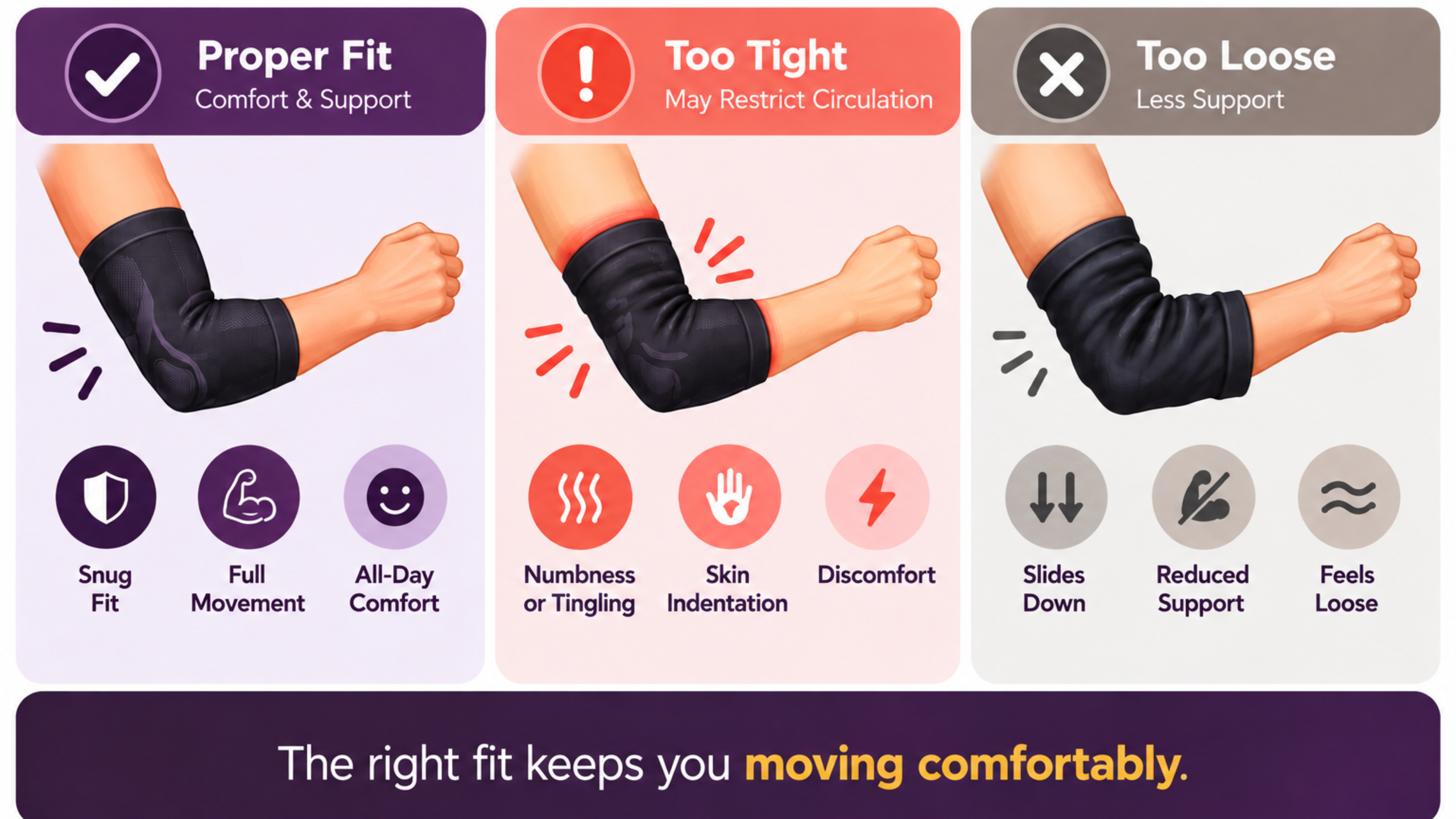
If the sleeve causes numbness or tingling, which are clear signs of nerve pressure, remove it right away to let normal sensation return [9]. If these feelings do not go away, seek medical advice.
Signs It Is Time to Take Your Sleeve Off
Knowing when to take off your sleeve is just as important as knowing when to put it on. Listen to your body and remove the sleeve in any of these practical situations:
- Your physical activity has finished: Once your workout, job tasks, or household chores are done, you no longer need active support.
- You feel numbness or tingling: Any change in sensation means the sleeve is putting too much pressure on your arm and should come off immediately [9].
- The fabric feels overly tight: If support turns into uncomfortable tightness, take the sleeve off to keep blood flowing normally.
- Skin irritation develops: Sweat and friction under synthetic fabrics can cause skin redness or irritation; removing the sleeve lets your skin dry and rest [10].
- The sleeve rolls or bunches up: If the fabric shifts out of place, remove and reposition it instead of leaving it folded over. Doubling or folding compression fabric significantly increases local pressure over that area [11].
A Flexible Option for Daily Support
- Flexible Daily Support: The Betterhood Elbow Support Sleeve can be used as a flexible accessory during the active parts of your day rather than as a rigid medical device that must be worn all day.
- Lightweight & Breathable: Its lightweight, breathable design fits easily under standard clothing and provides flexible support during long hours of activity without feeling bulky. [12]
- Natural Movement: The stretchable fabric moves naturally with your arm during errands, light lifting, or household tasks, while moisture-wicking properties help keep your skin dry. [12]
- Comfortable Joint Support: Its ergonomic design provides comfortable joint support during active movement and stays securely in place. [12]
- When to Remove It: When your daily tasks wind down, simply slide the sleeve off to let your arm relax naturally through the evening and night.
Summary
There is no fixed hourly rule for how long you should wear an elbow compression sleeve [1]. The best approach is to match sleeve wear directly to your daily activities: put it on when you want physical support for movement, workouts, or manual tasks, and take it off when those activities finish or when you are resting.
By choosing a breathable, flexible option and removing it during rest, you can get targeted support during active hours without feeling obligated to wear it all day or night.
Frequently Asked Questions
Can I wear an elbow compression sleeve for several hours at a time?
Wearing a sleeve across several hours of active work or chores is common practice, as non-prescription compression garments lack a fixed hourly time limit [1]. You can keep the sleeve on during these tasks as long as it fits properly without pinching [8], feels comfortable, and does not cause warning signs like numbness or tingling [9]. It is best to remove it once the task is finished.
What should I do if my elbow sleeve causes discomfort?
Remove the sleeve promptly if you experience numbness, tingling, skin discoloration, cold fingers, or localized skin irritation [9, 10]. Ensure the material has not rolled or folded over itself, as doubling the fabric layers multiplies pressure over that area [11]. Re-adjust for proper sizing or stop wearing the sleeve and seek medical advice if discomfort or altered sensation continues after removal.
References
- MacRae BA, Cotter JD, Laing RM. Compression garments and exercise: garment considerations, physiological effects and performance. Sports Med. 2011;41(10):815-843. https://doi.org/10.2165/11591420-000000000-00000
- Barss TS, Pearcey GEP, Munro B, Bishop JL, Zehr EP. Effects of a compression garment on sensory feedback transmission in the human upper limb. J Neurophysiol. 2018;120(1):186-195. https://doi.org/10.1152/jn.00581.2017
- Leabeater AJ, James L, Behm DG. Soft tissue displacement and neuromuscular attenuation via compression garments. Textiles. 2022;2(3):412-426. https://doi.org/10.3390/textiles2030023
- Ghai S, Nilson F, Gustavsson J, Ghai I. Influence of compression garments on proprioception: A systematic review and meta-analysis. Ann N Y Acad Sci. 2024;1536(1):60-81. https://doi.org/10.1111/nyas.15144
- Beliard S, Chauveau M, Moscatiello T, Cros F, Ecarnot F, Becker F. Compression garments and exercise: no influence of pressure applied. J Sports Sci Med. 2015;14(1):75-83. https://www.jsms.org/jasm/index.php/jsms/article/view/75
- Engel FA, Holmberg HC, Sperlich B. Is there evidence that runners can benefit from wearing compression clothing? A systematic review. Sports Med. 2016;46(12):1939-1952. https://doi.org/10.1007/s40279-016-0546-5
- National Institute for Health and Care Excellence (NICE). Pressure ulcers: prevention and management. Clinical Guideline [CG179]. 2014 (updated 2023). https://www.nice.org.uk/guidance/cg179
- Kraemer WJ, Bush JA, Wickham RB, et al. Influence of compression garments on upper body kinematics and muscle soreness. J Strength Cond Res. 2001;15(3):364-370. https://pubmed.ncbi.nlm.nih.gov/11710665/
- Encarnacion LD, Borenstein DG. External compressive peripheral neuropathy. Curr Sports Med Rep. 2005;4(1):35-39. https://doi.org/10.1097/01.CSMR.0000306071.18730.04
- Lazzarini R, Hafner M de S, Duarte I. Contact dermatitis caused by synthetic clothing materials and occlusion. An Bras Dermatol. 2013;88(4):650-653. https://doi.org/10.1590/abd1806-4841.20132048
- Thomas S. The physics and fitting of compression garments: application of Laplace’s Law. J Wound Care. 2014;23(9):436-444. https://doi.org/10.12968/jowc.2014.23.9.436
- Betterhood official product information — Betterhood Elbow Support Sleeve. https://shop.betterhood.in/products/elbow-support-sleeve