



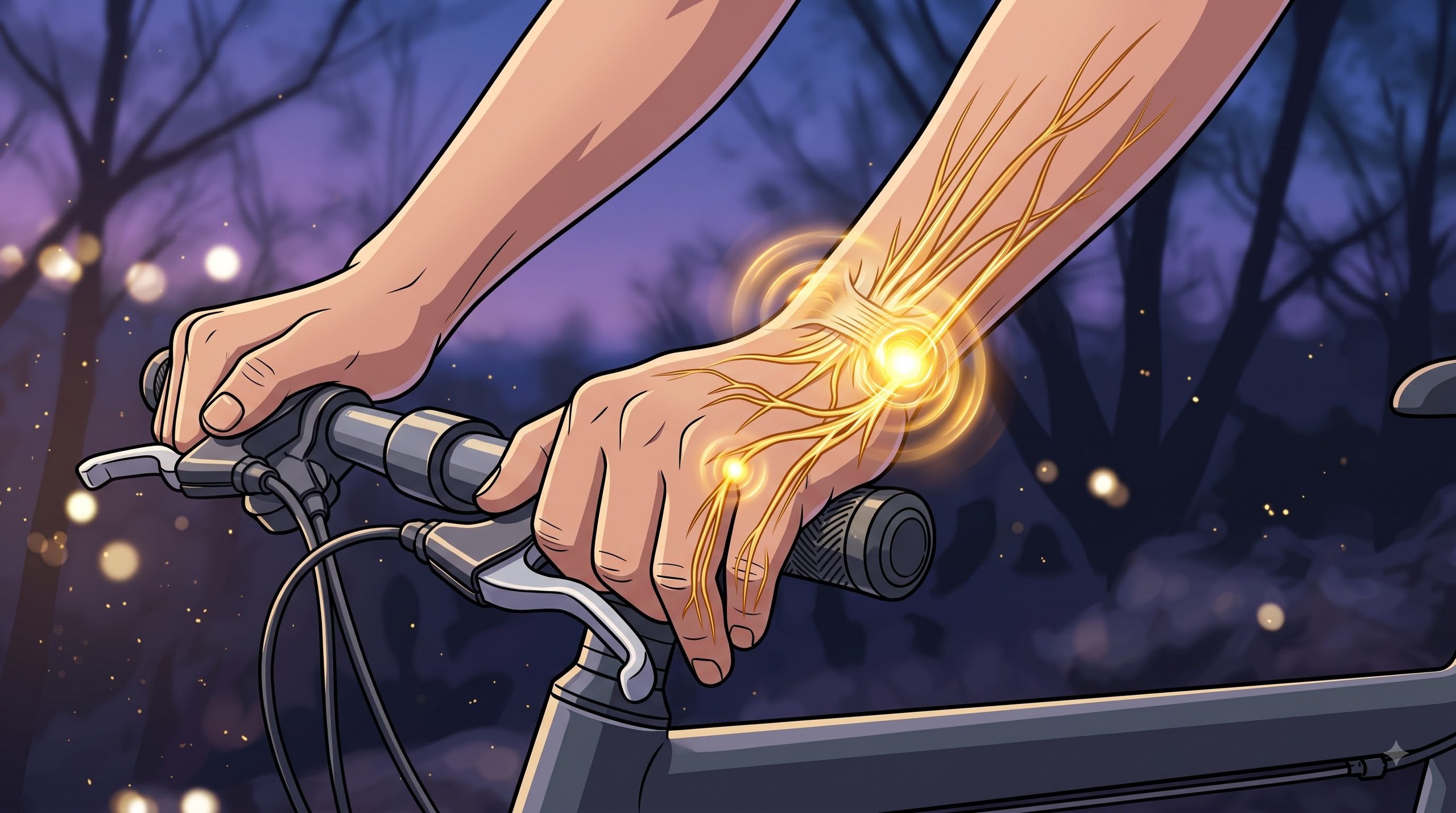
You’re 10 miles into a smooth Saturday morning ride. Your legs are warm, you’re in a great rhythm, and the weather is perfect. But then you feel it: a strange, prickling sensation in your outer hand. It starts at your wrist crease and creeps up into your ring and pinky fingers. What you’re feeling in that exact moment might be classic Handlebar Palsy (often called Cyclist’s Palsy).
You lift your hand off the bar, shake it out, and flex your fingers. It feels better for a minute, so you put your hand back on the hoods. But just two miles later, the “pins and needles” are back. Worse yet, when you go to shift gears, your hand feels surprisingly weak and clumsy.
You are not alone, Handlebar palsy (cyclist’s palsy) affects a significant portion of long-distance and recreational riders, with specific studies showing that upto 72% to 92% of long-distance cyclists experience transient or lasting sensory and motor symptoms in their hands.[9]
What Is Handlebar Palsy and Is It Causing Permanent Nerve Damage?
Handlebar palsy, also known as cyclist’s palsy, is an overuse injury caused by nerve compression in the wrist and hand during long periods of cycling.[1]
Do You Have Handlebar Palsy?
If you feel any of these on your ride, your nerves are taking a beating:
The Tingling (Sensory)
- Pinky & Ring Finger Buzz: Pins and needles in your outer two fingers.
- Thumb & Index Numbness: Burning or dead feeling in your inner fingers.
- Relief on Release: Feeling returns when you shake out your hand.[1]
The Weakness (Motor)
- Brake Struggle: Hard to squeeze the brake levers firmly.
- Clumsy Shifting: Fingers feel slow or awkward on the gear shifters.
- Post-Ride Drops: Difficulty opening a water bottle or turning a key after riding.[1]
The Ache (Discomfort)
- Palm Tightness: A dull ache right at the base of your hand.
- Forearm Cramps: Tightness creeping up into your wrist.[1]
How It Happens
Handlebar Palsy (known medically as Guyon’s canal syndrome) happens when the main nerve on the outer side of your hand gets crushed, stretched, and starved of blood flow while you ride.
The “Tunnel” Get Squeezed
Your ulnar nerve runs down your arm and passes through a tiny, tight space in your wrist called Guyon’s canal. This canal sits right under the fleshy pad of your palm, directly above a small, hard wrist bone (the hamate bone).
The Trap Drops
When you lean your upper body weight onto bicycle handlebars:
- Direct Pressure: Your body weight squishes the nerve flat against the bone beneath it.
- Over-Extension: Bending your wrist backward stretches the nerve tight like a pulled rubber band, shrinking the space inside the tunnel even further.
Blood Flow Cuts Off
High-frequency vibrations from bumpy roads act like a jackhammer on your palm. This constant shaking collapses the tiny blood vessels supplying oxygen to your nerve. Starved of oxygen, the nerve sends immediate warning signals to your brain: tingling, numbness, and sudden grip weakness.
Short-Term Risks
Reduced Bike Control
Loss of grip strength or numbness impairs your ability to react quickly, pull brake levers with full force, or control steering safely while riding.
Temporary Nerve Irritation
Transient numbness that usually subsides within a few minutes to hours after shaking out your hands or ending the ride.
Transient Neuropraxia
Temporary nerve dysfunction where symptoms linger for several days or weeks after a prolonged ride before nerve conduction fully recovers.
Long-Term Risks
Permanent Nerve Damage
Sustained, unmanaged compression can permanently impair the myelin sheath or axons of the ulnar or median nerves, resulting in chronic numbness or loss of sensation.
Muscle Atrophy
Prolonged motor nerve damage causes wasting (atrophy) of the small intrinsic muscles of the hand, particularly the hypothenar muscles (the fleshy pad beneath the pinky) and the web space between the thumb and index finger.
Deformity
Severe, uncorrected ulnar nerve damage can lead to dynamic or fixed joint deformities, such as an ulnar claw position where the ring and pinky fingers curve inward.
Chronic Weakness & Loss of Dexterity
Permanent loss of fine motor skills, making everyday tasks like buttoning a shirt, turning keys, or typing difficult.
Is Bike Fit or Poor Posture Causing Your Wrist Pain?
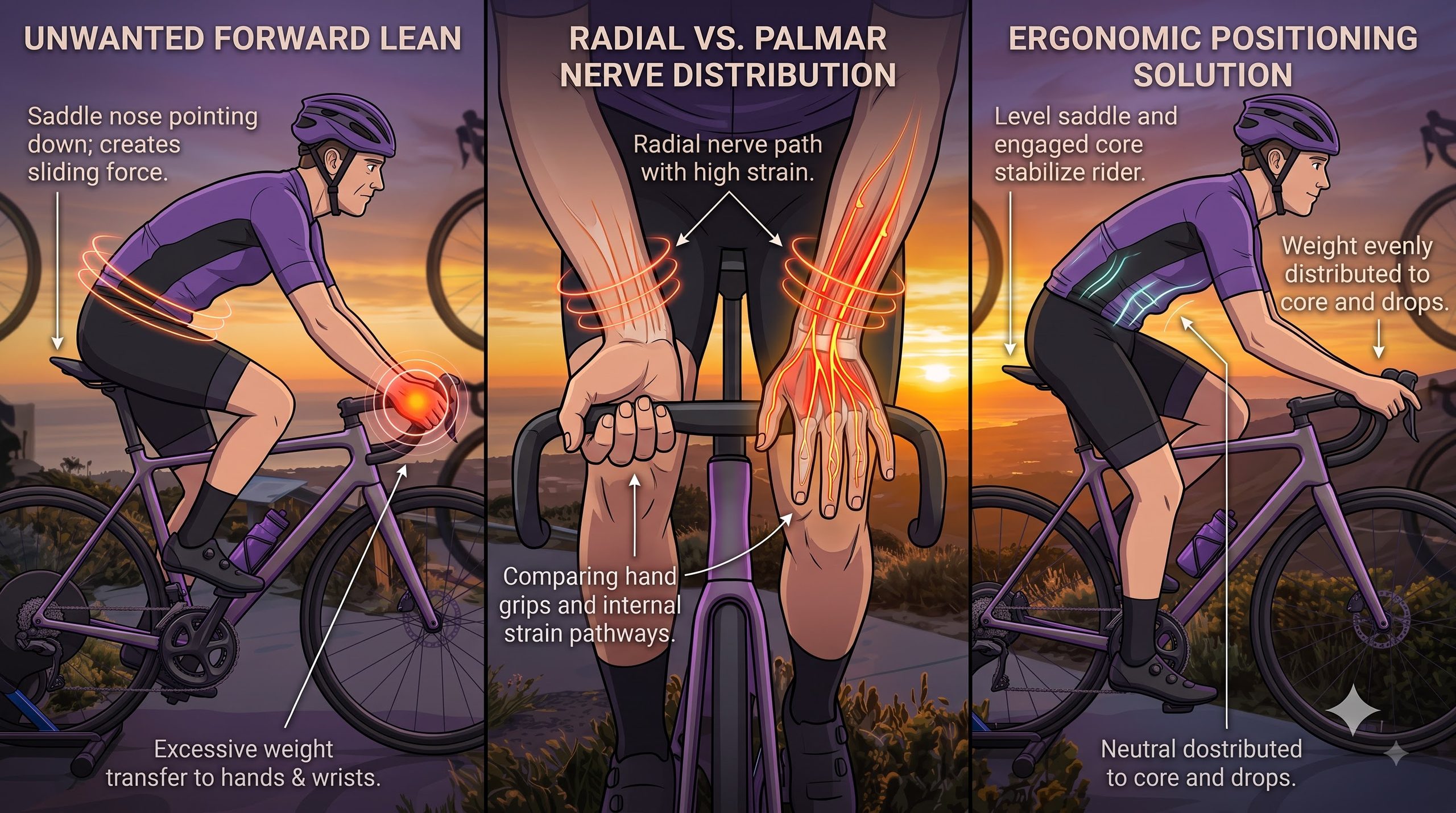
When you’re out on the bike, hand numbness usually comes down to two simple things: road vibration and where your weight rests. A few small tweaks to your riding style can make a world of difference:
Keep your wrists straight
Try not to bend your wrists backward while riding. Keep your forearm and hand in a flat, straight line, just like you’re reaching out for a soft handshake.[2]
Move your hands every few minutes
Don’t leave your hands glued to one spot. Switch between holding the tops, the sides, and the bottom of your bars every few minutes to take the pressure off your palms.[3]
Relax your arms and use your stomach
Don’t lean all your body weight into your palms! Tighten your belly muscles to hold your torso up, and keep a tiny bend in your elbows so your arms can absorb bumps like springs.[4]
Flatten your bike seat
If your seat points downward, you’ll slide forward and crush your hands against the bars. Make sure your seat is totally level so your hips carry your body weight instead.[5]
Cushion the road bumps
Rough roads send vibrations straight into your nerves. Wrap thick handlebar tape, let a little air out of your tires, or wear supportive wrist gear to soak up the road chatter.[6]
How Does the Betterhood Wrist Support Keep Blood Flowing on Long Rides?
The brace holds your wrist in a straight line with your forearm so your ulnar nerve stays uncompressed. By blocking joint hyperextension, it opens up Guyon’s canal and allows steady blood circulation to your ring and pinky fingers throughout your ride.
How a thumb loop acts as the primary anchor for the brace.
It prevents the brace from riding up your arm
When you grip bicycle handlebars, your hands constantly move, shift, and flex. Without a thumb loop:
- The wrist support tends to slip backward toward your forearm.
- Once the brace shifts, it loses its ability to keep your wrist in a flat, neutral position.
- The thumb loop acts as a secure anchor point, keeping the support padded directly over the base of your palm where nerve compression occurs.
It locks the joint in a neutral straight line
Handlebar palsy worsens when your wrist bends backward (hyperextension) under your body weight. By hooking around the base of the thumb, the strap creates leveraged tension that keeps your wrist straight without restricting finger movement, keeping pressure off Guyon’s canal.
It prevents over-tightening around the wrist
Without a thumb loop to hold the brace in place, riders often over-tighten the wrist strap to keep it from slipping. Tightening a wrist strap too much compresses the blood vessels and nerves at the wrist crease, making hand numbness worse rather than better. The loop allows the brace to stay secure with moderate, comfortable tension.
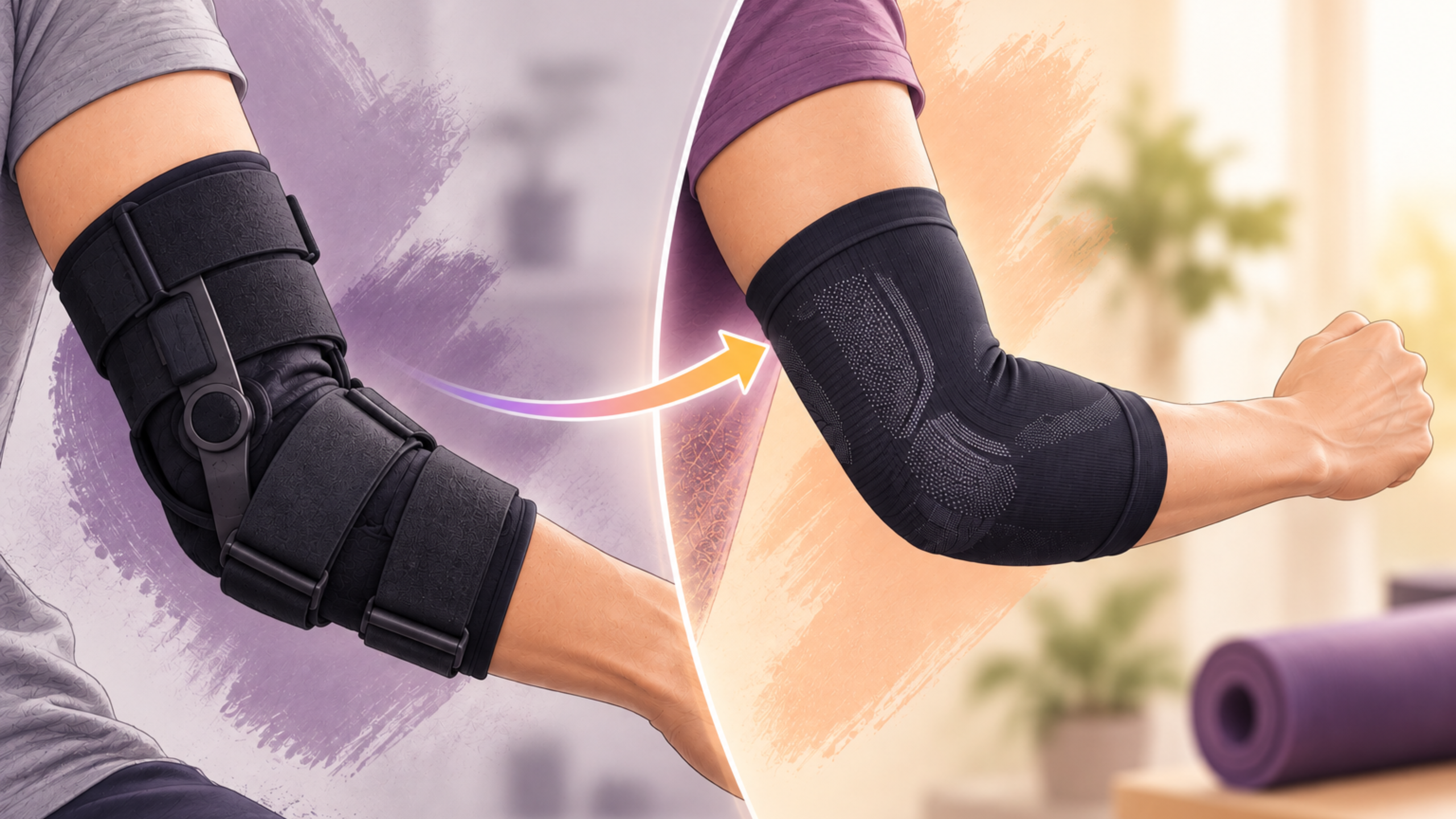
The betterhood Wrist Support Brace with Thumb Loop is a lightweight, physio-backed wrist brace engineered for everyday comfort, active workouts, and targeted injury rehabilitation.
Unlike stiff, bulky medical splints, betterhood emphasizes a zero-bulk, anatomical design that offers firm joint stabilization while leaving your fingers and thumb completely free for natural motion.
How it Stops Handlebar Palsy Before It Starts
During a ride, handlebar palsy occurs when continuous road chatter and backward wrist extension combine to squeeze the ulnar nerve inside Guyon’s canal at the base of your palm. The betterhood brace prevents this through three mechanism layers:
Neutral Alignment Retention: The anatomical thumb loop and adjustable compression strap keep the wrist joint in a straight line with the forearm. This prevents extreme wrist hyperextension when gripping brake hoods or flat bars, keeping the nerve pathway open.
Vibration Attenuation: The ortho-grade fabric acts as a micro-barrier against high-frequency asphalt feedback, absorbing chatter before it passes through your hands and irritates sensitive nerve fibers.
No Shift or Compression Lock: Unlike generic wrist wraps that slip backward and force riders to over-tighten them, the thumb loop anchors the brace over the wrist crease. You get effective stabilization without cutting off peripheral blood flow.
FAQ
How long does handlebar palsy last?
For mild cases caught early, numbness usually fades within a few hours to a couple of days after relieving pressure. However, if you ignore symptoms and suffer severe nerve compression (axonotmesis), full recovery can take anywhere from 2 to 8 weeks, as damaged nerve fibers regenerate at a rate of roughly 1 mm per day.[8]
What is the difference between Handlebar Palsy and Carpal Tunnel Syndrome?
It comes down to which nerve is being squeezed:
Handlebar Palsy (Ulnar Nerve): Affects the pinky and ring finger along the outer side of your hand near Guyon’s canal.
Carpal Tunnel Syndrome (Median Nerve): Affects the thumb, index, middle finger, and half of the ring finger through the center of your wrist.[7]
Do gel gloves fix handlebar palsy?
Not always. In fact, thick or improperly fitted gel pads can sometimes make numbness worse by concentrating extra pressure directly into the center of Guyon’s canal. A dedicated wrist support or ergonomically padded glove that leaves the central ulnar channel clear is far more effective.[6]
References
- https://lambertiphysiotherapy.co.za/handlebar-palsy-cyclists-palsy/
- https://www.cyclingweekly.com/fitness/how-to-avoid-wrist-pain-when-cycling-332202?utm_source=gemini
- https://www.reachphysioyeg.com/post/cyclist-palsy?utm_source=gemini
- https://www.handtherapyacademy.com/diagnoses/handlebar-palsy-also-know-as-ulnar-nerve-compression/?utm_source=gemini
- https://www.cyclingweekly.com/fitness/top-7-wrist-mobility-exercises-for-cycling-heres-how-to-prevent-hand-related-pain?utm_source=gemini
- https://www.bodiempowerment.com/cyclists-palsy-causes-symptoms-how-to-prevent-it-treatment/?utm_source=gemini
- https://www.handtherapyacademy.com/diagnoses/handlebar-palsy-also-know-as-ulnar-nerve-compression/?utm_source=gemini
- https://www.reachphysioyeg.com/post/cyclist-palsy?utm_source=gem ini
- https://www.vancityphysio.com/post/overcoming-cyclists-palsy-understanding-treatment-and-prevention
Disclaimer: This content is for informational purposes only and does not substitute professional medical advice, diagnosis, or treatment. Always consult a physician or physical therapist for persistent pain.