



If you experience lumbar spinal stenosis, a walk around the neighborhood may feel fine at first. However, after just a few minutes, an uncomfortable aching, heaviness, or numbness can build up in your legs.[1] Your legs might feel like lead, forcing you to stop. Fortunately, as soon as you sit down or lean forward over a bench or shopping cart, the discomfort begins to fade.[1]
If this pattern sounds familiar, you may be experiencing neurogenic claudication caused by lumbar spinal stenosis (LSS).[1-3]
This condition is common, particularly in adults over age 50.[3] Therefore, understanding how lumbar spinal stenosis affects your spine is key. Consequently, learning why certain postures change how you feel can help you manage discomfort and stay mobile.[2-4]
What Is Lumbar Spinal Stenosis and What Causes It?
Lumbar spinal stenosis is a condition where the open pathways inside your lower back gradually become narrower. As these spaces tighten, they press on nerve roots and small blood vessels. As a result, you may experience pain, numbness, or heaviness in your legs when standing or walking.[1-3]
According to the North American Spine Society (NASS), degenerative lumbar spinal stenosis occurs when structural changes reduce available spinal space.[3] The lumbar spine consists of five vertebrae separated by shock-absorbing discs. In addition, nerves branch off from the main spinal bundle in your lower back. These nerves pass through small bony openings to reach your hips, buttocks, and legs.[3]
Primary Anatomical Areas Affected
- Central Canal: The main vertical pathway running through the center of the spine. Narrowing here can compress multiple nerves within the main nerve bundle at the same time.[3]
- Neural Foramina: The small side exits between adjacent vertebrae where individual nerve roots leave the spinal column. Narrowing in these side passages causes targeted compression on specific nerves.[3]
Common Degenerative Causes
Spinal stenosis rarely happens overnight. Instead, it usually develops slowly over many years as part of the natural aging process in the spine:[2,3]
- Degenerative Disc Space Narrowing: As spinal discs naturally lose water and height over time, the space between your vertebrae decreases, causing surrounding tissues to settle and narrow the nerve pathways.[3]
- Thickening of the Ligamentum Flavum: The main ligament running along the back wall of the spinal canal can lose elasticity, buckle, or thicken over time, intruding directly into the canal space.[3,5]
- Bone Spurs (Osteophytosis): Age-related changes in the small spinal joints (facet joints) often cause smooth bony overgrowths to form, gradually narrowing both the central canal and the side exits.[3]
What Are the Symptoms of Lumbar Spinal Stenosis?
The most common symptoms of lumbar spinal stenosis include an aching, heavy, or tired feeling in the buttocks, thighs, or calves, often accompanied by numbness, tingling, or leg weakness during walking or standing.[1-3] While some people feel mild lower back discomfort, the main symptoms usually affect the legs.[1,3]
Understanding Neurogenic Claudication
Healthcare providers refer to this specific pattern of leg symptoms as neurogenic claudication.[1-3] The word “claudication” comes from a Latin term meaning to limp or walk with discomfort, while “neurogenic” simply means the feeling starts from nerve compression in the spine.[2]
For many people, neurogenic claudication follows a very recognizable pattern:[1-3]
- Leg-Dominant Discomfort: The symptoms usually start in the lower back or buttocks and travel down into the thighs, calves, or feet.[1,3]
- Heavy or “Lead-Like” Legs: You might feel like your legs are getting tired, heavy, or weak after walking a fairly predictable distance.[1]
- Affects One or Both Legs: Symptoms can happen in both legs at once or feel noticeably worse on one side, depending on where your nerves are compressed.[3]
- Relief with Posture Changes: Discomfort builds up while standing or walking upright, but eases when you sit down or bend forward at the waist.[1-4]
Why Does Walking or Standing Trigger Spinal Stenosis Symptoms?
Ever notice that your legs start aching or feeling heavy after standing for a while, but the discomfort eases when you sit down? The reason comes down to what happens to your lower spine when you stand upright. [4]
When you stand erect or lean slightly backward, your lower back naturally arches inward (a curve called lumbar lordosis). This posture physically reduces the space inside the spinal canal and side exits. [4] If those pathways are already narrowed by spinal stenosis, standing upright increases mechanical pressure on the nerves. [4, 5]
Biomechanical studies (such as landmark research by Inufusa et al. and imaging studies by Schmid et al.) show that upright posture reduces the physical space in the spinal canal and side exits, which can increase mechanical crowding around spinal nerves. [4,5] When you walk, active nerve tissue needs extra oxygenated blood. In a narrowed spinal canal, that circulation is restricted, leading to localised nerve irritation that shows up as aching, heaviness, or cramping after a short time on your feet. [4, 5]
Why Does Bending Forward or Sitting Relieve Spinal Stenosis Pain?
Bending forward or sitting down relieves spinal stenosis pain because flexing the lower back physically widens the spinal canal and nerve exits. [4] Bending forward flattens the inward arch of your lower back, stretching surrounding ligaments and taking pressure off squeezed nerve roots. [4, 5]
When you sit down or lean forward at the waist [4]:
- The spinal canal and nerve exits expand, creating more room for nerve roots. [4, 5]
- Direct mechanical pressure on sensitive nerve tissue is reduced. [4]
- Physical crowding and pressure on sensitive nerve structures are reduced. [4, 5]
- Leg aching, numbness, and heaviness begin to fade within a few minutes. [1,4]
What Is the “Shopping Cart Sign” in Spinal Stenosis?
In everyday life, this posture effect explains what doctors call the “shopping cart sign”. [2] You may notice that walking through a grocery store is much easier if you lean forward over a shopping cart or rolling walker. [2]
Leaning forward keeps your lower back in mild flexion. That small adjustment keeps the nerve pathways open, preventing the compression that normally happens when you walk completely upright and allowing you to walk further with less discomfort. [2,4]
To make sitting during rest breaks even more comfortable, some people choose to use a supportive seat accessory like the Betterhood Lumbar Back Cushion. While a seat cushion does not treat or reverse the underlying spinal stenosis, it can help provide physical comfort and support a relaxed posture when taking a seated break from standing or walking.
How Can You Tell Spinal Stenosis Leg Pain From Poor Circulation?
Spinal stenosis leg pain (neurogenic claudication) is caused by compressed nerves in the lower back and improves when you change your posture, such as sitting down or leaning forward. [2] Leg pain from poor circulation (vascular claudication) is caused by narrowed arteries in the legs (peripheral artery disease) and improves simply by stopping physical effort, regardless of whether you are standing, sitting, or leaning. [2]
Because both conditions are common in older adults and cause leg discomfort during activity, telling them apart is an important step toward getting the right care.[2]
| Feature | Neurogenic Claudication (Spinal Stenosis) | Vascular Claudication (Poor Circulation / PAD) |
| Primary Cause | Nerve compression and restricted blood flow in the lower spine | Reduced arterial blood flow to active leg muscles |
| Symptom Triggers | Walking, standing upright, or leaning backward | Muscle effort during exercise (walking, climbing stairs) |
| Impact of Posture | Eases when bending forward or sitting | Unchanged by posture; eases simply by standing still |
| Relief Mechanism | Flexing the spine to create space around compressed nerves | Stopping muscle work to lower oxygen demand |
| Walking Inclines | Walking uphill is often easier (body leans forward). | Walking uphill worsens symptoms faster (muscles work harder) |
| Foot Pulses | Typically normal | Often reduced or absent during a physical exam |
Note: In some cases, a person can have both spinal stenosis and poor circulation at the same time.[2] If you experience leg pain when walking, a thorough evaluation by a healthcare professional can help identify the exact cause.
Is Walking Good for Lumbar Spinal Stenosis?
Yes, walking is generally safe and beneficial for people with lumbar spinal stenosis when adapted to your personal comfort level, but you should not try to push through severe leg pain.[6] Staying active keeps your heart healthy, maintains muscle strength, and supports joint mobility. Avoiding activity entirely can lead to muscle weakness and make everyday walking harder over time.[6]
To make walking more comfortable:[6]
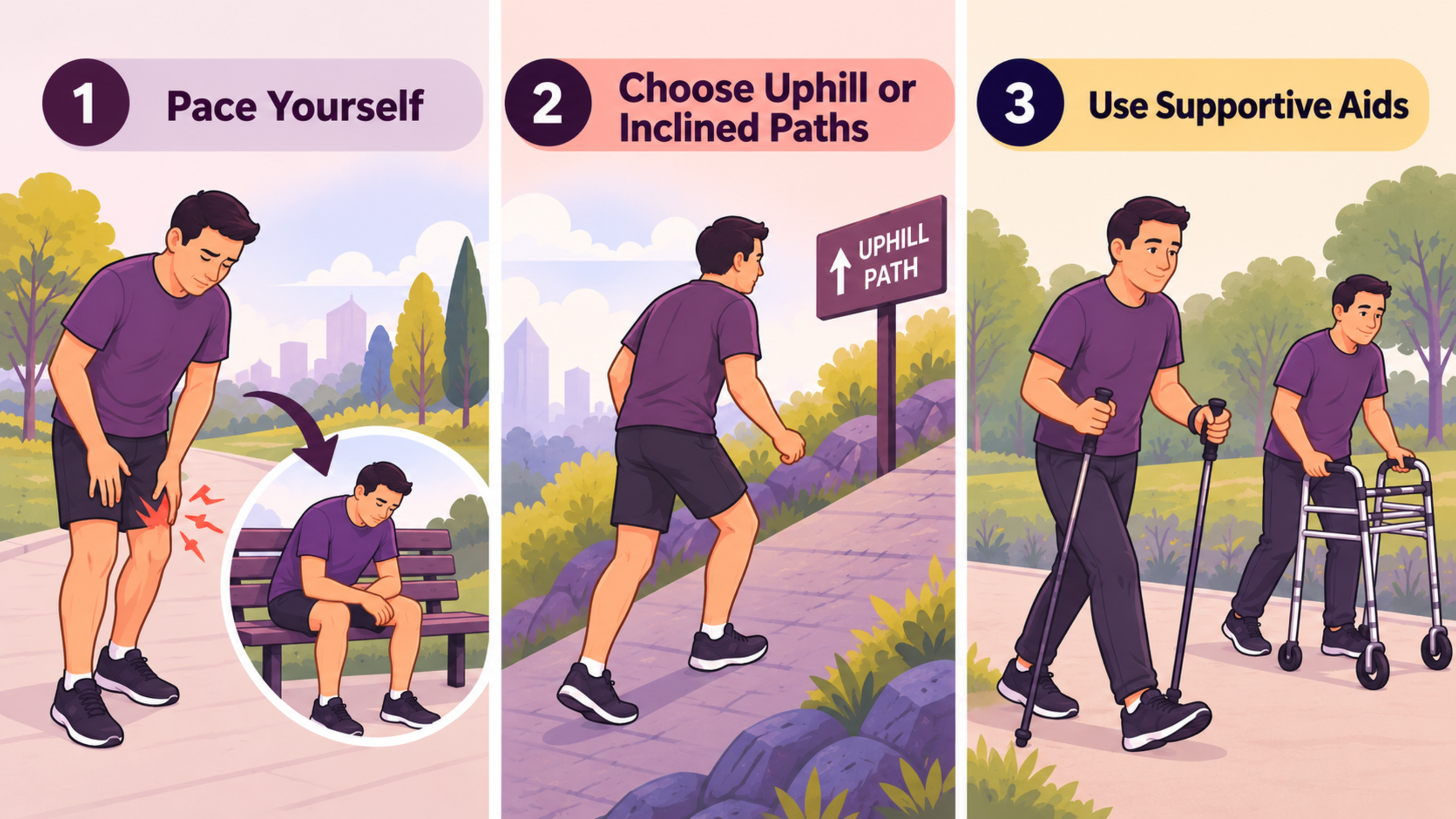
- Pace Yourself: Pause to sit or lean forward at the first sign of leg heaviness or numbness instead of pushing through the discomfort. [1,6]
- Choose Uphill or Inclined Paths: Walking on a slight upward incline naturally causes your body to lean forward slightly, keeping your spine flexed and often making walking easier. [4]
- Use Supportive Aids: Using trekking poles or a rolling walker encourages a slightly flexed posture, helping you walk further with less leg distress. [2,6]
How Can You Manage Lumbar Spinal Stenosis Without Surgery?
You can manage lumbar spinal stenosis without surgery through activity pacing, low-impact exercise, physical therapy, and movement strategies that keep your spine in comfortable postures. [3,6] While conservative care does not reverse the physical narrowing inside the spine, research shows it can significantly ease symptoms and improve your daily endurance. [3,6]
Structured Pacing and Interval Walking
Instead of walking continuously until leg pain forces you to stop, try structured pacing. Break your daily walks into shorter, planned intervals separated by brief rest breaks in a seated or forward-leaning position. [1,6]
Sitting down before symptoms build up gives your nerves time to recover blood flow, helping you cover a greater total distance throughout the day. [4, 6]
Supportive Topical Measures for Daily Comfort
While topical products do not fix or decompress the narrowed spinal canal itself, they can serve as helpful options for managing localised soft-tissue aches and back discomfort as part of your broader daily routine:
- Betterhood Pain Relief Patch: Applying a Betterhood Pain Relief Patch to the lower back can provide localised, temporary comfort for aching muscles after a walk. It does not treat the underlying nerve compression or open the spinal canal, but it may offer easy, targeted relief for temporary back soreness.
- Betterhood Pain Relief Spray: For quick application before or after daily activity, the Betterhood Pain Relief Spray offers another practical option for temporary, localised muscle and joint comfort. Like patches, topical sprays do not alter spinal structures or replace physical therapy, but they can complement your overall self-care routine.
Stationary Cycling for Aerobic Fitness
Staying active is key, but walking or treadmill exercise can sometimes trigger leg symptoms quickly. A comprehensive Cochrane review indicates that stationary cycling, particularly in a flexed or supported posture, may be better tolerated than upright walking for some people with lumbar spinal stenosis. Sitting on a bike naturally places your lower back in mild flexion, keeping the spinal canal open while providing a great cardiovascular workout. [4, 6]
Targeted Physical Therapy and Flexion Exercises
A physical therapist can design a tailored programme to support your mobility without overextending your lower back. [3,6] Helpful approaches often include:
- Flexion-Biased Stretches: Gentle movements like single or double knee-to-chest stretches, seated forward folds, or gentle back rounding can ease tight lower back muscles and temporarily open nerve pathways. [4, 6]
- Core and Hip Strengthening: Strengthening your abdominal muscles, glutes, and hips helps stabilise your pelvis and keeps your lower back from arching excessively when you stand.[6]
- Gait and Posture Guidance: A therapist can suggest small adjustments to your walking style and help you choose supportive aids to keep you moving comfortably.[6]
When Should You See a Doctor for Spinal Stenosis?
You should schedule a medical evaluation if leg aching, numbness, or heaviness consistently limits how far you can walk, interferes with daily tasks, or fails to improve with rest.
A doctor, physical therapist, or spine specialist can perform a physical exam and order an MRI if needed—to confirm what is causing your symptoms and build a personalised care plan.[3]
What Warning Signs Require Urgent Medical Evaluation?
While spinal stenosis is usually a chronic, manageable condition, certain neurological signs point to severe nerve compression and require immediate emergency medical care:[3]
- Bowel or Bladder Changes: A sudden or progressive loss of normal bowel or bladder control, such as being unable to urinate or experiencing sudden incontinence. [3]
- Saddle Numbness: A sudden loss of feeling or persistent numbness in the “saddle area”—including your groin, buttocks, inner thighs, or genitals. [3]
- Progressive Leg Weakness: Rapidly worsening weakness in your legs or feet, such as suddenly being unable to lift the front of your foot while walking (foot drop) or your legs giving way beneath you. [3]
Frequently Asked
Can lumbar spinal stenosis be managed without surgery?
Yes, many people effectively manage lumbar spinal stenosis without surgery through conservative strategies like physical therapy, activity pacing, flexion exercises, and low-impact workouts. [3,6]
Is walking good for lumbar spinal stenosis?
Yes, walking is safe and beneficial for lumbar spinal stenosis when adapted with frequent rest breaks or forward-leaning postures to prevent nerve irritation. [1,6]
Can lumbar spinal stenosis get worse over time?
Because lumbar spinal stenosis stems from age-related spinal degeneration, symptoms often progress slowly or wax and wane over time, though conservative management helps preserve mobility. [2,3]
Final Takeaway
Living with lumbar spinal stenosis often means adjusting to how standing and walking affect your back and legs. Standing upright arches the lower back and tightens nerve pathways, triggering the leg aching or heaviness known as neurogenic claudication. [1-4]
Conversely, sitting or leaning forward flattens the lumbar curve, opening the spinal canal and bringing quick relief. [1-4]
While conservative care cannot reverse age-related structural narrowing, strategies such as structured pacing, physical therapy, and posture-aware activities help maintain mobility and daily comfort. [3,6]
If persistent or worsening neurological symptoms begin to interfere with your daily routine, seeking a medical evaluation ensures you get an accurate diagnosis and a tailored plan to keep you moving safely. [3]
References
- Genevay S, Atlas SJ. Lumbar spinal stenosis. Best Pract Res Clin Rheumatol. 2010;24(2):253-265. doi:10.1016/j.berh.2009.11.001 https://pubmed.ncbi.nlm.nih.gov/20227646/
- Suri P, Rainville J, Kalichman L, Katz JN. Surgical versus non-operative treatment for lumbar spinal stenosis: a review. Curr Rev Musculoskelet Med. 2010;3(1-4):63-71. doi:10.1007/s12178-010-9063-0 https://doi.org/10.1007/s12178-010-9063-0
- Kreiner DS, Shaffer WO, Baisden JL, et al. An evidence-based clinical guideline for the diagnosis and treatment of degenerative lumbar spinal stenosis (update). Spine J. 2013;13(7):734-743. doi:10.1016/j.spinee.2012.11.059. https://pubmed.ncbi.nlm.nih.gov/23830297/
- Inufusa A, An HS, Lim TH, Hasegawa T, Haughton VM, Nowicki BH. Anatomic changes of the spinal canal and intervertebral foramen associated with posture and loading. Spine (Phila Pa 1976). 1996;21(12):1448-1456. doi:10.1097/00007632-199606150-00010 https://doi.org/10.1097/00007632-199606150-00010
- Schmid MR, Stucki G, Duewell S, Wildermuth S, Romanowski B, Boos N. Changes in cross-sectional area of the cervical and lumbar spinal canal during flexion and extension: in vivo MRI study. AJR Am J Roentgenol. 1999;172(4):1095-1102. doi:10.2214/ajr.172.4.10587158 https://doi.org/10.2214/ajr.172.4.10587158
- Ammendolia C, Stuber KJ, Rok E, Rampersaud R, Kennedy CA, Pennick V, et al. Nonoperative treatment for lumbar spinal stenosis with neurogenic claudication. Cochrane Database Syst Rev. 2013;8:CD010712. doi:10.1002/14651858.CD010712. https://pubmed.ncbi.nlm.nih.gov/23996271/