



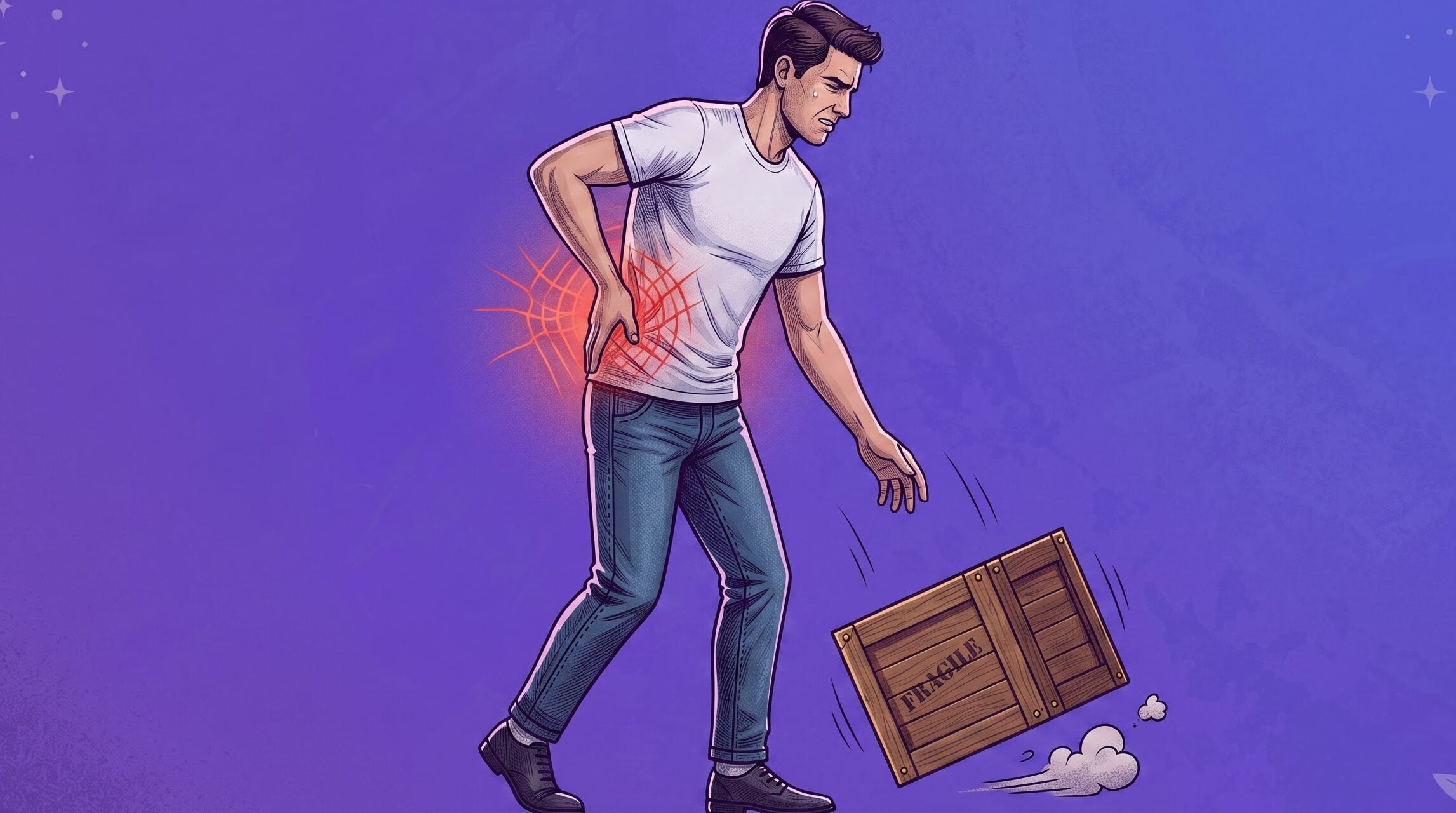
It was late Sunday afternoon when 34-year-old Rahul decided to tackle clearing out his storage room. Understanding the difference between sciatica vs lower back muscle strain was the last thing on his mind when he leaned down, picked up a heavy wooden crate of books without bending his knees, and immediately felt a sharp, unexpected “catch” deep in his lower back.
He dropped the box and stood up slowly. By evening, his back felt tight, stiff, and sore. He rubbed the area, took a warm shower, and assumed what most people assume when their back gives out after heavy lifting: I’ve just pulled a muscle.
Why Sciatica and a Lower Back Muscle Strain Are Often Confused
That night, as Rahul lay on the couch trying to find a comfortable position, he wondered why a sudden back injury hurts so intensely right away.
When Rahul leaned over that heavy crate under a heavy load, his spine was placed in forward bending (flexion). In that moment, two major structures were put under sudden stress: the deep muscles supporting his spine and the flexible, rubbery discs that cushion his spinal bones.
Inside Rahul’s body, his back muscles, specifically the erector spinae, were forced to overstretch beyond their capacity, causing microscopic tears in the muscle fibres. [1] In response to this sudden tissue damage, his body instantly triggered a natural defence mechanism: muscle spasm. The surrounding muscles then contracted into a tight, protective “splint” to keep his spine from moving further. [1]
This sudden reaction explains why distinguishing between sciatica vs lower back muscle strain can be so difficult early on. [1]
The body floods the lower back with localised inflammation and muscle tightness to lock the area down. [1]
At this early stage, Rahul’s discomfort was localised entirely to his lower back. It felt dull, aching, and stiff, the hallmark signs of an acute muscle strain. [1] Satisfied with his self-diagnosis, Rahul went to sleep expecting to feel slightly better by morning.
How Do You Know If It’s Sciatica or Muscle Pain?
When Rahul stepped out of bed the next morning, he realised his injury had changed its behaviour overnight.
The dull ache in his lower back was still present, but as he walked toward the kitchen, a sharp, burning sensation shot down through his right buttock and extended into the back of his thigh. [2] He stopped in his tracks, placing a hand on his leg.
He asked himself a question that thousands of people type into Google every day: When comparing sciatica vs lower back muscle strain, can a simple muscle strain travel all the way down into your leg?
To understand what Rahul was experiencing, it helps to look at how different tissues transmit pain.
Muscle tissue is local. When you strain a lower back muscle, the pain stays right where the physical injury occurred. It might feel sore to the touch or spread slightly into the top of the hip, but it does not travel long distances because muscle tissue lacks the “wiring” to project pain far away. [1]
Nerves, on the other hand, function like high-speed electrical cables. [2]
The sciatic nerve is the thickest nerve in the human body. It originates from several spinal nerve roots in the lower back (L4–S1 region), bundles together deep in the hip, and runs all the way down the back of each leg to the feet. [2]
When Rahul lifted the heavy crate, the strain also squeezed one of his lumbar discs. [2]
Overnight, localised swelling pushed that disc slightly outward, pressing against or irritating the sciatic nerve root. Even though the irritation was high up in his spine, Rahul’s brain registered the pain along the entire route, sending a hot, radiating signal down his leg [2].
Why Does Sitting Make Sciatica Worse Than a Muscle Strain?
By mid-morning, Rahul sat down at his computer to work. Within ten minutes, the burning sensation in his leg intensified dramatically into a deep, agonizing ache. Distressed, he stood up and began pacing around his living room. To his surprise, walking around brought noticeable relief to his leg.
He couldn’t help but wonder: Why does sitting make my leg hurt so much worse, while standing up eases the pain?
The answer lies in how daily postures change internal spinal pressure.
When Rahul sits, especially if he slumps or leans slightly forward, his pelvis tilts backward, flattening the natural curve of his lower back. This position dramatically increases intradiscal pressure (the physical compression squeezing the cushioned discs between his spinal bones). [3]
When Rahul stood up, the pressure inside his spinal discs dropped significantly, easing the direct squeeze on his irritated nerve root and calming the leg pain.[3]
If Rahul had experienced only a muscle strain without nerve involvement, the opposite often happens: sitting quietly supported in a chair rests the back muscles. Standing and walking force those torn, guarding muscle fibers to actively contract to hold the body upright, which usually worsens muscle pain.[1]
Can Sciatica and a Muscle Strain Happen at the Same Time?
As the afternoon went on, Rahul noticed a confusing pattern. When he stood up and walked around, the burning pain down his leg settled down, but the middle of his lower back started aching with a deep, muscular soreness.
This left Rahul feeling puzzled: Could I actually have both a muscle strain AND sciatica at the same time?
Yes, and in fact, it happens quite frequently.[1]
When a spinal disc bulges or irritates a nerve root, surrounding lower back muscles don’t sit idly by. Recognizing an issue deep within the spine, the brain instructs nearby back muscles to lock up in a protective effort to keep the spine stable.[1]
In Rahul’s case, he sustained micro-tears in his back muscles during the heavy lift and irritated a lumbar nerve root. The resulting muscle spasms were his body’s attempt to guard the injured disc.[1]
Understanding how sciatica vs lower back muscle strain symptoms can coexist helps explain why back injuries feel so complex. You can feel a sharp, electrical pain traveling down your leg whenever you bend forward, while simultaneously feeling a tight, bruised soreness across your lower back muscles whenever you try to stand upright. [1,2]
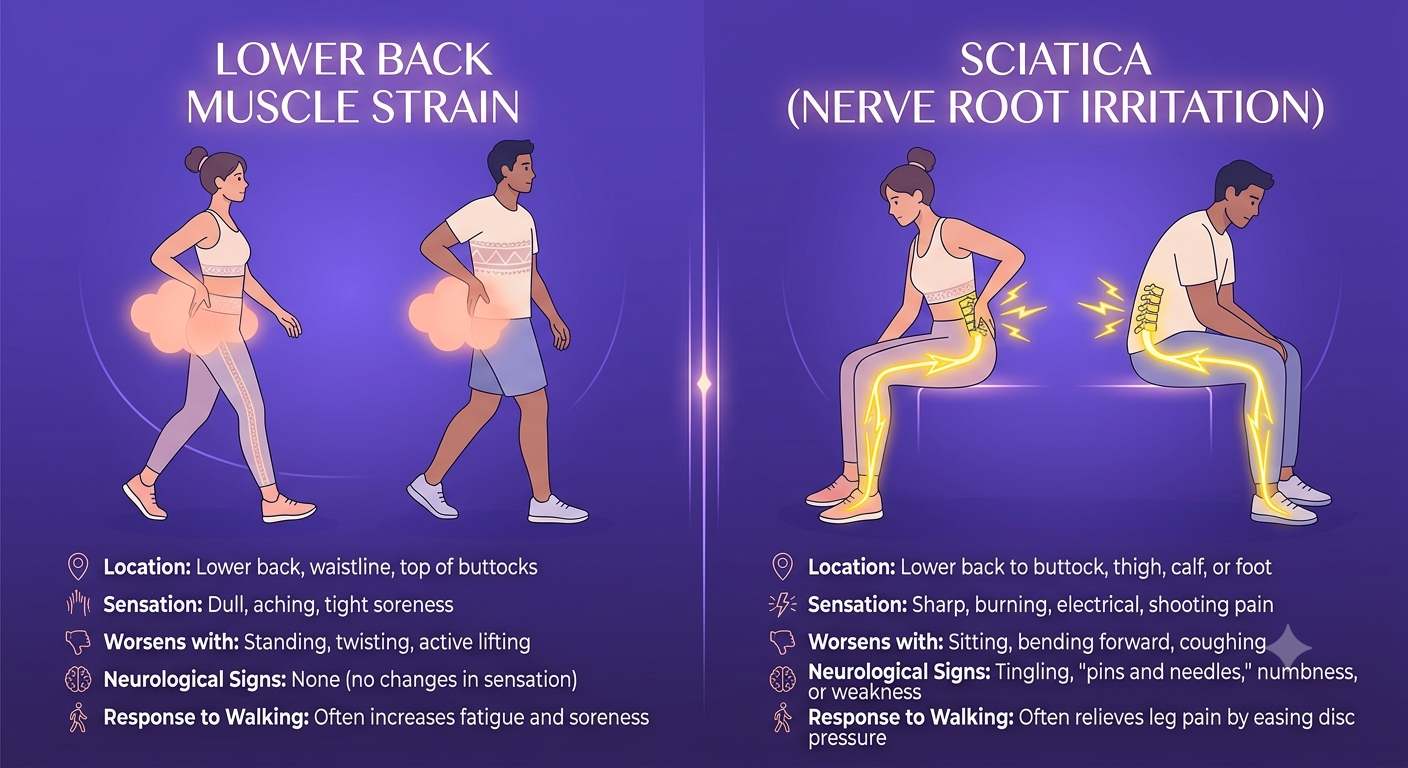
Sciatica vs. Muscle Strain Symptoms: A Side-by-Side Comparison
As Rahul tried to evaluate his symptoms, taking note of specific symptom patterns helped clarify what was going on inside his back:
When Should You See a Doctor for Lower Back Pain?
By evening, Rahul felt anxious about the nerve pain in his leg and wondered whether he should go to an urgent care clinic or give his back time to settle down.
While most cases of back pain and mild nerve irritation improve over time with conservative care, certain symptoms indicate a potential medical emergency that requires immediate attention.[4]
Rahul checked himself against these critical medical “red flags”: [4]
⚠️ Critical Warning Signs Requiring Immediate Emergency Care:
- Loss of Bowel or Bladder Function: Inability to pass urine, loss of control, or unexpected incontinence. [4]
- Saddle Anesthesia: Sudden loss of feeling or numbness in the areas that would touch a saddle (inner thighs, groin, or buttocks). [4]
- Progressive Leg Weakness: Inability to lift the front part of the foot while walking (“foot drop”) or legs suddenly giving out under weight. [4]
- Unexplained Systemic Symptoms: High fever, chills, or sudden unexplained weight loss accompanying back pain. [4]
Finding none of these severe red flags, Rahul scheduled a routine consultation with his primary care physician. His doctor evaluated his range of motion, tested his reflexes, and confirmed a diagnosis: an acute lower back muscle strain accompanied by mild lumbar disc irritation affecting his sciatic nerve.
Why the Right Support Depends on the Cause of Your Pain
During his appointment, Rahul asked a practical question: “What is the best way to help my back recover?”
His doctor explained that when evaluating sciatica vs lower back muscle strain, recovery strategies must match the specific structural issue involved:
- For a Simple Muscle Strain: The primary goal is restoring local blood flow and maintaining gentle, pain-free movement. [1,6] Recovery focuses on gradual active rehabilitation, light walking, and gentle mobility work to help muscle fibers heal without becoming excessively stiff. [6]
- For Disc-Related Sciatica: The primary goal changes. While gentle movement is still valuable, the immediate priority is protecting the spine from compression and forward bending while the irritated nerve root settles down. [3,5]
Because sitting at his desk pushed Rahul’s lower back into forward bending increasing disc pressure and triggering his leg pain, his doctor suggested paying close attention to his posture and spinal support during daily activities. [3]
Supporting Your Back During Recovery: When Can the Betterhood LS Belt Help?
Rahul now understood that keeping his lower back in a stable, upright posture was key to preventing his disc from pressing on his sciatic nerve while working. [3]
This is where targeted external support plays a practical role in conservative management. [5]
The Betterhood Lumbar Support (LS) Belt is designed to provide external stabilization across the lower back and abdomen during daily tasks. [5]
When recovering from disc-related sciatica, an LS belt provides practical support in several key ways:
- Eases Intradiscal Pressure: Applying comfortable compression around the lower abdomen and lumbar region shares the mechanical load on the spine, helping reduce pressure spikes that trigger leg pain during prolonged sitting or standing. [5]
- Encourages Proper Posture: It acts as a continuous tactile reminder to avoid slumping or rounding the lower back, keeping the spine in a neutral alignment where the nerve root can settle. [5]
- Provides Confidence During Movement: Gentle stabilization allows you to perform essential daily tasks, like walking, light desk work, or household chores, with reduced discomfort. [5]
The Betterhood LS Belt is a substitute for professional diagnosis, or a replacement for targeted physical therapy exercises. For an uncomplicated, isolated muscle strain, continuous external support may not even be necessary. [5] However, when navigating disc-related nerve pain, a supportive lumbar belt can serve as a helpful aid to keep you moving comfortably while your body heals. [5]
Frequently Asked Questions
Should I be using ice or heat for sciatica and muscle pain?
Use ice during the first 48 hours for acute nerve flare-ups and swelling, and switch to heat later to relax tight, sore back muscles. [4]
Is walking good for both lower back muscle strains and sciatica?
Yes. Gentle walking supports recovery for both conditions by boosting circulation and easing disc compression without putting heavy stress on the spine. [3,6]
How long does a lower back muscle strain take to heal compared to sciatica?
Muscle strains typically heal in two to four weeks due to rich blood supply, whereas nerve-related sciatica often takes four to eight weeks or longer to settle. [1,2]
Could aggressive stretching actually make sciatica worse?
Yes. Forward-bending stretches increase spinal disc pressure and pull forcefully on irritated nerve roots, which can trigger sharp pain spikes. [2,3]
Can nerve pain travel down the front or side of the leg instead of the back?
Yes. Irritation in the upper lumbar spine (L2–L4) radiates nerve pain down the front thigh, groin, or hip rather than the back of the leg. [2,7]
Can your sleeping position make nerve pain or muscle strains worse?
Yes. Unsupported sleeping twists the spine, so side sleepers should place a pillow between their knees and back sleepers under their knees to maintain neutral alignment. [3,6]
What other conditions are commonly mistaken for sciatica?
Piriformis syndrome, sacroiliac joint dysfunction, and hip osteoarthritis frequently mimic sciatica by referring pain into the buttocks or upper legs. [2,6]
Does every type of lower back pain benefit from a lumbar support belt?
No. Support belts primarily aid disc issues like sciatica, whereas simple muscle strains usually heal best through unassisted movement without external bracing. [3,5]
When is the right time to use a lumbar support belt during recovery?
Wear a support belt selectively during high-stress activities, like sitting, commuting, or light chores, to stabilize the spine alongside core exercises. [3,5]
How can you prevent a lower back strain or sciatica flare-up in the future?
Maintain core strength, practice safe lifting by bending your knees, and break up prolonged sitting every 30 to 45 minutes. [3]
How Rahul Navigated His Recovery
Armed with an accurate understanding of sciatica vs lower back muscle strain, Rahul adjusted his recovery approach.
Instead of stretching his lower back aggressively, which would have strained his irritated nerve further, he focused on frequent, short walks, avoided deep forward bending, and used his Betterhood LS Belt for targeted support while working at his desk. [5, 6] Within three weeks, the radiating pain down his leg subsided completely, and his lower back muscles regained their strength.
If you are experiencing lower back discomfort, taking the time to listen to your symptom patterns, paying attention to where the pain travels and what movements trigger it, can help you make informed decisions about your care.
When in doubt, consult a qualified healthcare professional for a personalized evaluation, and choose recovery strategies that give your back the support it needs to heal naturally.
References
- Casiano VE, De Nardo A, Varacallo M. Low Back Pain: Evaluation and Management. [Updated 2025 Jan]. In: StatPearls [Internet]. Treasure Island (FL): StatPearls Publishing; 2025 Jan-. Available from: https://www.ncbi.nlm.nih.gov/books/NBK538173/
- Davis D, Vasudevan A. Sciatica. [Updated 2024 Jun 30]. In: StatPearls [Internet]. Treasure Island (FL): StatPearls Publishing; 2024 Jan-. Available from: https://www.ncbi.nlm.nih.gov/books/NBK507908/
- Wilke HJ, Neef P, Caimi M, Hoogland T, Claes LE. New in vivo measurements of pressures in the intervertebral disc in daily life. Spine. 1999 Apr 15;24(8):755-62. doi: 10.1097/00007632-199904150-00005. https://doi.org/10.1097/00007632-199904150-00005
- Qaseem A, Wilt TJ, McLean RM, Forciea MA; Clinical Guidelines Committee of the American College of Physicians. Noninvasive Treatments for Acute, Subacute, and Chronic Low Back Pain: A Clinical Practice Guideline From the American College of Physicians. Ann Intern Med. 2017 Apr 4;166(7):514-530. doi: 10.1073/M16-2367. https://doi.org/10.7326/M16-2367
- van Duijvenbode IC, Jellema P, van Poppel MN, van Tulder MW. Lumbar supports for prevention and treatment of low-back pain. Cochrane Database Syst Rev. 2008 Apr 16;2008(2):CD001823. doi: 10.1002/14651858.CD001823.pub3. https://doi.org/10.1002/14651858.CD001823.pub3
- National Institute for Health and Care Excellence (NICE). Low back pain and sciatica in over 16s: assessment and management [NG59]. London: National Institute for Health and Care Excellence; 2016 Nov (updated 2020 Dec). Available from: https://www.nice.org.uk/guidance/ng59
- Alexander CE, Kasner SE, Varacallo M. L2-L4 Radiculopathy & Femoral Nerve Irritation. [Updated 2024 Aug]. In: StatPearls [Internet]. Treasure Island (FL): StatPearls Publishing; 2024 Jan-. Available from: https://www.ncbi.nlm.nih.gov/books/NBK482387/