




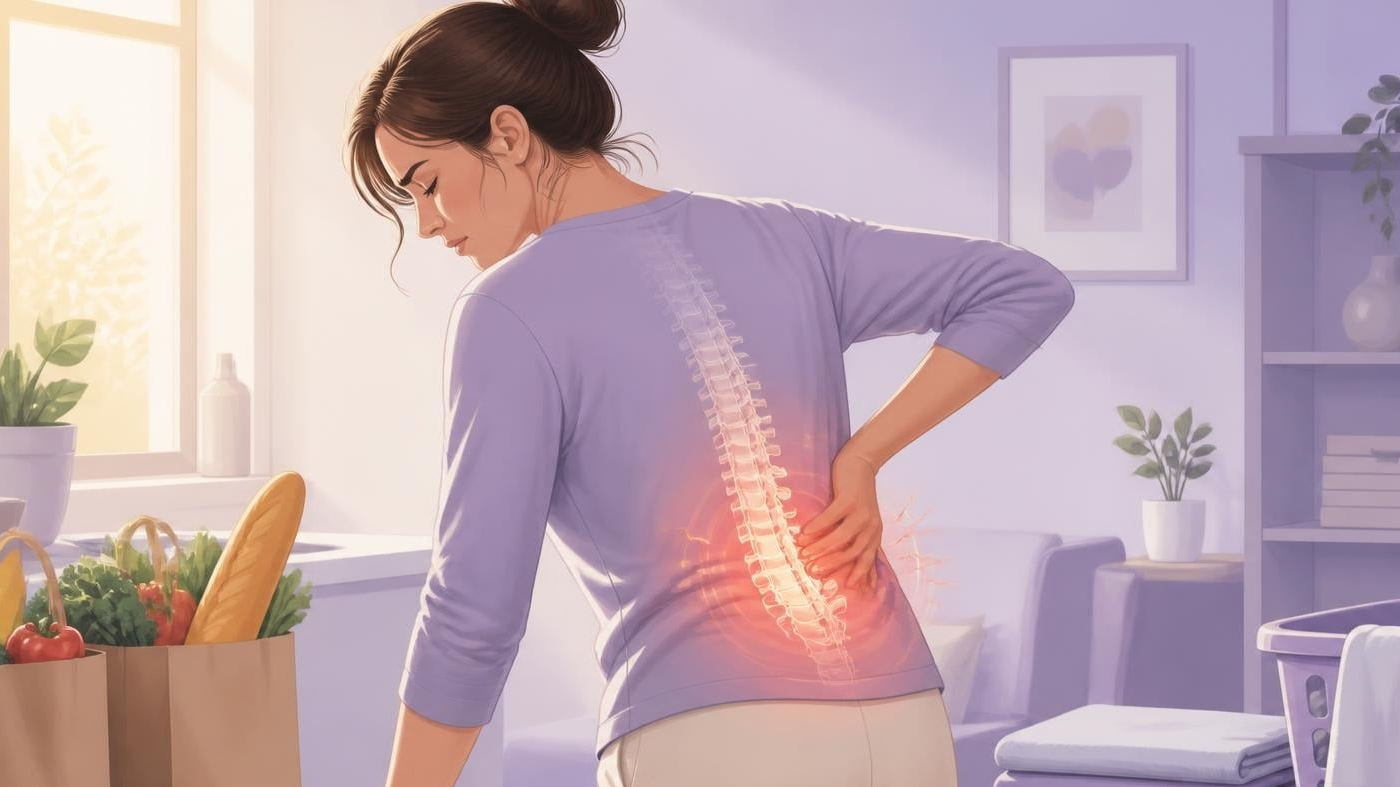
If chores like groceries and laundry with a herniated disc are making your back spasm, you are not alone. This article explains herniated disc chores and how to prevent a back spasm while working at home. For many people, herniated disc chores trigger pain when bending or lifting.
Repetitive bending and twisting is a top trigger.
It’s just a normal day, and all you were trying to do was unpack a bag of groceries. Nothing crazy just leaning down into the car trunk, grabbing the bag and turning slightly to set it on the counter.
Zap.
Right in the lower back. A sudden, sharp tightening that instantly made you freeze mid-step, holding your breath and waiting for the wave to pass.
You’d think after that warning, you have learned your lesson for the day. But an hour later, there you are in the laundry room. The spasm hit again, locking up your back so fast you had to lean against the wall just to stay upright.
It’s crazy how it’s never the big, dramatic stuff that gets you. It’s always those tiny, everyday movements, a slight bend here, a quick twist there that suddenly leave your lower back holding all the weight and throwing a complete tantrum.
A back spasm is basically your lower back going into a full, sudden lockdown.
Think of it like your spine’s panic button. Whenever your brain senses that something in your back is strained, unstable, or irritated, it tells the nearby muscles to violently clamp down and seize up all to keep you from moving and hurting yourself any further.
It feels like a sharp, painful muscle cramp that completely freezes you in place, turning simple things like bending or twisting into an absolute nightmare.
Why Chores Like Groceries and Laundry Make Your Back Spasm With a Herniated Disc
For most people, a herniated disc isn’t caused by a single traumatic event. Instead, it is often the quiet result of daily wear and tear over many years.[1]
How Natural Aging Process causes herniated disc
Why does getting older make my back so vulnerable?
As you age, your spinal discs gradually lose their water content and flexibility. In your youth, these discs are soft, and filled with fluid. Over time, they become drier, stiffer, and flatter.
How Incorrect Lifting can be a cause for herniated disc
Can one bad movement really break your disc?
While aging sets the stage, improper movement can trigger the actual tear. Lifting heavy items using your back muscles rather than the powerful muscles in your legs and thighs places massive compressive force on your lumbar spine. Adding a twist or turn while lifting creates torsional shear stress that is notorious for pushing a compromised disc past its limit.
Traumatic Injuries
Does it always happen slowly, or can it strike instantly?
In many cases, people cannot pinpoint the exact moment their disc herniated. It simply happens during routine daily activities. However, in rarer instances, a sudden force such as a hard fall, a sports injury, or a car collision can apply enough direct pressure to cause an otherwise healthy disc to rupture instantly.[1]
Several lifestyle, genetic, and environmental factors can influence your likelihood of developing a herniated disc.
What keeps your back healthy or puts it at risk, let’s look at the daily habits, environment, and underlying factors that secretly put pressure on your spine over time.
How do simple daily habits silently overload your back?
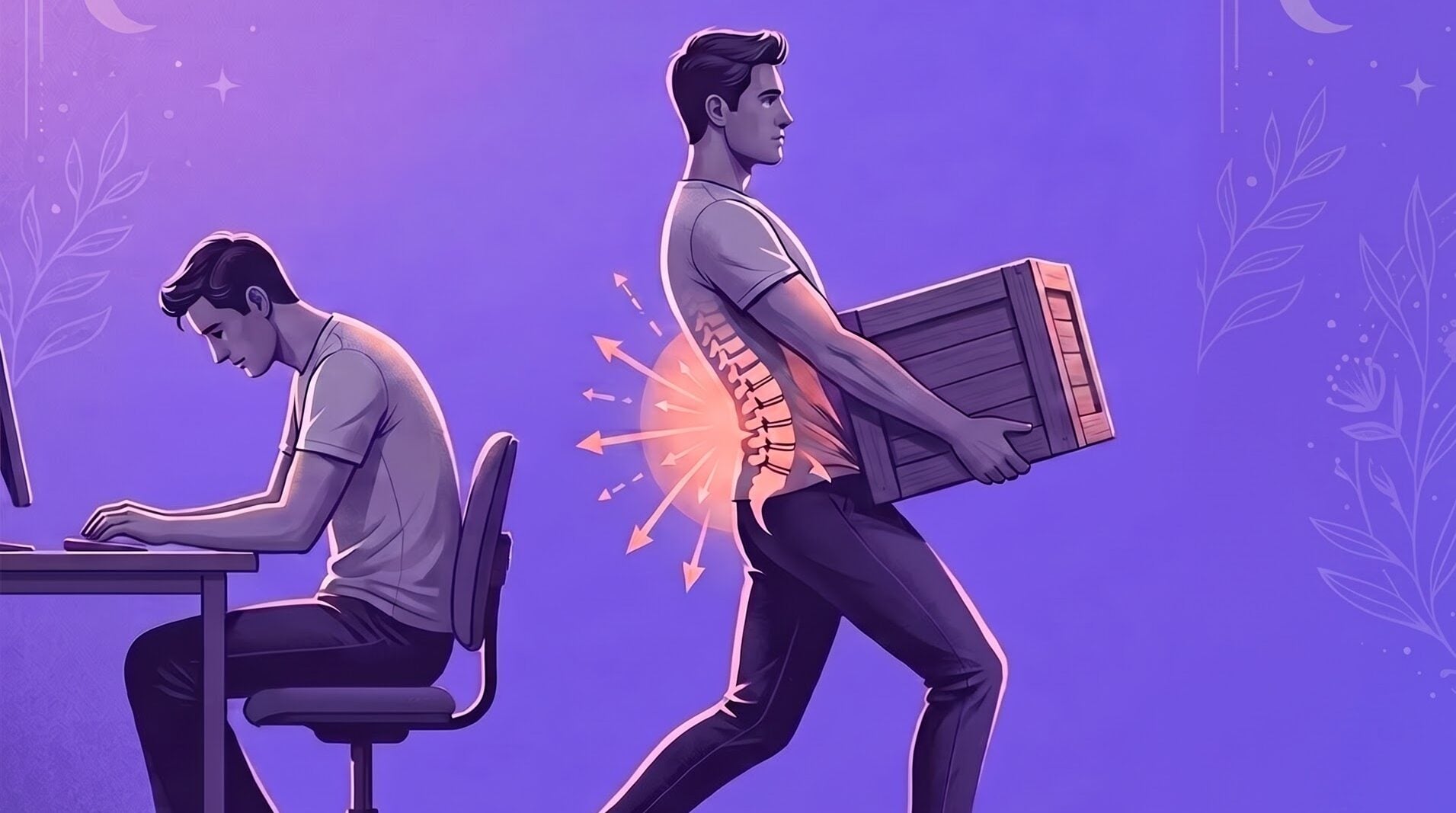
Carrying extra body weight adds extra stress to the structures of your lower back.
Why do both hard labor and sitting still pose a danger?
Physically demanding Work requires heavy lifting, pushing, pulling, repetitive bending, or constant side-to-side twisting, your spine experiences stress that elevates your risk over time.
Your lack of regular physical activity leaves your core and back muscles weak. Without strong supporting muscles to stabilize your trunk, your spinal discs end up absorbing forces that your muscles ought to handle.
Sitting for long stretches exerts more pressure on your lumbar discs than standing upright.
Can my lifestyle choices or DNA weaken my spine from the inside?
Smoking does more than damage your lungs, it restricts blood circulation throughout your body.
Your family history might play a subtle role. If members of your family have a history of disc degeneration or spinal issues, you may have inherited a genetic predisposition toward weaker connective tissue in your spine.[1]
How Long Does It Take to Recover from a Herniated Disc?
For most people, the timeline for recovering from a herniated disc is surprisingly encouraging. While the initial sharp pain, stiffness, or shooting nerve sensations can feel overwhelming, the vast majority of herniated discs heal naturally over time through your body’s immune and repair processes.[3]
Your First Month (Weeks 1 to 4)
Symptoms improve significantly within 4 to 6 weeks. There will be a dramatic decrease in back and leg pain.
Months 2 to 3 (Weeks 6 to 12)
If symptoms persist past your first month, conservative care such as targeted physical therapy, core stabilization, and anti-inflammatory support continues to yield steady progress. You will return to your full daily routine, work, and recreational activities during this window.
After 3 Months include Advanced Interventions (If Needed)
If your pain has not improved after 6 to 8 weeks, or if severe nerve symptoms interfere with daily life, a healthcare provider may recommend more advanced medical treatments like injections and surgical options.[3]
How can you treat the pain?
Once the intense contraction eases enough for you to move, gentle activity is essential. Prolonged bed rest beyond 48 hours weakens core muscles and delays healing.
Frequent, Short Walks
Take 5-to-10-minute walks on flat surfaces three or four times a day. Walking acts as a natural dynamic traction for the spine, pumping oxygen and nutrients into the discs without high compressive impact.[4]
Core Stabilization
Work with a physical therapist to learn non-flexing core exercises such as the Bird-Dog, Side Plank, and Modified Curl-Up. These exercises build 360-degree muscular endurance around your spine without bending or twisting your lumbar discs.[4]
Maintain Strict Spinal Hygiene
Always use a hip hinge (pushing your hips back with a flat spine) when getting up, brushing your teeth, or picking up items. Avoid loaded flexion (bending forward at the waist) and twisting simultaneously.[4]
How to safely do chores with a Herniated disc with no more spasms?
Master Your Posture
Cleaning your home doesn’t have to mean sacrificing your lower back. Every time you sweep, reach, or pick up a laundry basket, your spinal mechanics determine whether you build functional resilience or trigger protective muscle spasms.
By applying a few core principles of postural alignment and spinal hygiene, you can transform routine housework into a safe, low-impact movement session.
Unloading groceries and managing laundry are two of the most biomechanically demanding household chores. Both tasks involve a risky combination of lifting, reaching, and repetitive bending movements that can quickly trigger lower back fatigue or protective muscle spasms if executed poorly.
Carrying and Staging
Balance the Load and don’t carry all your groceries in one hand or take all bags in one trip. Distribute weight evenly between both arms, or carry one light bag at a time.
Immediately place bags onto a kitchen island, table, or counter upon entering. Never drop grocery bags onto the floor, as picking them up off the ground forces lumbar flexion.
Is herniated disc pain only showing up after chores?
Catching it when its activity related is the best time to act
Can a Lumbo-Sacral Belt support early recovery?
It can be a little backup for your back
The Story of the betterhood™ LS Belt: Support That Moves With You
Traditional back braces?
Thick. Stiff. Uncomfortable. They lock your spine, weaken your muscles, and turn simple things like sitting, driving, carrying groceries into a robotic chore.
We think back support should help you move, not stop you.That’s why we built betterhood’s LS belt.
Works With Your Treatment Plan
Designed to be used alongside guidance from your doctor or physical therapist. The LS Belt gives light compression and support during daily activities, so you can move with more confidence between appointments.
Key Technical Specifications & Features of the LS belt:
8-Stabilizer Support System: Features a rigid central contour aligned to the spine’s natural curve (lumbar lordosis) flanked by 8 flexible side stabilizers to absorb rotational and axial load.
AeroMesh 3-Zone Fabric: Built from a lightweight blend of AeroMesh, neoprene, and cushioned mesh for all-day breathability under or over clothing.
Dual Strap Adjustable Compression: Double-strap closure system with broad hook-and-loop panels allowing customizable intra-abdominal pressure.
Lightweight Profile: Weighs approximately 180–250g to avoid the heavy, bulky feel of traditional orthopedic braces.
Certifications: CE Certified.
Ideal Use Cases
Daily Chores & Lifting: Provides a muscular safety net when bending and pivoting to handle groceries, laundry, or household cleaning.
Desk & Sedentary Work: Prevents slouched lumbar flexion and disc compression during long hours of sitting.
Travel & Driving: Dampens engine micro-vibrations and stabilizes the lower back during commutes.
Active Rehab & Exercise: Assists spinal alignment during light workouts, walking, and gym compound movements.
Common FAQs
What actually happens during a herniated disc?
A spinal disc acts as a rubbery shock absorber between your vertebrae, consisting of a tough outer ring (annulus fibrosus) and a gel-like center (nucleus pulposus). A herniation occurs when the gel pushes through a tear in the outer ring, often compressing nearby nerve roots and causing sharp pain, numbness, or sciatica down the leg.
Can a herniated disc heal naturally without surgery?
Over 80–90% of lumbar disc herniations resolve or significantly improve over 6 to 12 weeks through conservative management—such as targeted physiotherapy, short-term activity modification, and structured lumbar support during high-strain tasks.
Should I stay in bed if I herniate a disc?
Strict bed rest beyond 24–48 hours slows down recovery. Light walking, controlled movement, and avoiding forced lumbar flexion (bending forward) help maintain blood circulation to the disc and promote faster tissue repair.
Why does my back suddenly “lock up” or go into spasm?
A muscle spasm is your body’s automatic defense mechanism. When your brain senses instability, micro-tears, or nerve irritation around the spine, it forces the surrounding muscles to contract tightly into a rigid, protective wall to prevent further injury.
What is the immediate first aid for an acute back spasm?
First 48 Hours: Apply an ice pack wrapped in a cloth for 15–20 minutes at a time to numb acute pain and control localized inflammation.
Rest Position: Lie flat on your back on a firm surface with your knees bent at a 90-degree angle supported by pillows (psoas position) to take direct stress off the lower spine.
Support: Slip on an LS support belt before standing up or walking to prevent secondary spasms caused by sudden instability.
How do I distinguish between muscle strain and nerve pain (sciatica)?
· Muscle Strain: Pain stays localized in the lower back or glutes, feeling like a dull ache or tight knot that gets tender to the touch.
· Sciatica (Nerve Pain): Involves a burning, electric, or shooting pain that radiates down through the buttock, thigh, calf, or foot, often accompanied by tingling or numbness.
How does the betterhood™ LS Belt help with herniated disc and spasms during chores?
The belt acts as an external muscular frame:
Decompresses Disc Pressure: Its central rigid contour and lateral stabilizers help preserve the natural inward curve (lumbar lordosis) of your lower back.
Creates Intra-Abdominal Pressure: Dual compression straps wrap around the abdomen, transferring part of your torso’s weight away from the spine.
Calms Spasms: By limiting sudden twisting or sharp bending, it prevents the pain triggers that cause muscles to lock up.
How long should you wear the belt each day?
For most people managing active pain or working long hours, wearing the belt in 2 to 4-hour blocks during active tasks (desk work, chores, driving) works best.
Can I wear the betterhood™ LS belt during gym workouts or deadlifts?
Yes. The slim AeroMesh material and flexible 8-stabilizer architecture allow it to fit under or over workout clothes while providing lumbar alignment during squats, deadlifts, and compound movements.
References:
- https://www.mayoclinic.org/diseases-conditions/herniated-disk/symptoms-causes/syc-20354095
- https://www.fyziosvet.cz/articles/7-most-common-questions-about-herniated-discs-in-the-lumbar-spine/#:~:text=Immediate%20medical%20attention%20should%20be%20sought%20if,nerve%20root%20compression%20in%20the%20spinal%20canal.
- https://my.clevelandclinic.org/health/diseases/12768-herniated-disk
- https://northernnevadachiropractic.com/blog/back-pain-prevention/the-mcgill-big-3-exercises-for-core-stability/#:~:text=They%20are%20more%20commonly%20know%20as%20the,increase%20injury%20risk%20and%20performance%20will%20suffer.
Disclaimer: This content is for informational purposes only and does not substitute professional medical advice, diagnosis, or treatment. Always consult a physician or physical therapist for persistent joint pain.


